

In this article, we will tell the story of one of the employees of EnglishDom who learned English in quite an unusual way - through the role-playing game Dungeons & Dragons. Here and below, we present his story almost unchanged. We hope you enjoy it.

To begin, let me share a bit about 'Dungeons & Dragons' for those who are hearing about this game for the first time. In short, it's a tabletop game that has become the predecessor of many computer games in the RPG genre.
Elves, dwarfs, gnomes, epic adventures, and the ability to become a hero and have complete freedom of action in a fantasy world. In short, a little imagination, and you are already a barbarian half-orc smashing enemies with your two-handed axe. In another game, you might be an elf who professionally picks locks and shoots accurately.
D&D truly offers characters almost complete freedom to act within the module (the term for the story-driven game). You can act however you want, just remember that any actions will have consequences.
If you've never heard of D&D before, there was a very interesting and understandable presentation on TED about what it is. Check it out:

Experienced role-players can move on to the next section.
How I Got Into D&D
I have been playing 'Dungeons and Dragons' for four years now. And today, I already understand that the first master I was lucky enough to play with was quite rigid about the rules. He had the rule books in English, and we had to keep the character sheet in English as well.
At least, the game itself was conducted in Russian. During the first few sessions, when I was just getting the hang of the basics, it was unusual to hear something like:
— I cast chromatic orb, spending one sorcery point to twin the spell.
— Make an attack roll.
— 16. Did I hit?
— Yes, roll for damage.
Now I understand why the master did this - existing translations of the D&D rule books are very imperfect, so it was much easier to use such workarounds.
My then-knowledge of English allowed me to somewhat understand what was actually happening, and more experienced players helped me. It was unusual, but no more than that.
That same evening, I found a fully translated and professionally formatted version of the Player's Handbook (PHB) in Russian online. I asked: why are we playing in English then if there is already a proper translation?
In general, he showed me a page in Russian. I laughed. Here it is:
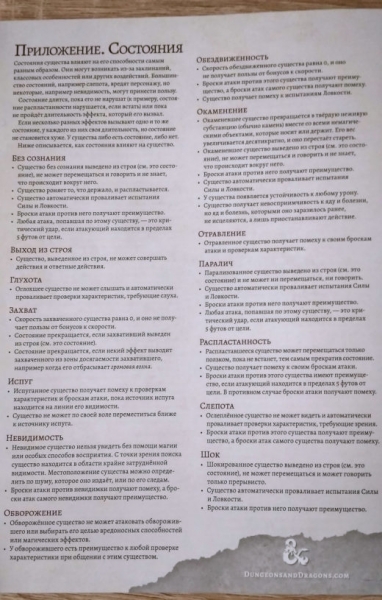
The status 'Prone', which essentially means 'lying down' or 'knocked down', was adapted by the translators as 'spread out'. Moreover, the entire table of statuses is translated inconsistently and is disturbingly bad. How do you use 'spread out' in gameplay? You slipped and now you are spread out? Spread out?
And what is this explanation anyway: 'A spread-out creature can only crawl until it stands up, thus ending the state'? Even my not-so-perfect understanding of English was enough to realize that the phrase was just translated literally from English.
In later fan translations, it was somewhat better. Instead of 'spread out', it was 'knocked down', but my trust in the Russian 'slob' was already damaged. Later, I tried mastering it myself and found ambiguities in the wording of the rules that complicated the interpretation of player actions significantly. Occasionally, I had to dive into the English corebook to check the information there.
How I ended up playing with the English.
About six months later, our master moved to another city. It became simply boring not to have anyone to play with — there were no D&D clubs in town. So I started looking for online modules and stumbled upon the website .
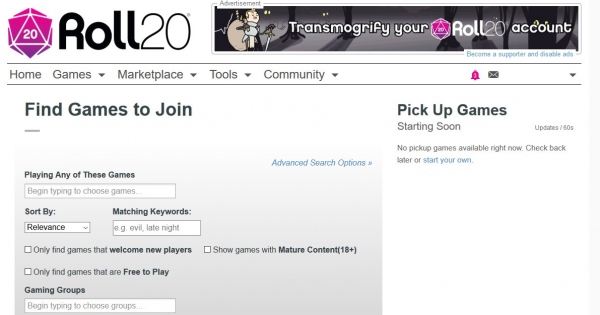
In short, this is the largest platform for conducting online sessions of tabletop games. But there is a downside — almost all games are conducted in English. There are, of course, a few Russian modules, but they are very few. Moreover, for the most part, they are 'for their own', meaning they don’t accept players from outside.
I already had an advantage — I knew the English terminology. My overall English was at the Intermediate level, but my conversational skills were about 'What, are you mute?'
In the end, I registered and applied for a 'beginner' module. I talked to the master, mentioned my scant knowledge of the language, but it didn’t deter him.
The first online module turned out to be a failure for me. For most of the time, I struggled to understand what the master and players were saying because two of them had terrible accents. Then I frantically tried to describe my character's actions. To be honest, it didn’t go well. I mumbled, forgot words, and hesitated — in short, I felt like a dog that understands everything but cannot say anything.
Surprisingly, after such a performance, the master offered me to play in a longer module designed for 5-6 sessions. I agreed. What I did not expect at all was that by the last fifth session of the module, I would be able to understand both the master and the other players fairly well. Yes, I still had issues expressing my thoughts and describing actions, but I could manage my character through speech.
To summarize, games on roll20 gave me what traditional classes could not:
Normal language practice in real life. Essentially, I was working through the same scenarios that textbooks offered — going to the store, bargaining with a client and discussing a task, trying to ask for directions from a guard, describing items and clothing details. But all in a setting where I enjoyed it. I remember spending about an hour preparing for a session to find and memorize the names of all the harness elements for a horse.
A moment of self-education from the online English school EnglishDom:
Reins — reins
saddle — saddle
horsecloth — horse blanket (yes, literally 'horse clothing')
bar bit — bridle
blinders — blinders
girth — girth
bridle — bridle
breeching — breechingTo study English words much easier than I did, download the . By the way, as a gift, you get a premium access to it for a month. Enter the promo code dnd5e or right in the app
The perception of live language. While I handled 'student English' well, I was initially unprepared for the live language. I could manage with the American accent, but there were also a Polish and a German player. Their charming English with Polish and German accents was mind-boggling to me, which is why I hardly communicated with their characters. By the end of the module, it got easier, but it wasn't an easy experience.
Vocabulary enhancement. I had to work seriously with the vocabulary. The plot was tied to events in the city and in the forest, so I had to quickly study various names: trees and herbs, craftsmen and shops, ranks of aristocrats. In total, I learned about 100 words for a fairly small module. And interestingly, they came quite easily because I had to use them right away in the game world. If something was unclear during the game, I asked for the spelling and looked it up in Multitran, and then added the word to my dictionary.
Yes, I already knew the basic names of actions and spells in English, which really helped me get settled. But there was also a lot of new stuff. I spent about an hour and a half before the next session going through the vocabulary and character features, repeating something or seeing what I could bring new.
Motivation. To be honest, I didn't consider D&D as a way to learn English at all — I just wanted to play. English, in this case, became a tool that helped me revive my gaming experience.
You don't perceive it as a goal in itself; it serves simply as a tool. If you want to communicate properly with the players and portray your character, you need to brush up on the material. Yes, there are D&D clubs in large cities, but there weren't any in my city, so I had to make do. In any case, the experience turned out to be interesting. I'm still playing on Roll20, but now I find it much easier to communicate in English.
Now I realize that my experience is a great example of gamifying learning. When you study something not because you have to, but because you're incredibly interested.
In fact, even during the very first module, when I learned about 100 words in 5 sessions, it was easy for me. Because I was learning them with a specific goal — to say something through my character, to help my teammates develop the plot, or to solve some puzzle myself.
More than three years have passed since my first online module, but I can still explain the structure of a horse harness and the names of each of its elements in English. Because I learned not out of obligation, but out of curiosity.
Gamification is widely used in education. For example, The process of learning a language is similar to role-playing. You are given tasks, you complete them, gain experience, level up specific skills, and even earn rewards.
I believe that learning should be like this — unobtrusive and immensely enjoyable.
I'm not going to say that my good English is solely due to Dungeons and Dragons, because I have also taken courses and studied with a teacher to improve my language skills. However, it was this role-playing game that pushed me to learn the language and sparked my interest in further engagement with it. I still see English purely as a tool — I need it for work and recreation. I'm not trying to read Shakespeare in the original and translate his sonnets. Nevertheless, D&D and role-playing games managed to do what school and university could not — awaken my interest in the language.
Yes, this method is clearly not for everyone. But who knows, maybe some D&D fans will get interested and go on roll20 to play there, and in the process, improve their English a bit.
If not, there are more well-known and familiar ways to learn a language. The main thing is that the process itself is interesting and enjoyable.
The online school EnglishDom.com — inspiring you to learn English through technology and human care
Exclusively for Habr readers ! When purchasing classes, receive up to 3 lessons for free!
Get a full month of premium subscription to the ED Words app for free.
Enter promo code dnd5e or directly . The promo code is valid until 27.01.2021.
Our products:
Source: habr.com
