

Good day.
Today we'll discuss a tabletop role-playing system of our own design, inspired by both console eastern games and our encounters with western tabletop giants. The latter turned out to be less enchanting up close than expected—bulky in terms of rules, featuring somewhat sterile heroes and items, and overwhelmed with bookkeeping.
So why not create something of our own? With Zodiac Signs and Eidolons. That’s how it all began. It took about five to six years for the idea to evolve from several scattered pages into a 256-page book.
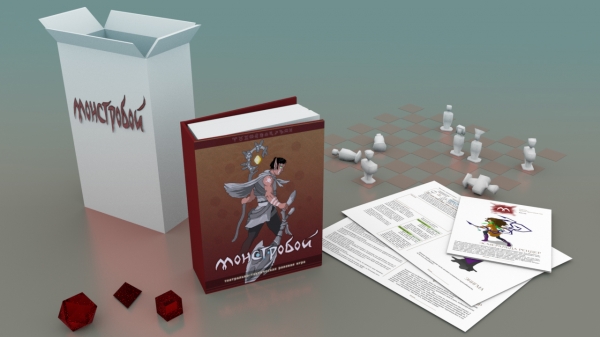
‘Monster Hunter’ is a role-playing game dedicated to fantastical tactical battles. Here, heroes draw new combat knowledge from their weapons, monsters possess their own ‘artificial intelligence,’ and instead of gaining experience, there’s an achievements system.
But let's take it step by step. My overall view of role-playing games as a phenomenon was formed back in the '90s, after reading an excellent overview article in one of the volumes of the ‘Encyclopedia of Computer Games’. The article was titled ‘On Role-Playing Games,’ describing both the specifics of tabletop role-playing experiences and numerous examples of computer RPGs that borrowed the atmosphere and color from tabletop universes. It was especially emphasized that tabletop role-playing games are not about competition to see ‘who won’ or about ‘training’ careless participants by the game master, but rather about collaborative creativity and enjoyable pastimes for everyone.
Game Master: Standing on the bridge of the descending "Pshezo," the sun elf Sigmar peered into the approaching mist. Yes, somewhere in here, the rare types of monsters needed for the experiment should be present. He placed his palm on the ship's control pearl to adjust the course, and the shell-like vessel obediently veered away, circumventing the sharp peak of the cliff. Finally, a gap appeared in the mist, and "Pshezo" rushed towards it. The shell-like ship settled on a small rocky ledge, the power line lights on its hull partially dimmed, entering standby mode. After a couple of minutes, the bottom of the shell clicked and extended downward. From the belly of the ship stepped out an elf, a mushroom girl, and a goblin... Although, no, let's just stick with the elf and the goblin. So, ladies and gentlemen, welcome to the Misty Dungeon!
Intriguer: Wait, wait! What about the mushroom girl?
Game Master: Let's start with these two characters for now, and we'll see how it goes.
Rules Expert: Just say you forgot to write her parameters.
Game Master: *sarcastically* Maybe I just decided that she's too good to give to you?
Somewhere in the early 2000s, I was creating various small tabletop games to have something to play with friends while simultaneously diving into the wonderful world of console exclusives (the unforgettable original PlayStation). I found a Magic: The Gathering card club in the city (just at the time when the colorful Kamigawa set was released, while the powerful Mirrodin block was fading, and cards had yet to be printed in Russian) and... finally got into tabletop role-playing games as well, finding a gaming group and a practicing game master.
As we played a decent number of adventures, the difference between what was expected and what was received began to become clearer. The systems themselves turned out to be overloaded with excessive math, and there was a constant feeling of cycling through a limited set of options; any character with suboptimal parameters was viewed as useless, and often the most interesting and engaging part of the game became... the preparation for it — the very stage of character creation.
It is important to differentiate the degree of influence that each individual element has on what is happening. Yes, players may approach the events too superficially, wandering the game world as gray, listless blobs, mere dolls laden with valuable items or sights through which abilities can be launched. Yes, the master may abuse their position, trying to forcibly drag players along the narrative tracks and destroy the atmosphere. However, a lot also depends on the system itself and how it is structured. This particular aspect often remains 'off-screen' because one of the secrets of tabletop role-playing games is that, one way or another, enjoyment can be derived from every gaming system, provided that there is a sufficient level of interest among the participants.
Naturally, not all systems can and should be lightweight. Some of them are precisely about the diversity of content, about a complex set of rules intricately woven into a single ingenious mechanism, and about delving into all these details. A little bookkeeping won't hurt, tables will come in handy, and sometimes you can't escape from mathematics, but moderation is key in everything.
Thus, it turned out that our adventures sometimes unfolded in interesting ways, the characters turned out well, and the group acted cohesively — thanks to the efforts of the master and players, we managed to navigate the sharp edges of the system.
I simply wanted to create my own system because my vision of what I wanted to achieve gradually began to form. First and foremost, I wanted a fairy-tale atmosphere (or fantastic, surreal), a diverse cast of characters with varying levels of power (which often occurs in movie and book plots), a simple yet deep tactical component, free creative development of characters, unique game items, and travels between worlds.
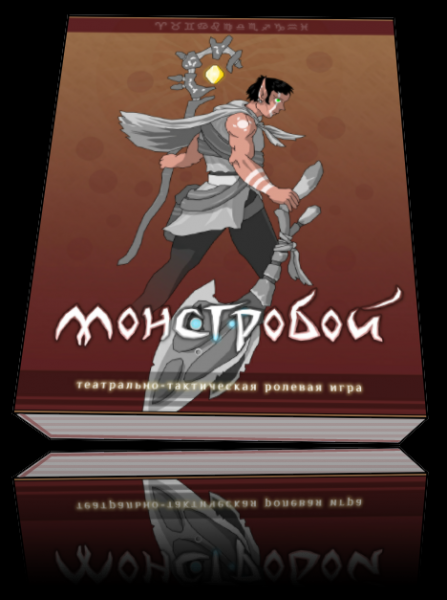
, and below I will discuss the main points.
Game World
The fairy-tale universe of 'Monster Boy' operates under special laws that differ from those in reality. The inhabitants here are not at all surprised by the necessity of frequent battles with wild monsters born from the chaotic play of magical elements.
Every being here possesses a hidden essence, irracio. This inner core of the being consists of interconnected particles of magical energy. These particles, known as Spheres, also exist in free form. Like electrons, they orbit various objects and creatures, can change owners, and are used to create material items.
The hero perceives their irracio as a unique spectrum of feelings, gaining knowledge about certain game mechanics. For instance, they become aware of having a certain amount of health. The majority of other parameters are sensed by the hero as some obvious patterns that are quite difficult to express in words. There are also parameters that the hero is completely unaware of, such as attributes (Agility, Body, Mind, and Intuition). All metrics and terms are, of course, known to the player, but the main principle guiding their decisions is as follows: the character is not a copy of the player; it is a real living entity with its own motives and perceptions of the surrounding world.
It is worth noting that during battles, heroes are most often not physically harmed, as enemy attacks do not leave marks in the form of scratches or bruises; instead, they damage health and other parameters. Thus, everything that attacks the hero in battle — the blade of a sword, claws, shots, bursts of magic — will reflect on the configuration of their irracio, rather than on the material shell. Receiving various types of physical injuries and conditions is still possible, but not during tactical combat.
In the game world, a character should be most wary of two things: story death and the disintegration of irracio. The first case implies the character's demise due to various circumstances: the outcome of a fatal illness, a lethal injury, accumulated wounds, complete loss of sanity, and so on. The second case occurs when the character's health drops below minus five (-5): at that point, their irracio becomes so unstable that the connections between the magical particles break down.
Since ancient times, the inhabitants of the magical world have learned to create weapons and gear designed solely for battles. These items possess varying degrees of effectiveness and fairly strict rules of use. Additionally, new unique ways to influence enemies irrationally are constantly being devised.
In addition to the main fairy-tale world, another dark one is mentioned.
Plot nodes
The "Monster Fight" system features a flexible setting that consists of a general description of the world and some of its individual areas, called Nodes, which are not pre-connected by a common map. The book presents such Nodes as the fairy-tale city of waterfalls (Utada), the village of dragon riders (Zaskan), the restored ruins of an ancient city in the middle of the desert (New Asgard), a mysterious castle in the forest (Matorika), and so on.
This structure allows for the integration of any other elements and locations into this gaming world, such as beloved places from different books and films. The gaming world itself is also built by the participants during their personal adventure; it is not rigidly determined. Nodes are like free energy in the hands of the game master, which has not yet transformed into matter. The flow of the narrative translates Nodes from a free state into a connected, material one.
Explorer: *impatiently* So what's next? We arrived, and?
Game Master: Actually, sort the characters. Who's the elf, who's the goblin?
Intriguer: I would take the mushroom, but you didn't give it to me!
Game Master: There will be more characters later. For now, you need to show the basics of combat.
Tactician: Ah, combat! What can the goblin do?
Game Master: The goblin can throw bombs. And grenades. If you find a grenade tree.
Tactician: Oh, I take him.
Explorer: *scanning the party* I'll be the elf then, if no one minds.
Intriguer: Go ahead.
Game Master: Great. By the way, he has a most intriguing backstory.
Biography and Characteristics
A biography is a few words/phrases about the essence of a character. For example: "elf", "witch", "wind-up dragon", "fire mage with a prosthetic arm", "druid from the Twisted Forest", "merchant with a suspicious appearance", "royal messenger", "cursed orc blacksmith", "necromancer's apprentice", "arrogant paladin girl", "shadow foreigner with his undead dog", and so on.
This parameter contains all important information about the hero himself, his state, and indicates possible development vectors for the hero.
Characteristics are the degree of the hero's success in various classes of actions, the strength of the connection between his inner essence and each of the four main elements. If the hero performs a plot action or undergoes a plot influence, relevant checks of the Characteristics may be required.
Agility (the flexibility of fire)
Body (the hardness of earth)
Mind (the curiosity of air)
Intuition (the mystery of water)
Every hero has an understanding of their Biography but is completely unaware that the success of their actions is influenced by Characteristics (the magnitude of the Characteristic does not affect the hero's appearance, strength, mass, or intellect).
For example: a hero has a Biography of "professor of technomagic", and his Mind is equal to "-2". A low Mind value does not make the hero unintelligent. He is well-versed in technomagic devices and theories, as well as everything that can be attributed to this field of knowledge. A Mind of "-2" only means that in matters requiring Mind, but not related to his path, technomagic, he will be unsuccessful.
The life of a character is subject to self-belief and personal ambitions. He cannot compare his achievements with anyone else's on an absolute scale; in evaluating his qualities, he is quite subjective. Some are not deterred by failures, while others deceive themselves, burying true talent in the ground.
In this ignorance lies a special charm: confidence in something truly turns the conceivable into the tangible — by performing various deeds, the hero thus earns a Biography. Each specific Biography, in turn, increases the success of the actions that the character performs related to it.
For example: if the character is a 'druid', then they will often be able to move silently through the forest based on that alone. However, if the master decides to impose a Dexterity check for silent movement, the difficulty for the 'druid' will not be high.
Game Master: Let's continue. Shortly after moving away from the ship, Sigmar and Otto stumbled upon a group of metal golems, whose appearance resembled animated armor. Around each of these strange creatures, mist swirled, seeping through the gaps in the metal. One of the golems dragged behind it a struggling mass of dark hair, while another clutched a strange fluffy creature with cheeks as rosy as if they had been roasted. The other armors, seeing the approaching elf and goblin, rushed at them...
Tactician: I suppose with the intent to kiss?
Game Master: Worse. Roll the die... However, let's not overload with rolls just yet. The elf will act first, followed by the goblin.
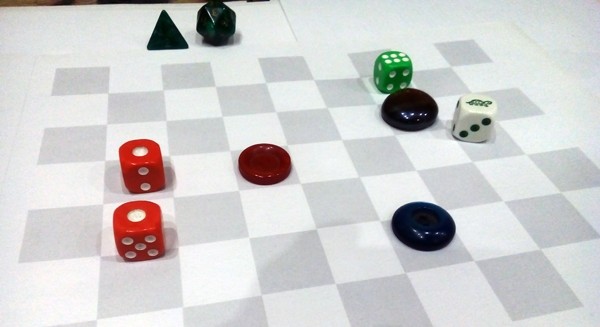
Even when there are no miniatures, it is always possible to use makeshift means to model the combat situation — dice, tokens, buttons.
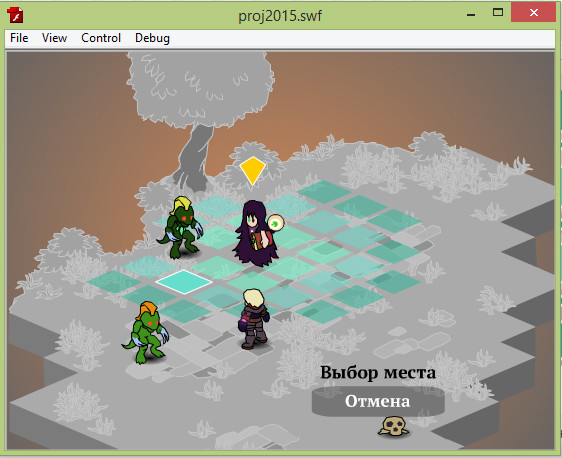
Frame from the battle in the Flash prototype.
Battles
This tabletop role-playing system implies that combat encounters will often occur in a tactical mode between a group of adventurers and their various enemies. This can range from just an attack by wild monsters to a showdown with a cunning opponent, a scene of unexpected betrayal, or a humorous duel in the arena.
Before each upcoming fight, turn order is determined by rolling dice. If two or more heroes have the same results, they will share a turn, with the option to split and combine their actions in any way they choose.
At the start of a turn, a hero usually receives about 3 Action Points and 1 Combat Action. Action Points are primarily spent on movement, performing auxiliary tasks (like using items or changing equipment), and serve as an additional resource (enhancing the attack being made). Combat Actions are spent on various attacking maneuvers or activating powerful abilities.
Unused Combat Actions at the end of a turn are lost, while Action Points can accumulate with some heroes, serving as fuel for special moves. Any non-standard actions by heroes in battle are also possible if they do not contradict the situation — the master decides how many and what resources are spent on their payment.
Game Master: By scattering the hostile armor aside, you free its treasure. It’s a girl with extraordinarily long, slightly moving hair, which almost completely conceals her figure. Along with her, another rescued creature glances at you curiously — a slightly levitating clump resembling a rosy pastry that smells like freshly baked bread. Upon closer inspection of the discarded armor, Otto noticed that streams of mist were escaping from them.
Tactician: Hmm, what could this mean? I need to think.
Game Master: Meanwhile, we have new heroes available for selection. So let's decide who will play whom.
Intriguer: Well, well. What do we have here? A damsel in distress and a plump one at that?
Tactician: *rolling with laughter* You’re something else!
Explorer: What a passage!
Game Master: *instructively* Actually, this witch is not a damsel in distress, as you put it. She is quite capable of standing up for herself. By the way, besides this pair, you can choose metal golems.
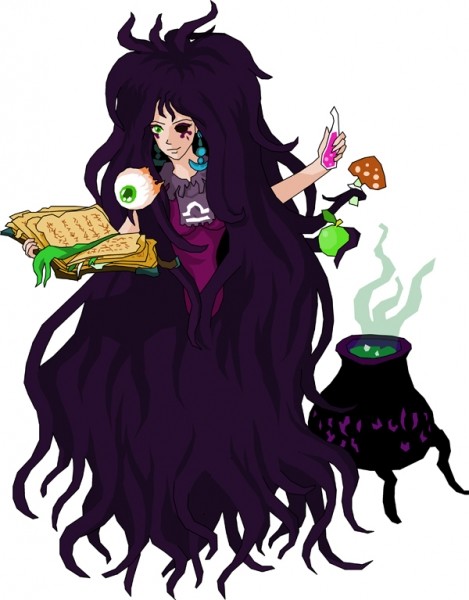
Witch Truanne — one of the pre-set characters
Hero Archetypes
Each hero has a certain combat archetype. There are four in total: 'Mage', 'Rogue', 'Fighter', and 'Medium'. The names of the archetypes are conditional, and the heroes themselves are unaware of them (for example, the 'Mage' archetype does not mean the hero must be some kind of spellcaster by Biography).
As previously mentioned, the foundation of each creature possesses some durability: a reserve of Health Points. But in addition to regular health, heroes also have Spiritual Health: the higher it is, the more focused the hero is when performing various magical or energy actions. If a hero loses all Health Points, they fall unconscious or even die. However, if they lose all Spiritual Health, their combat effectiveness sharply declines: the character can no longer use techniques and special Mysteries of Signs, leaving them with only a simple attack with or without a weapon.
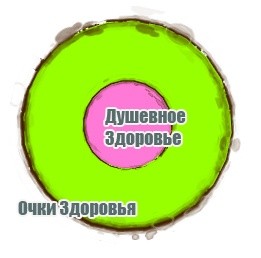
The hero can spend their Soul Health on certain special actions if desired, but the majority of actions and Rituals consume other, more easily replenishable resources (like Mana Points). Therefore, in most cases, it's better to conserve Soul Health for as long as possible.
As long as the character has no armor equipped, they take hits to their Health Points. However, once they have armor, the effect of their archetype begins to take effect, and part of the damage taken is redirected to the hero's Soul Health or is completely mitigated.
For example, a hero of the 'Mage' archetype has the highest amount of Mana Points compared to other archetypes. Damage blocked by their physical defense is redirected from regular health to Soul Health. Damage blocked by magical defenses is fully mitigated — that is, with a defense of 1 against fire-air magic, the hero will take 1 less damage from fire or air attacks.
No one forbids such a hero from engaging in close combat with the opponent (where physical attacks usually occur), but the game hints that keeping a distance from enemies will generally be more effective for this archetype.
The 'Rogue' archetype is fairly versatile and, due to an increased reserve of Soul Health, feels comfortable in any position. The 'Fighter' is better protected in close combat, but magical attacks can cool their ardor. The 'Medium' is the most balanced and controls their state better than others.
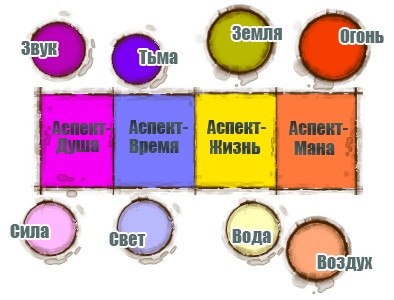
There are four types of magic in the game, each of which includes two elements. Thus, protection against the Aspect of Time in the character's equipment will help them defend against both Light and Dark attacks.
Assistant: How many golems were there?
Game Master: In what sense?
Assistant: Well, how many characters will there ultimately be in the group?
Rules Expert: Probably as many as we choose.
Game Master: Naturally. Actually, golems were introduced specifically as an additional option and as a way to expand the number of participants if more people had come to play.
Intriguer: Interesting.
Tactician: But these are clones. Being a clone is bad.
Game Master: If many people choose golems, then yes, the initial game mechanics parameters of their heroes will be the same. However, this does not stop different players from playing different characters and making some changes to the appearance of their heroes.
Mysteries
The heroes of 'Monster Battle' can use various mystical disciplines, known as Mysteries, multiple times a day. There are exactly 12 of them, each one protected by its own Zodiac Sign. At the start of the game, each character possesses Mysteries from two Signs — their native and a secondary one.
Each Mystery can be applied in two different ways: theatrical and tactical. The first method is only used during the narrative part of the game. The second method is used in tactical combat or in some way related to it (allowing the creation of a combat item or enchanting a weapon).
For example: The Mystery of Mimicry (Guardian Sign: Cancer) allows the owner to duplicate any magical, energy, or mystical effects they observe at the cost of 1 use. You can throw a fireball back at an evil dragon, raise a corpse in response to a similar action from a necromancer, and so on. For the cost of an additional use, you can negate the effect instead of copying it. During tactical combat, Mimicry allows the hero to replicate others' attacks or techniques.
Most Mysteries do not consume Combat Actions or Action Points during combat, so they can be used multiple times during a single turn (as long as there are uses available) without losing the ability to move or attack. On the other hand, Mysteries generally provoke attacks of opportunity from nearby enemies for each act of their use.
Intriguer: Great, I'll be a metal golem!
Game Master: I thought you would choose a witch.
Assistant: I'm taking the little witch. Does she have a spellbook?
Intriguer: I wanted to pick a mushroom. Oh, can I have a relief of a fly agaric on my golem?
Explorer: Looks like it's going to be interesting.
Game Master: You're really making me happy. Yes, there is a spellbook. Yes, a relief is possible. *looking at the Rules Expert* Who are you choosing — the bakery elementalist or the metal golem?
Rule Expert: So was that a baked elemental? I’ll take it without a second thought.
Game Master: You'll like him, he's also a healer.
Rule Expert: The servant of the Great Heavenly Bakery?
Game Master: Almost.
Intriguer: Oh, he will be baking us healing rolls!
Tactician: Or lethal ones.
Researcher: It all depends on the filling.
Helper: Rolls are great!
Game Master: Let's introduce the heroes. Tell each other about yourselves.
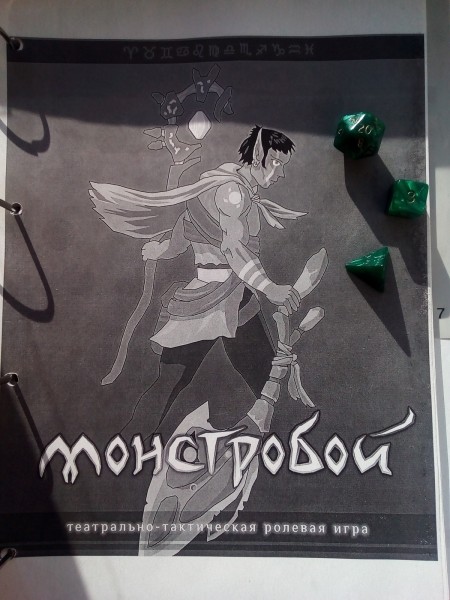
Dice
‘Monster Slayer’ uses 3 types of dice: tetrahedron (D4), hexagon (D6), and icosahedron (D20). Each serves its own role in the game mechanics: the tetrahedron and icosahedron are used in tactics, while the hexagon typically regulates the narrative.
D4, weapon attack
In battle, heroes use various weapons, each with four damage positions. The die roll determines the position.
For example: the hero attacks an enemy with a Rapier. The damage parameters of this weapon are: 2/3/4/4. If the die shows 1, the enemy will take 2 damage.
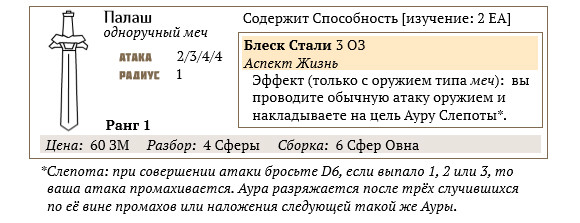
Positions may contain zeros, dashes, or letters. A dash indicates a complete miss, while zero indicates a hit but with zero base damage. If the weapon had damage bonuses or other effects, they will apply in position 0.
For example: A Magic Wand (-/0/1/1) is enchanted to add ‘+1’ fire damage to the attack. If a 1 shows on the die, the attack misses. If it shows 2, the Magic Wand hits, dealing the enemy 0 physical damage and 1 fire damage. If it shows 3 or 4, the enemy receives 1 physical and 1 fire damage.
In rarer weapons, positions may contain letters indicating one of the Hero's Attributes.
For example: An Ink Blade hits enemies with darkness instead of physical damage. Its parameters are I/4/6/8. The owner of the blade currently has an Intuition equal to 5. If the attack die shows 1, the blade will deal 5 darkness damage.
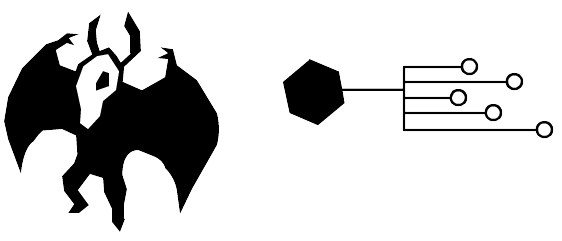
D6, checks
During the narrative, certain actions by heroes require a successful check against one of the Attributes (Agility, Body, Mind, Intuition). The Master sets the difficulty of the check, and the player rolls the die, adding it to the required Attribute.
For example, the witch wants to understand the meaning of the ancient symbols that cover the walls of the catacombs. The Master sets a Wisdom check with a difficulty of 6. The witch's Wisdom is 2, and a roll of 3 is made. In total, there are 5, which is below the required difficulty, so the meaning of the symbols remains unsolved.
D20, intelligence of monsters
Most ordinary monsters are controlled by a die that dictates a specific action from a list. The Master simply chooses a target and decides when the monster will move: before or after the action.
For example, combat is underway, and the enemy Goblin takes its turn. The Master rolls the die and gets a 19. The Goblin's parameters state that if a number between 15 and 20 is rolled, it is required to cast Poison Aura on a target within a radius of 1. The Master moves the Goblin closer to one of the heroes, after which it applies Poison Aura to them.
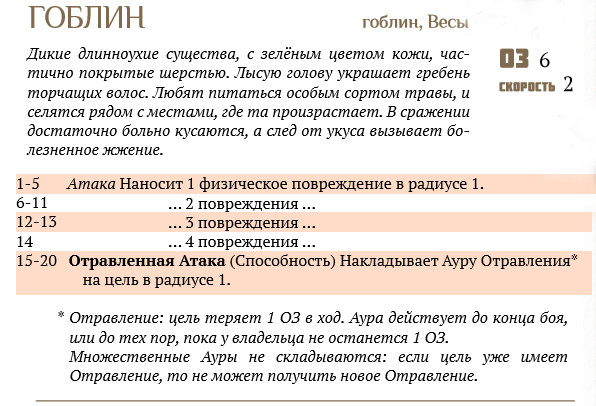
The concept of the gaming mechanics model of a monster includes the following parameters:
Identification — rank (from 1 to 5), Sign (one of 12), type (undead, animal, goblin, etc.).
Basic — these are Health Points and Speed (sometimes there are Mana Points).
Actions — a list of attacks and maneuvers tied to the intervals of a 20-sided die.
Optional — physical and magical defenses, immunities, other features and restrictions.
Players manage summoned monsters and Eidolons (special creatures into which heroes can transform using the Mysteries of the Sign of Scorpion) in the same way.
For example, for several turns, a 2nd level paladin transformed into Leviathan, the Architect of the Depths (an Eidolon of the water element). Each turn, the player rolls the die, determining the prescribed action; this time, a 2 is rolled. A number in the range from 1 to 9 instructs the Leviathan to inflict on a target within a radius of 1 Water damage equal to 2 + the hero's level. Thus, the Eidolon will deal 4 water damage to the enemy.
Intriguer: Why are you just standing there, turn him into a frog!
Assistant: Can I do that? Master, Master?
Game Master: I think your specialization supports this, but since you are still a beginner, you don't specifically have this spell under your control.
Intriguer: Oh well, still — threaten, bluff, intimidate!
Assistant: Let's just let this shadow go in peace; it hasn't done anything to us yet.
Intriguer: You're not such an evil witch after all.
Assistant: Why does a witch have to be evil? She's not old after all.
Rules Expert: And here is where I finally understood everything about witches.
Intriguing One: Then signal me when you grow old. At least I’ll have time to hide.
Assistant: Too late, I remember you!
Titles and Milestones
In battle, characters can unlock Titles — various simple achievements. You can hold many Titles, but only one is active during the gaming day and provides the hero with a specific bonus. Those heroes who have access to Performance (Aquarius Mark’s Mystery) can chant a known Title during combat, sharing its effect with all allies. Additionally, there are secret (unique) Titles that can only be unlocked once, after which they become inaccessible to other heroes.
Example of a Title:
"Savior," secret Title
Conditions for obtaining: you experienced a state close to death but did not die, and moreover, there is someone who loves you.
Benefits of the Title: "the one you hold by the hand cannot die" (biography trait).
But Titles are not the only feature of the "Monster Slayer." It expands on these ideas and goes further, completely abandoning the use of gaming experience (Exp) in favor of global gaming achievements — Milestones. The hero starts at the first level of a Milestone and can unlock those Milestones defined in the development plan 9 times (thus progressing from the first level to the maximum, 10th).
Examples of Milestones:
"Mission" — the hero completed an important quest given by a game character
"Taste of Battle" — the hero won in 3 battles
"Echo of Reflections" — the hero was in a trance state
A starting set of nine different Milestones is suggested, which each hero can unlock once. Such a development plan will be quite challenging but very diverse. The game master can create a custom plan, shaping a specific adventure style: focusing on drama, world exploration, combat successes, and so on. The final version is confirmed before the game begins.
The plan can be quite simple and focused, like "Mission (9)," meaning the hero will gain levels only by completing important storyline quests. To achieve the maximum level of Milestone, they simply need to unlock the "Mission" 9 times in a row — that is, complete 9 different tasks given by characters in the game world. Alternatively, the plan can be very diverse and as free as possible, with many Milestones offered at once, each of which can be unlocked more than once.
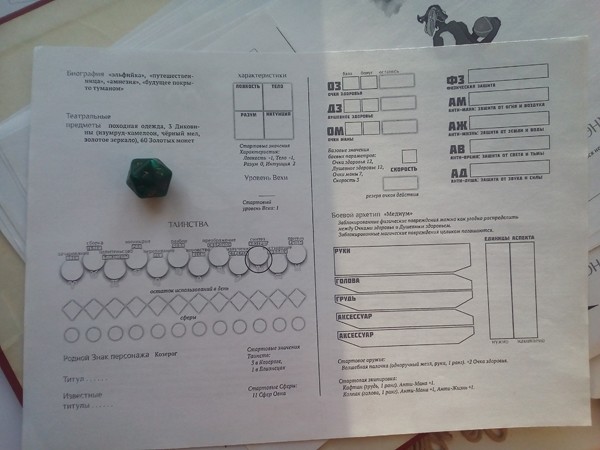
Character postcards
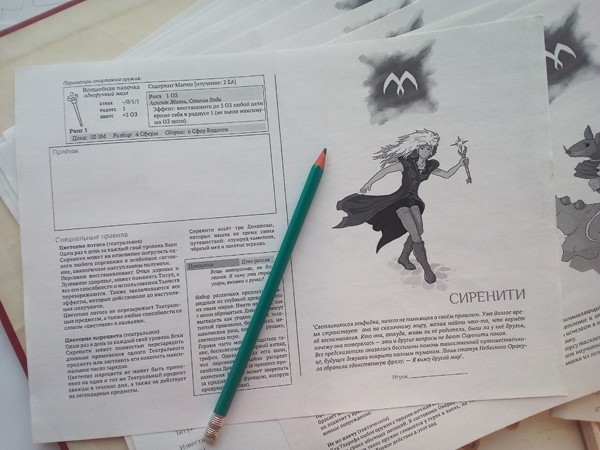
Of course, in "Monster Battle," you can create a hero from scratch by reading the dedicated chapter on this. However, I decided to offer beginners not just a 'build it yourself' constructor, but unique pre-made heroes. Each of them belongs to a separate class and has character outlines. This is important because we want to emphasize that the hero is not a copy of the player. It's hard to grasp this nuance when you are just entering the hobby and are given a hero constructor — there is a strong temptation to create a simpler template without much backstory and continue doing so later. This is not an issue in video games, but it can become one at the table.
Thus, a new player can simply print a postcard with their character, where all of their starting abilities are listed. Mandatory bonuses for leveling up are provided, but the hero's abilities and class can be developed in any way during gameplay — it depends only on the creativity of the player and the master, as well as the evolving story situations. The hero already possesses many skills from the start; they do not need to wait for some high level just to start enjoying their class.
In other words, there isn't a mage-illusionist who, at the first level, can only perform tricks, becomes invisible at the seventh level, and can create an illusory city at the fifteenth. The local mage-illusionist follows the player's thoughts, starting with just a general concept and some pre-defined mechanics, such as creating educational illusions for a certain period, using a certain resource. Strictly speaking, this system does not deny the existence of heroes with defined enhancements at specific levels (since the levels themselves exist), but they become a special case, while the freedom of development remains.
Weapons and combat items also have levels — power levels or ranks. From these items, heroes learn various combat abilities — after engaging in two or three battles with a magic staff, a hero learns the magic contained within it, allowing them to use it later without that item. Abilities from low-rank items remain somewhat relevant even when heroes acquire abilities from higher-rank items. In earlier versions of the game, there was often a situation where certain abilities seemed more 'transitional' and became less needed once a more powerful equivalent appeared. On the other hand, from the very beginning, the game included the ability to dismantle outdated items. I wouldn’t say that everything a character has learned benefits them constantly, but even a slight adjustment has proven useful — allowing for more variety and creativity.
In addition to the basic heroes from the book, there are about 15 cards with additional characters. Here you can find representatives of the race of artifacts (intelligent magical items), heroes from the dark dimension, mushroom people, and even a virus that possesses monsters. It’s easier to construct new heroes based on these.
Improvisation
Yes, of course, a master needs to have the ability to improvise. The player must come up with ways to use the hero's abilities in various situations; they will need to invent new approaches. But that's the most interesting aspect that non-computer role-playing games can offer! Moreover, other game elements constantly provide inspiration, making this task easier. I myself, as a master, practice prepared improvisation, and the book discusses the game from this perspective, offering the master a variety of tools to realize their ideas.
It's simply a matter of changing the focus of your aspirations — there's no need to craft a monolithic dramatic-cinematic epic only to present it to the group as a non-interactive monologue in the middle of wooden sets. No, we won’t be following a railway and forcing players, by any means possible, towards a singular correct door. Instead, I propose to prepare a set of key events and clues before the game that will arise during play and adapt to the current situation. This results in a sandbox game with noticeable story fragments, a more or less coherent narrative, and good participant engagement, despite the high degree of player freedom.
Miniatures
A few thoughts regarding gaming accessories. Like many, I enjoy well-detailed, stylish miniatures in tabletop role-playing games. However, in practice, they are not particularly convenient for use in the game.
Personally, in tactical tabletop RPGs, I would prefer to see some standardized miniatures that are not overly vibrant. Something universal in a cubism-minimalism style, especially when it comes to opponents/monsters. Usually, players use whatever miniatures are available, gathered from different sources, sets, and games.
Such figures for role-playing games are usually produced for a specific setting. The high degree of detail allows one to recognize the character's race, clothing, and other specifics. This is great, but settings and character classes in games change very frequently; one cannot buy new figures every time for a new style/class and so on.
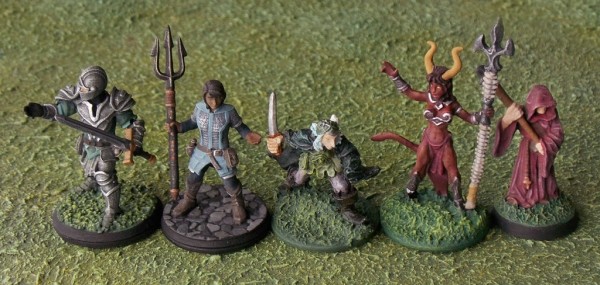
It's great if you have a series of miniatures in the same style. However, these have too much of a fantasy look; they wouldn't fit well in a space opera game or a Lovecraftian detective story. But then again, when has that ever stopped anyone?
I'm leading up to what kind of figures I would include in the box for my game, if such a box were produced:
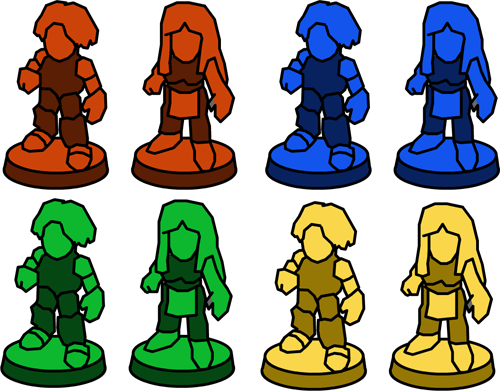
First, there would be colorful figures of the main characters for players. If the models are relatively detailed, I could have male and female versions for each color. Or simply create more different colors, with one abstract model for each, like a 'wanderer'. If a player brings their favorite figure, that's fine, but this way we have a basic option for any scenario.
For opponents—several groups of identical models. This would make it convenient to form packs of several enemies of the same type. I usually structure most combat encounters as 'a party against a group of skeletons', 'a party against goblins and their leader', 'a party against a couple of werewolves and a couple of zombies'—as you can see, typically the same types of monsters show up. Therefore, for a group of goblins, I'd prefer to use identical figures, rather than displaying different ones and then forgetting who is where.
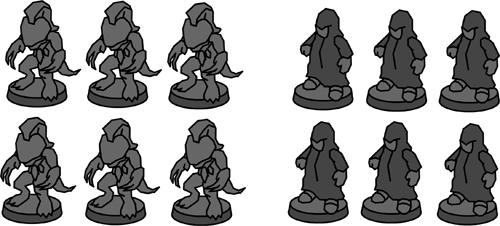
It's very desirable to see some sort of numbering on the models from the same group. These could be numbers, dots, stripes, letters, or symbols. On the belly of the figure, on the back, or on top. This would be very convenient for tracking the amount of remaining health for enemies. So, when a hero pokes that figure to the left of them from the group of skeletons, we immediately see that it’s 'skeleton number 3' that got hit, not someone else. Again, this helps the master keep track of which opponents have already acted and which ones haven’t.
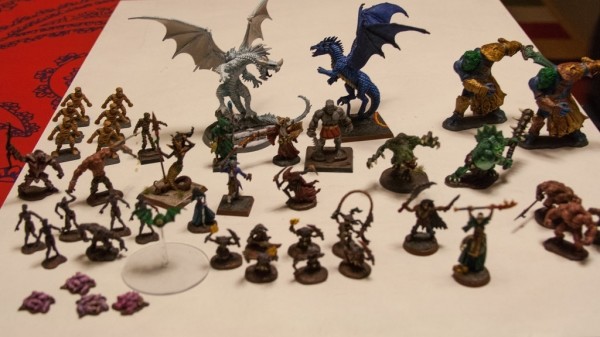
When there's so much on the table—it’s hard to figure out who's who.
In principle, for conveniently displaying different groups of enemies, dice work very well—they can be uniform and shown with different numbers facing up. But if it were a figure with numbers—that would be great. So I would make enemies with numbers.
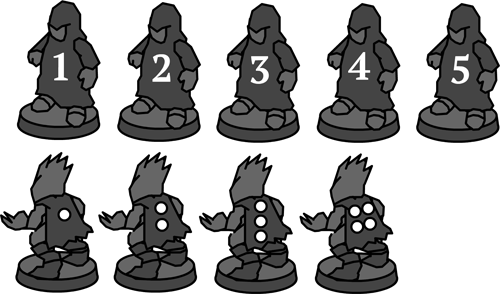
For opponents, abstract models are the best choice, as they clearly show markings and will not distract us from the current atmosphere with their details when changing locations and worlds. We simply group them in slightly different colors, use sets of varying sizes, and label them—everything needed for universal battles.
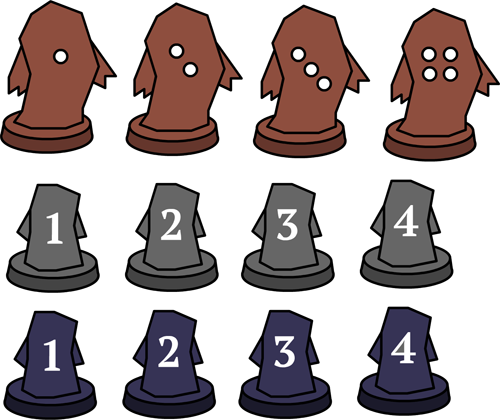
For exclusive opponents, any other figures from the collectible chaos at your disposal can be used. The Master can also take one of the unused colored figures. Since we are talking about figures that would come in the game box, we could create a few of those specific ones and include one random exclusive enemy figure in each box.
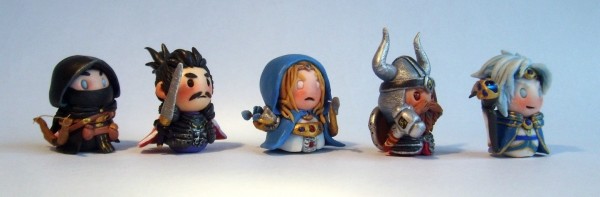
I found these cute little things online.
Thus, in the most minimal version for tactical gameplay, I would like to see a few minimalist multi-colored figures for heroes and several groups of abstract numbered miniatures for opponents.
However, the basic set can certainly be more varied and detailed. But I am firmly against the practice of having tons of beautifully detailed miniatures scattered in cardboard boxes throughout the house, while we diligently rummage through them trying to find figures that closely match our situation. Then we suffer because they’re not in a uniform style. Later, we buy more zombies because we now often encounter zombies in the game, but don’t have suitable figures. Then we lay everything out on the table and still get completely confused. There may be many figures, but they should be easy to navigate if we want to use them in the game, rather than just decorating a shelf.
Tesserfact
In principle, the gameplay mechanics of 'Monstroboy' can be adapted for a computer implementation. Although it's not as easy as it seems. I have always liked Final Fantasy Tactics and wanted something in a similar style, and the combat in 'Monstroboy' is quite close in spirit. Be that as it may, computer tactics is currently just one of the ideas shelved for now. There was only a small Flash prototype with one scene and this video showing the direction of thought.

The Tesseract is a special powerful stone that opens a passage between dimensions, as mentioned in the book. The plot is centered around it.
This video is more recent. I created one of the hypothetical locations in Unity. It's starting to resemble the style of FFT.

Summary
"Monster Boy" is not the only role-playing game I have written, but it is certainly the most robust and contains the fundamental impulse that led me to develop tabletop role-playing games in the first place — the desire to create an accessible game with tactical combat. The other tabletop role-playing books I've worked on are much more narrative. This makes sense, as they explore different role-playing niches.
.
I'll end the story here. Have a great weekend.
Source: habr.com
