

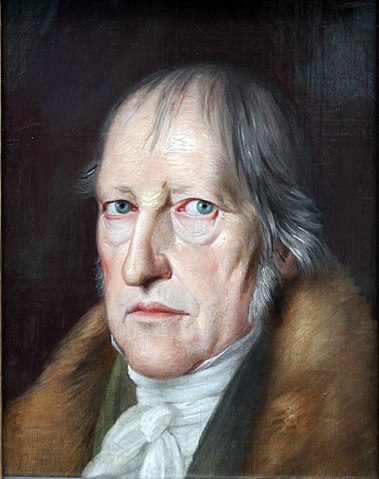
This article is devoted to the comparative analysis of logical entities from the work of the German philosopher Georg Wilhelm Friedrich Hegel, 'Science of Logic,' and their analogs or lack thereof in programming.
Entities from 'Science of Logic' are highlighted in italics to avoid confusion with commonly accepted definitions of these words.
Pure Being
If you look up the definition pure being in the book, you will see an interesting line: 'without further definition.' But for those who haven't read or understood it, don't rush to accuse the author of dementia. Pure Being — this is a basic concept in Hegel's logic meaning that some object is, please do not confuse it with the existence of the object; the object may not exist in reality, but if we somehow defined it in our logic, it is there. If you think about it, indeed such things as pure being it is impossible to give a definition, and any such attempt will result in you simply referring to its synonyms or antonyms. Pure Being so abstract a concept that it can be applied to absolutely anything, including itself. In some object-oriented languages, there is an ability to represent everything as an object, including operations on objects, which essentially gives us such a level of abstraction. However, in programming, there is no direct analogy to pure being . To check the existence of an object, we need to check its absence.
if(obj != null);It’s strange that such syntactic sugar is still missing, considering that this check is quite popular.
Nothing
As you might have guessed nothing is the absence of anything. Its analog could be NULL. It is worth noting that in science, logic nothing is pure being, because it also exists. This presents some difficulties; we cannot refer to NULL as an object in any language, though in essence it is also one.
Becoming and Moments
Becoming is the transition from nothing downward API support (simultaneously with this in being and from being downward API support (simultaneously with this in nothing. This gives us two moments, the first is called emergence, and the second passing away. Passing away is called so instead of disappearance because the logical entity cannot essentially disappear unless we forget it. Elimination This can be referred to as the assignment procedure. If we initialize an object, it occurs at the moment of occurrence, and in the case of assigning another value or NULL the moment of disappearance.
obj = new object(); //occurrence
obj = null; //disappearance
Actual being
In brief actual being — refers to an object that lacks a clear definition yet possesses specificity. What does this mean? A canonical example is a simple chair. If you try to give it a clear definition, you will face many difficulties. For example, you might say: "it's a piece of furniture intended for sitting," but an armchair is also made for that, and so on. However, the absence of a clear definition does not prevent us from identifying it in space and using it to convey information about it; that's because in our minds we have specificity the concept of a chair. Perhaps some have already guessed that to distinguish such objects from the data stream, neural networks were created. A neural network can be defined as a function that determines this specificity, but there are no types of objects that would include both clear and unclear definitions at the same level of abstraction.
The law of transition from quantitative changes to qualitative changes
This law was formulated by Friedrich Engels as a result of interpreting Hegel's logic. However, it can be plainly seen in the first volume in the chapter about measure. Its essence is that quantitative changes in an object can affect its quality. For example, we have an object, ice, which when accumulating heat will turn into liquid water and change its qualities. To implement such behavior in an object, there exists a design pattern called "State." The emergence of such a solution is due to the absence of something like the basis for for the emergence of an object. The basis determines the conditions under which an object can arise, and in the algorithm, we decide when we need to initialize the object.
PS: If this information is interesting, I will conduct a review of other entities from "The Science of Logic."
Source: habr.com
