

The LGA2066 platform and Skylake-X family processors were introduced by Intel over a year and a half ago. Initially, this solution was aimed at the HEDT segment, meaning high-performance systems for users involved in content creation and processing, as Skylake-X contained significantly more computing cores compared to the usual members of the Kaby Lake and Coffee Lake families.
However, since the launch of Skylake-X, the landscape of the processor market has changed significantly, and today, quite affordable CPUs can have six or even eight computing cores, while promising mass-market CPUs expected to be released this year may have ten or even twelve cores. Does this make Skylake-X chips obsolete? Most likely not. Firstly, there are offerings in this series with 16 and 18 cores, and there won’t be similar mass options on the market in the near future. Secondly, the LGA2066 platform has other advantages that set it apart from standard consumer processors, such as superiority in memory channels and available PCI Express lanes.
Therefore, the cosmetic update of the Skylake-X lineup that the microprocessor giant conducted at the end of last year seemed quite reasonable—it fit perfectly into Intel's established schedule of annual announcements. However, the company's attitude towards its HEDT newcomers was somewhat surprising: the company not only did not revise prices but also refused to provide samples of the processors to the IT press, limiting itself to just a formal presentation and the subsequent start of sales.
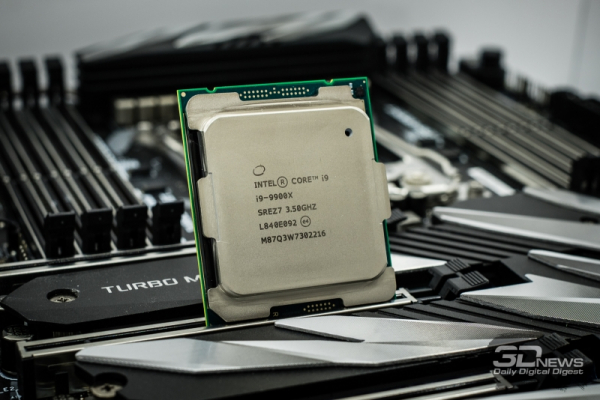
Apparently, the company considers the new Skylake-X to be secondary and uninteresting products, but we fundamentally disagree with this characterization. Yes, the number of computing cores in this model range did not increase during the update. However, there are other interesting improvements: the new models feature higher clock speeds, an increased L3 cache size, and an improved internal thermal interface. Therefore, we decided to pay some attention to the updated Skylake-X, aided significantly by the computer shop "Regard," which agreed to provide us with a couple of new LGA2066 ten-core processors: the Core i9-9820X and Core i9-9900X.
Moreover, since the moment of the Skylake-X Refresh announcement, we couldn't shake the question: why did Intel choose such a similar name for the senior ten-core HEDT processor, reminiscent of the popular mass-market eight-core Core i9-9900K? What does it mean? And now we have a chance to figure it out...
Skylake-X Refresh Series
Intel announced the arrival of new LGA2066 processors with model numbers from the nine-thousand series back in October of last year. The new line includes seven models: six Core i9 processors with core counts ranging from 10 to 18, and one eight-core Core i7 model that is conditionally entry-level. There are no six-core or four-core options for LGA2066 in this new generation, which is not surprising given the rapid growth of the LGA1151v2 platform's capabilities.
| Cores/Threads | Base frequency, GHz | Turbo Frequency, GHz | L3 Cache, MB | Memory | TDP, W | Price | |
|---|---|---|---|---|---|---|---|
| Core i9-9980XE | 18/36 | 3,0 | 4,5 | 24,75 | DDR4-2666 | 165 | $1 979 |
| Core i9-9960X | 16/32 | 3,1 | 4,5 | 22,0 | DDR4-2666 | 165 | $1 684 |
| Core i9-9940X | 14/28 | 3,3 | 4,5 | 19,25 | DDR4-2666 | 165 | $1 387 |
| Core i9-9920X | 12/24 | 3,5 | 4,5 | 19,25 | DDR4-2666 | 165 | $1 189 |
| Core i9-9900X | 10/20 | 3,5 | 4,5 | 19,25 | DDR4-2666 | 165 | $989 |
| Core i9-9820X | 10/20 | 3,3 | 4,2 | 16,5 | DDR4-2666 | 165 | $889 |
| Core i7-9800X | 8/16 | 3,8 | 4,5 | 16,5 | DDR4-2666 | 165 | $589 |
The most notable change in the processors listed in the table, compared to the previous Skylake-X series models, is the increase in clock speeds. The nominal frequencies have risen by 200-600 MHz, while the maximum frequencies achieved in turbo mode have increased by 200-300 MHz. Additionally, the lower-tier models have seen an increase in the third-level cache size. Previously calculated at a rate of "1.375 MB per core," now each core can have up to about 2 MB of cache. Lastly, the PCI Express controller of the eight-core Core i7-9800X has been fully unlocked, giving this processor access to all 44 lanes that were previously available only in processors with 10 or more cores.
However, all these pleasant changes have also led to an increase in heat generation. While the first generation of Skylake-X had a thermal package limited to 140 W, the new processors have a TDP increased to 165 W. In other words, the higher frequencies assigned to the new processors, achieved without any fundamental changes in the 14nm manufacturing process, come at the cost of expanded energy and thermal limits.
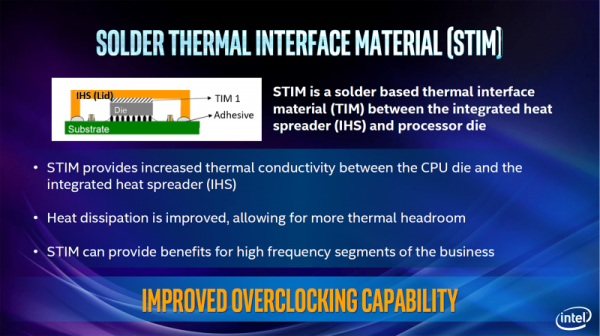
However, Intel claims that the improvement in performance characteristics was made possible by the introduction of the third version of its manufacturing technology, colloquially referred to as 14++ nm, which is currently used to produce Coffee Lake and Coffee Lake Refresh processors. Without this, heat generation could have been even higher. But there is no reason to fear that the new Skylake-X processors may be prone to overheating. Improved thermal interface material beneath the heat spreader is expected to lower the operating temperatures of the new processors. The polymer thermal paste previously used has been replaced with solder that has significantly higher thermal conductivity.
But everything said above is just the tip of the iceberg. The thing is that the change in specifications, primarily the increase in the third-level cache size, is based on much more unexpected grounds. Now, for the production of HEDT processors, Intel is using somewhat different semiconductor dies with a different "meaning."
This means the following: HEDT processors have always represented a desktop version of server chips. Traditionally, Intel would take lower modifications of Xeon, adapt their memory controllers and some other specifications, and transfer them to a desktop environment. While for its server products, Intel produced three types of semiconductor chips: LCC (Low Core Count) with 10 cores, HCC (High Core Count) with 18 cores, and XCC (eXtreme Core Count) with 28 cores, only the simplest versions of these chips made it into the desktop HEDT processors. For instance, in the first generation Skylake-X processors with 6, 8, and 10 cores, the LCC chip was used, while configurations with 12, 14, 16, and 18 cores utilized the HCC chip.
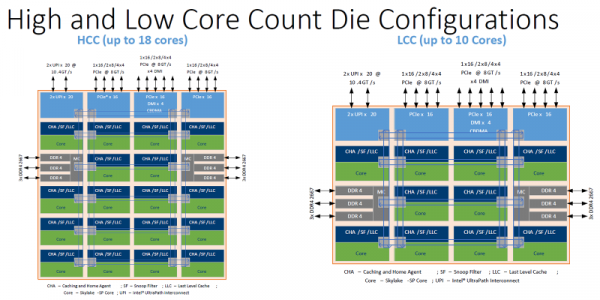
In the updated Skylake-X models that are being discussed today, the lower version of the LCC chip is no longer used. All new HEDT processors in the nine-thousand series, including the eight- and ten-core variants, are based on the HCC chip. This means that even in the Core i7-9800X or Core i9-9900X, there are potentially 18 cores, though a significant portion of them is hardware-locked during production.
This seemingly strange decision was made specifically to increase the cache memory in the new processors. The internal structure of Skylake-X assumes that each computing core is allocated a portion of cache memory of 1.375 MB. If the same Core i9-9900X were to use the lower LCC chip, it could not possibly achieve more than 13.75 MB of L3 cache. The larger HCC chip is more flexible in this regard, as it includes a total of 24.75 MB of cache, and this increased volume is partially utilized in the new generation of eight- and ten-core processors.
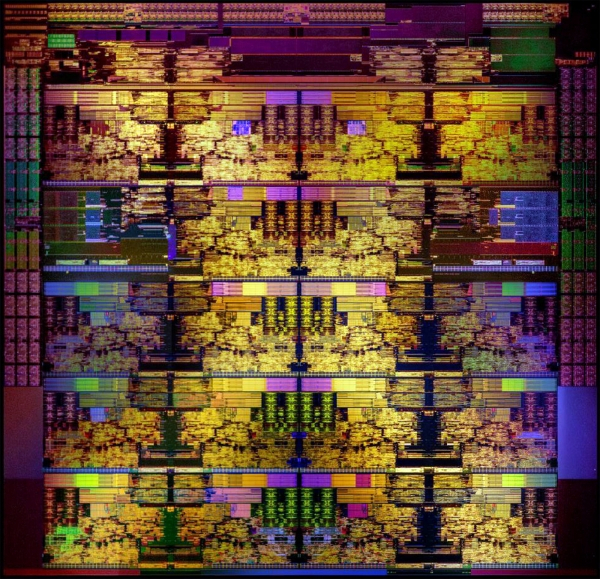
As a result, all Skylake-X have been unified in design, but the downside of this unification has been the widespread use of a very large semiconductor die with an area of about 485 mm², which is more than two and a half times the size of the die in the eight-core Coffee Lake Refresh. This means that any of the LGA2066 processors in the nine-thousand series has a significantly higher cost of production compared to the Core i9-9900K. However, despite this, the eight-core Core i9-9800X is listed at only $100 more than the Core i9-9900K. Therefore, it seems reasonable to suppose that the production of eight- and ten-core processors based on 18-core dies still has some economic sense for Intel; for example, the company might be taking advantage of this opportunity to utilize semiconductor dies with a high number of manufacturing defects that have yet to find a suitable application.
Learn more about the ten-core Core i9-9900X and Core i9-9820X
For our testing, we took two 'next-gen' ten-core processors – the Core i9-9900X and Core i9-9820X. Despite these CPUs moving to the new HCC die, they have not changed significantly compared to the Core i9-7900X. Normally, Intel transitions second-generation processors for previous types of HEDT platforms to a newer microarchitecture upon release, but this did not happen this time. The changes only pertain to numerical parameters; qualitatively, with the Core i9-9900X and Core i9-9820X, we have nearly the same offering as the ten-core Core i9-7900X from 2017.
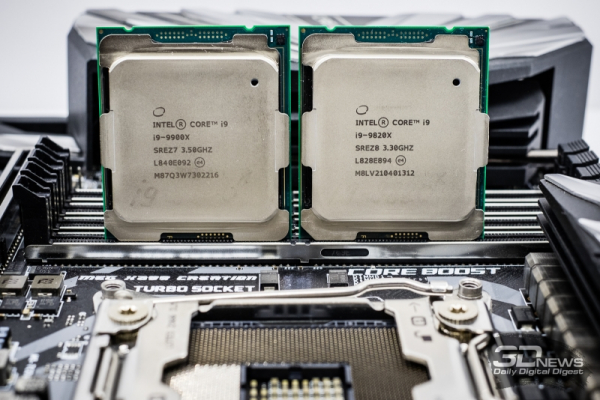
However, the second generation of Skylake-X does not have any compatibility issues: they work perfectly in existing LGA2066 motherboards based on the Intel X299 chipset. Like their predecessors, they feature a quad-channel DDR4 memory controller, and the integrated PCI Express 3.0 controller supports 44 lanes, which can theoretically be split into an arbitrary number of slots — from three to eleven.
However, the semiconductor die HCC, which forms the basis of the Core i9-9900X and Core i9-9820X, is somewhat different from the dies used in the higher-end Skylake-X models earlier. Although the formal stepping retained the M0 designation characteristic of the original Skylake-X versions with more than 12 cores, Intel has now begun to use modified lithographic masks in the manufacturing process due to the use of a more mature 14++ nm technology process instead of the previous 14+ nm process. The key technological difference lies in the slightly larger pitch between the transistor gates, which, as we have seen with Coffee Lake, positively impacts frequency potential.
At the microarchitecture level, however, there are no changes at all. Surprisingly, the new Skylake-X Refresh processors do not even include any hardware fixes to combat the Meltdown and Spectre vulnerabilities. This is quite strange considering that in the parallel Coffee Lake Refresh product released at the same time, certain patches have already appeared. For example, modern LGA1151v2 processors are protected against Meltdown (Variant 3) and L1TF (Variant 5) attacks at the hardware level.
But the most frustrating part is not even this. The main reason for disappointment is the lack of any changes in the scheme of combining processor components into a single unit. Skylake-X Refresh continues to utilize a symmetrical mesh network overlaid on the array of processor cores. This inter-core connection scheme performs well with a significant increase in core counts in server processors, but for HEDT products with a relatively low number of cores, it is much less suitable than a traditional ring bus, causing dramatic latency increases. One method to combat this negative effect could have been to accelerate mesh connections, but everything remains the same here. The frequency of the interconnects in both previous and current Skylake-X remains at 2.4 GHz, which means that the L3 cache and memory controller on LGA2066 processors have noticeably worse latency compared to the mass-market Coffee Lake Refresh. However, this is partially offset by the expanded second-level cache, which in Skylake-X has a capacity of 1 MB per core, rather than four times less.
This can easily be illustrated with a graph of the memory subsystem latency of the current generation Skylake-X processors compared to Coffee Lake Refresh. It clearly shows the lack of improvement in latency issues with the new HEDT processors.
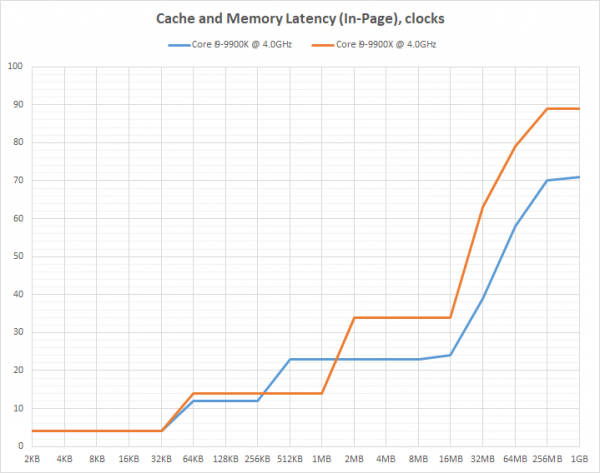
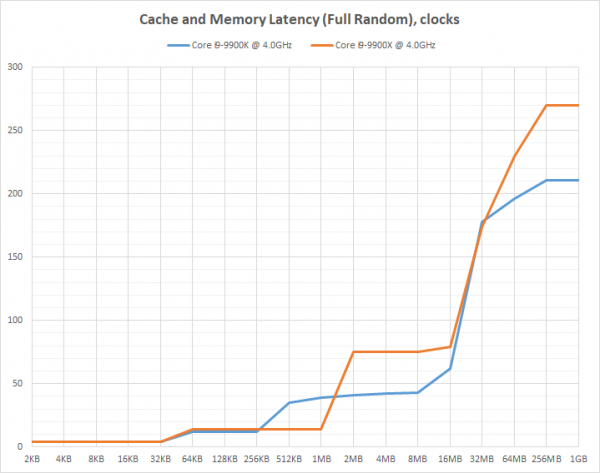
However, the new ten-core processors can boast advancements in clock speeds and cache size. For example, the Core i9-9900X features a substantial L3 cache of 19.25 MB, which is 40% larger than the cache of the previous ten-core processor, the Core i9-7900X. The base clock speed of the new model has increased from 3.3 to 3.5 GHz, but the maximum frequency of the Core i9-9900X in turbo mode can reach the same 4.5 GHz that was available to the previous generation ten-core processor. In both cases, reaching the 4.5 GHz mark requires the use of Turbo Boost Max 3.0 technology, while the traditional turbo mode offers a maximum frequency of 4.4 GHz for the Core i9-9900X.
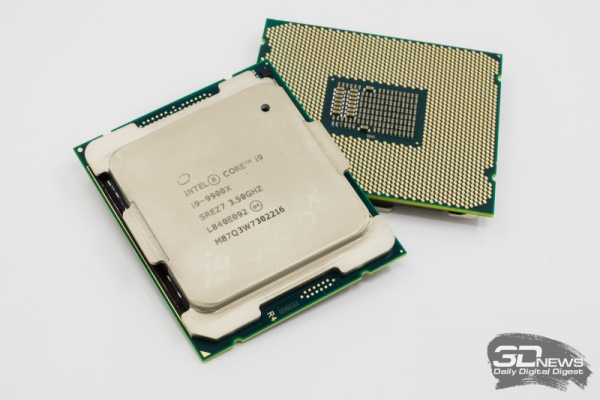
However, in practice, the situation with the Core i9-9900X clock speeds is somewhat different. Under full load across all cores, the processor operates at a frequency of 4.1 GHz.
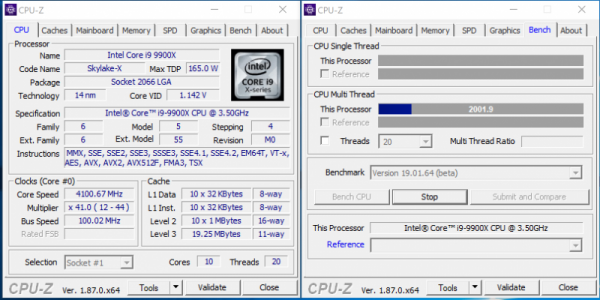
If this load utilizes AVX instructions, the processor frequency drops to 3.8 GHz.
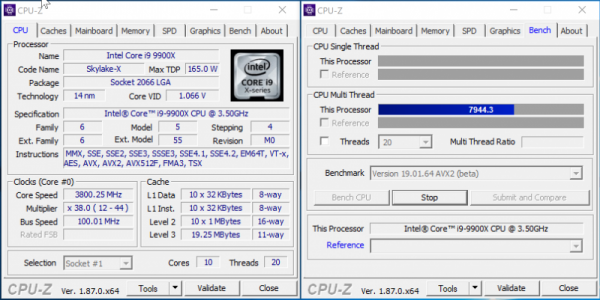
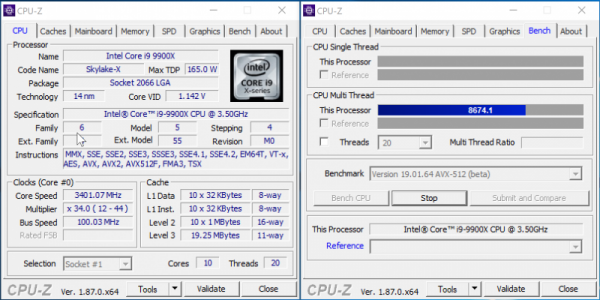
Moreover, the most resource-intensive 512-bit instructions from the new AVX-512 set, under full load across all cores, cause the processor to throttle down to 3.4 GHz, which, it should be noted, is even lower than the stated nominal frequency.
Speaking of the ten-core Core i9-9820X, which is a step down, its main difference from its higher-end sibling is the size of the third-level cache, which is reduced to 16.5 MB. The specified frequencies are slightly lower as well, but it should be noted that all Intel HEDT processors have unlocked multipliers, allowing enthusiasts to ignore this drawback.
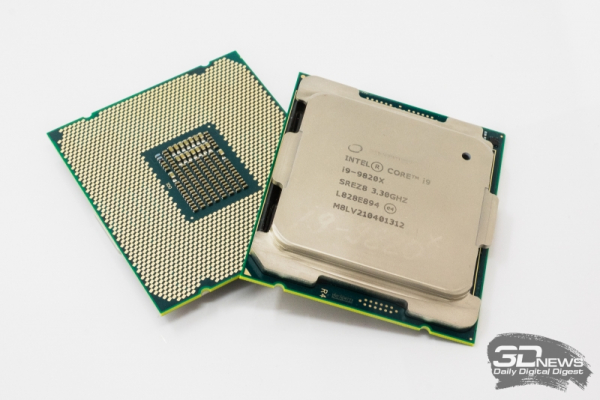
Nevertheless, the nominal frequency of the Core i9-9820X is 3.3 GHz, while the maximum frequency in turbo mode is 4.1 or 4.2 GHz, depending on whether it refers to Turbo Boost 2.0 or Turbo Boost Max 3.0 technology.
In practice, when operating the processor with default settings and under full load across all cores, the Core i9-9820X can run at a frequency of 4.0 GHz.
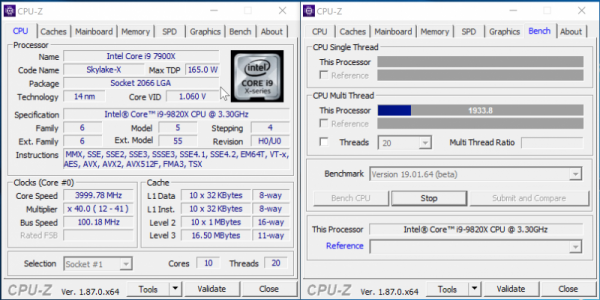
If the load utilizes AVX instructions, the processor reduces its operating frequency to 3.8 GHz.
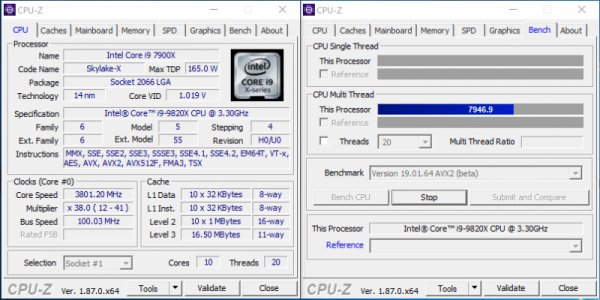
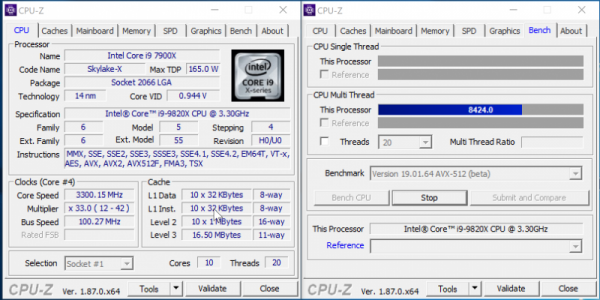
In AVX-512 mode, the frequency of the Core i9-9820X drops back to its nominal value of 3.3 GHz.
When discussing how the new ten-core LGA2066 processors are better than the old Core i9-7900X, it's important to note the transition to a more efficient internal thermal interface. The heat spreader is now soldered to the die, similar to what has been done in Coffee Lake Refresh. Intel claims that this allows the new processors to cool more effectively and operate at lower temperatures; however, there are two caveats. Firstly, the solder used by Intel has not impressed overclockers, as it is less effective than liquid metal. Secondly, the procedure for delidding has now become largely inaccessible for most enthusiasts: removing the lid without damaging the processor has become very difficult, making it extremely challenging to improve the existing thermal interface.
In conclusion to the discussion on the specifications of the Core i9-9900X and Core i9-9820X, it's worth mentioning the prices. Here Intel did not show much imagination, setting the price of the higher-end ten-core Core i9-9900X at the same $989 that it asked for the Core i9-7900X of the previous generation. However, the Core i9-9820X is $100 cheaper, making it a more attractive offering for enthusiasts, as the 15% smaller L3 cache is unlikely to significantly impact performance, and the nominal clock speeds hold no importance for true high-performance enthusiasts.
Source: 3dnews.ru
