

The release of Windows 10 in the summer of 2015 was undoubtedly a significant event for the software giant, which had previously faced setbacks with Windows 8, a version that failed to gain widespread adoption due to its controversial dual desktop interface — the traditional and the tile-based interface known as Metro.
Learning from Mistakes
In developing the new platform, the Microsoft team aimed to address all critical feedback regarding the lukewarm reception of 'the eight' and even launched the Windows Insider program — the largest user engagement initiative in the company's history, allowing users to actively participate in the OS's development by downloading test versions, engaging with developers, and providing their suggestions and feedback. This unprecedented openness from Microsoft enabled the company to release a high-quality product that fully met the demands of its user base, which appreciated the new system.
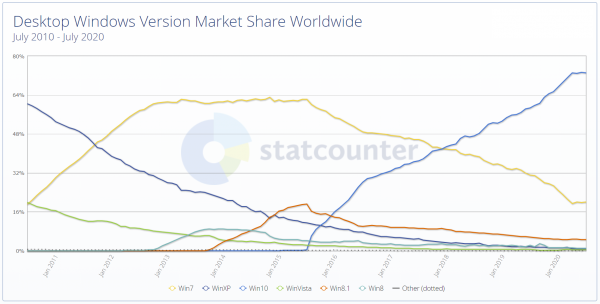
A well-structured marketing strategy played a crucial role in the rapid rise of Windows 10's popularity, allowing free installation of the 'ten' for owners of earlier OS versions. This generous gesture from the Redmond team worked wonders and ensured a strong start for Microsoft's latest platform: within the first day after its release, the operating system approximately 14 million times. The milestone of 50 million installations was reached about two weeks after the platform's release, and it took two months to install 100 million copies. It’s no surprise that the newcomer quickly overtook Windows XP/8/8.1, and two and a half years later, it dethroned the market favorite — Windows 7, which at that time held strong positions in the corporate sector.
Currently, Windows 10 is the most popular OS from Microsoft worldwide. According to According to the analytics agency StatCounter, Windows 10 is installed on 73.1% of computers, while 20% of PC owners use Windows 7. The third most popular is Windows 8.1, but its share is a modest 4.5% and is steadily declining. Overall, various versions of Microsoft's software platforms account for 77.7% of the global operating system market for personal computers. Approximately 17.1% of the market belongs to macOS, while around 1.9% is attributed to various Linux distributions.
Changing Priorities
With the release of Windows 10 for personal computers, Microsoft switched to a new OS update model known as "Windows as a Service," which entails large updates being released twice a year (in spring and fall) and supported for 18 months. An exception is made for corporate and educational editions of the platform, whose fall releases are supported for 30 months from the release date. To understand the scale of the changes, it's enough to consider that in previous years, Windows was updated every three years. Now, the development process has accelerated sixfold, which inevitably affects the quality of the products released. However, let's not get ahead of ourselves and will discuss this important point later.
In five years of work on the platform, specialists from the software giant have managed to release nine updates that significantly expanded its functionality. This is an undeniable fact, which can be easily verified in our and publications dedicated to Windows 10.
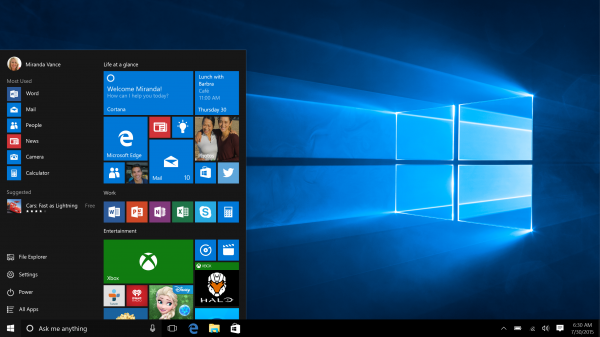
When comparing the 2015 version of the 'ten' to the current version, it's impossible not to notice how much the platform has transformed and evolved over the years. The OS has gained support for 3D technologies, Mixed Reality, DirectX 12 Ultimate, a gaming mode, and the ability to instantly connect to external Bluetooth devices. It now features quick data sharing tools between devices, new tools for working with multimedia, network, and entertainment content, the option to reinstall the system from the cloud, and support for a 'picture-in-picture' mode that allows a small window to be placed over other active programs to multitask. Significant improvements have been made to security features: mechanisms have been added to protect against ransomware and potentially unwanted software, automatic PC locking in the absence of a user, and the Sandbox component, which allows running questionable applications in an isolated environment without risk. The list of changes and improvements is truly impressive.
Peace, friendship, Open Source
With the release of Windows 10, Microsoft made a significant step towards open technologies, and this shift has been highly praised by the Open Source professional community. Among the work done in this direction, we highlight the browser based on the source code of the Chromium project and the Windows Subsystem for Linux (WSL), which enables running Linux applications in a Windows environment. Additionally, Microsoft is actively working to integrate the software platform with devices based on Android. It is expected that in the future, through the OS-included 'Your Phone' application, users will be able to launch and use any apps originally created for Android on the 'ten'. All this makes Windows 10 an excellent tool for IT administrators of multi-platform systems, programmers, web developers, and those who work with open-source applications or simply have an interest in Linux-based platforms.

Less is more
Now it's time to discuss the sad truth. Namely, in the pursuit of frequent releases of the Windows 10 operating system, Microsoft has paid less attention to quality control of its flagship product. This is evidenced by numerous complaints and reviews from users who frequently encounter various issues after installing OS updates. A wealth of materials on this topic can be found in specialized IT forums and the media. Need examples? Here are just a few of them: , , , .
It first became known in 2018 that Microsoft faced serious issues with the development, debugging, and testing of its software, when the company openly released a 'raw' major autumn update, skipping the Release Preview testing phase through the Windows Insider program. As it turned out, this was not the best decision, as a critical error in the Windows 10 October 2018 Update was found that deleted user files stored in the 'Documents' folder on some PCs. Microsoft acknowledged the problem and suspended the rollout of the update. After restarting the update, a host of bugs and problematic areas were discovered again, including at the system level, accompanied by the appearance of the Blue Screen of Death (BSoD). The company had to pause the distribution of the update package for the 'ten' several times.

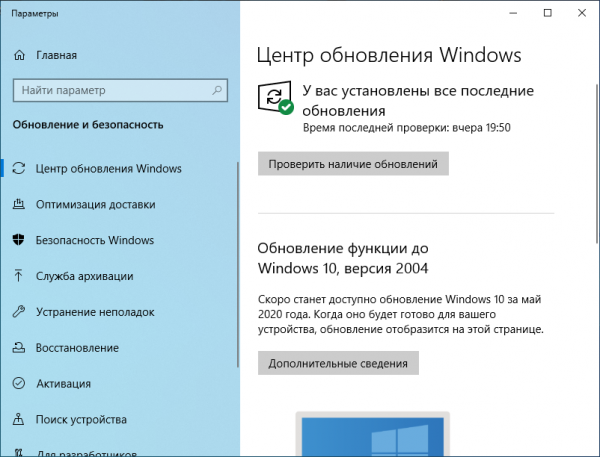
The apotheosis of professional prowess from the software giant’s programmers was the recent release of the major update, Windows 10 May 2020 Update, with ten (sic!) issues on board that lead to critical platform errors including Blue Screen of Death (BSoD). Compatibility problems have been noted with the Thunderbolt interface, Nvidia graphics cards, Conexant Synaptics audio drivers, Realtek Bluetooth network adapters, Intel Optane memory, and other PC components. The extent of the shortcomings was such that Microsoft had to the deployment of a major update for problematic computers. Why was there such a rush to release a problematic update package for Windows 10? Why the hurry to release a product that was not ready for a wide audience? There are many questions, but few answers.
According to experts, the root of the problem lies in the updated OS development scheme, which implies releasing major updates with new features twice a year. With such a frantic pace, you won't get very far. And can you really deliver a quality product when developers are focused not on fixing bugs but on endless improvements to the Start menu and notification panel, adding new icons in Fluent Design style, and expanding the kaomoji emoji set? Why the cyclical wandering and tightening of 'nuts' in the user interface of the system when programmers can't handle the aforementioned pile of problems? Windows 10 has long been, at Microsoft's behest, a testing ground for experiments—recently, not very successful ones.
Regardless of how you look at it, the picture is not very rosy. One can only hope that the series of scandals regarding Windows 10 updates will lead to improvements in Microsoft's software development practices. There are prerequisites for this. The corporation has already its approach to testing new OS builds within the Windows Insiders program. Additionally, according to network sources, Microsoft's management serious changes to the strategy for releasing Windows 10 updates. If major updates currently come out in the spring and fall, the new schedule will imply only one such update per year. And that is the right approach.
Chasing two hares
Interestingly, against the backdrop of clear failures with Windows 10, the company the creation of the new Windows 10X platform, developed with a focus on dual-screen and foldable devices. The system is expected to feature a radically redesigned user interface and built-in support for virtualization to run Win32 applications. The first hardware solutions with Windows 10X onboard are anticipated. in spring 2021. At one time, Microsoft made unsuccessful attempts to establish itself in the mobile market with Windows 10 Mobile. Now, with the announcement of 'the ten' for hybrid devices, the company aims to enter a related territory and firmly believes in the success of its initiative. Is it not a bit too early?
Source: 3dnews.ru
