

Thanks to a recent update, GeForce 10th and 16th series graphics cards can now perform ray tracing in DXR-supported games. , on and (as well as any other NVIDIA models except for GeForce RTX and older accelerators on Pascal chips), this feature tends to operate more like a demo rather than offering any practical value. However, while real-time ray tracing may be out of reach for the GeForce GTX 1660, it does not diminish the other merits of this entry-level Turing model. The GeForce GTX 1060 has lost its former appeal, and the balance of power among mid-range graphics cards has shifted in favor of the Radeon RX 580 and , but the new models based on the TU116 chip have quickly restored NVIDIA to a leading position.
In reviews of high-performance graphics cards, the media usually focuses on expensive models with powerful cooling systems, striking designs, and numerous additional features. However, when it comes to mainstream hardware, it's more important to examine the lower end of the price list. The low power consumption of the GeForce GTX 1660 allows for a significant simplification of the graphics card's supporting hardware while still maintaining a large margin for overclocking. To what extent this simplification preserves overclocking potential will be explored with the Inno3D GeForce GTX 1660 Twin X2 as an example.
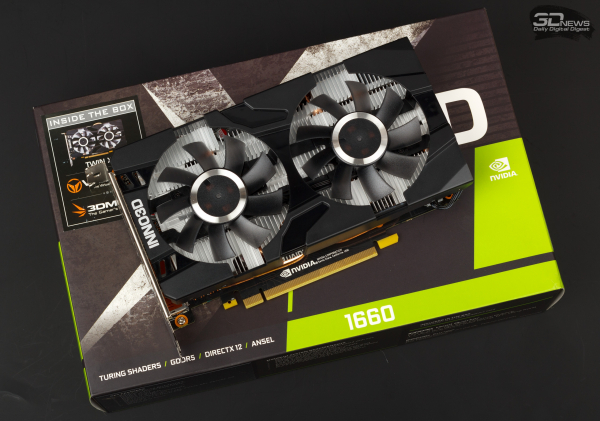
Specifications, package contents, prices
Unlike the products from more well-known manufacturers, Inno3D's modern offerings catalog lacks diversity, with the GeForce GTX 1660 and GTX 1660 Ti available only as Twin X2 models. Under this brand, Inno3D has released several accelerators based on all Turing architecture graphics processors, up to the GeForce RTX 2080 Ti. Each of them is notable for its affordable price in its market niche and operates at strictly reference clock speeds. Accordingly, the base clock frequency of the Inno3D GeForce GTX 1660 Twin X2 is 1530 MHz, while the approximate value under typical load (Boost Clock) is 1785 MHz. However, NVIDIA tends to underestimate the potential of its graphics cards, as devices from the GeForce 10th, 16th, and 20th series usually overclock better even in the most demanding games. But we’ll confirm this during the testing phase. Like all variations of the GeForce GTX 1660, the Inno3D board carries 6 GB of GDDR5 memory, which again is characterized by a reference bandwidth of 8 Gbit/s per bus contact.
| Manufacturer | NVIDIA | Inno3D |
|---|---|---|
| Model | GeForce GTX 1660 | GeForce GTX 1660 Twin X2 |
| Graphics Processor | ||
| Title | TU116 | TU116 |
| Microarchitecture | Turing | Turing |
| Process Technology, nm | 12 nm FFN | 12 nm FFN |
| Number of transistors, million | 6 600 | 6 600 |
| Clock frequency, MHz: Base Clock / Boost Clock | 1530/1785 | 1530/1785 |
| Number of shader ALUs | 1408 | 1408 |
| Number of texture mapping units | 88 | 88 |
| Number of ROPs | 48 | 48 |
| Number of tensor cores | No | No |
| Number of RT cores | No | No |
| Memory | ||
| Bus Width, bits | 192 | 192 |
| Chip Type | GDDR5 SDRAM | GDDR5 SDRAM |
| Clock frequency, MHz (bandwidth per contact, Mbit/s) | 2000 (8000) | 2000 (8000) |
| Size, MB | 6 144 | 6 144 |
| Bus width | PCI Express 3.0 x16 | PCI Express 3.0 x16 |
| Performance | ||
| Peak FP32 performance, GFLOPS (calculated at maximum specified frequency) | 5027 | 5027 |
| FP32/FP64 performance | 1/32 | 1/32 |
| FP32/FP16 performance | 2/1 | 2/1 |
| Memory bandwidth, GB/s | 192 | 192 |
| Video output | ||
| Display Interfaces | DL DVI-D, DisplayPort 1.4a, HDMI 2.0b | DL DVI-D, DisplayPort 1.4a, HDMI 2.0b |
| TBP/TDP, W | 120 | 120 |
| Retail Price (USA, excluding tax), $ | 229 (recommended) | N/A |
| Retail price (Russia), rub. | 17,990 (recommended) | From 15,658 (market.yandex.ru) |
In the Russian market, NVIDIA initially priced the GeForce GTX 1660 at 17,990 rubles, but a month after the release, the prices for its various modifications diverged in both directions from the recommended value. 'Premium' versions of the GTX 1660, according to Yandex Market, reach 20,240 rubles, while the most 'popular' model can be bought for just 15,975 rubles — this is the Inno3D GeForce GTX 1660 Twin X2. However, we did not find it on foreign marketplaces, so private importers will have to consider other ways to save.
Despite its excellent price-to-performance ratio, the Inno3D GeForce GTX 1660 Twin X2 has worthy competitors in the sub-$250 graphics card category. AMD responded to the debut of the 'green' newcomers by lowering prices on the Radeon RX 580 and Radeon RX 590. The flagship accelerators based on Polaris chips are now priced starting from 16,261 rubles, while the Radeon RX 580 in an 8 GB RAM configuration starts at 12,517 rubles. These values correspond closely to how competitors were positioned in our initial review of the GeForce GTX 1660. However, AMD allows for an even deeper cut in upgrade costs with the Radeon RX 580 models featuring 4 GB of memory, starting at 10,579 rubles.

Despite the affordability of the Inno3D GeForce GTX 1660 Twin X2, the graphics card package includes something valuable — keys to the paid versions of the 3DMark and VRMark benchmark suites. However, there are no other accessories included in the box apart from the software disc.
Design
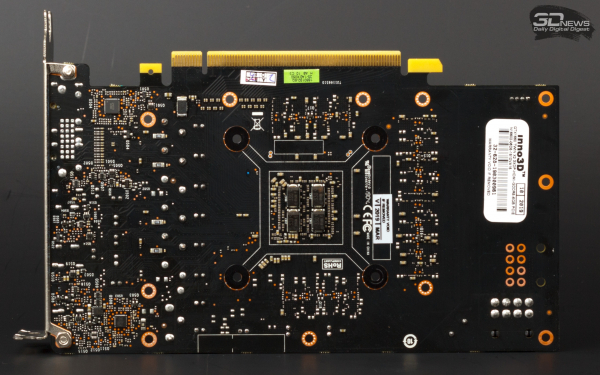
The exterior of the Inno3D GeForce GTX 1660 Twin X2 speaks for itself and does not require detailed description. Visually, the graphics card does not differ much from the numerous other budget modifications of the GeForce GTX 10 and 16 series. Due to its modest size, one might think it fits within Mini-ITX form factor systems, but it's actually 1.96 cm longer than the 17 cm standard. Naturally, there is no LED lighting or other non-essential decorations. Even the protective backplate on the PCB is absent.
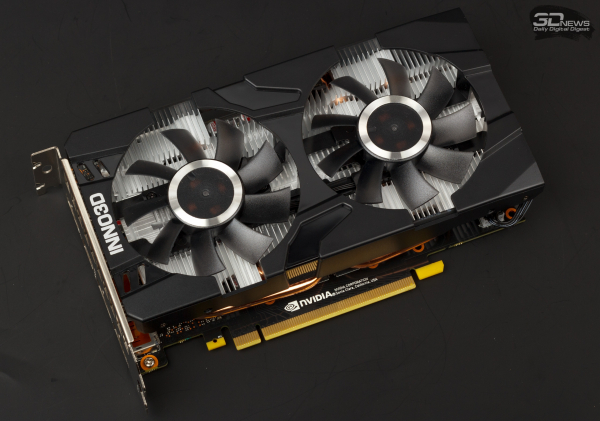
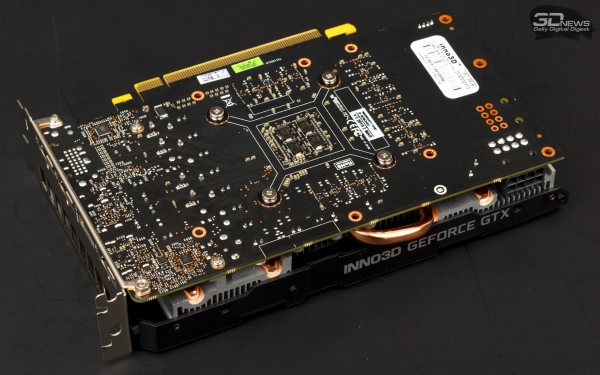
The insides of the Inno3D GeForce GTX 1660 Twin X2 are cooled by two 72 mm fans. Since the manufacturer did not extend the cooling system's housing beyond the PCB dimensions, which is often done with compact graphics cards, there was not enough room for wider fans. With the core temperature at the threshold of 45 °C, the cooling system operates in a peculiar semi-passive mode: the fans remain stationary most of the time but occasionally spin for a few seconds.
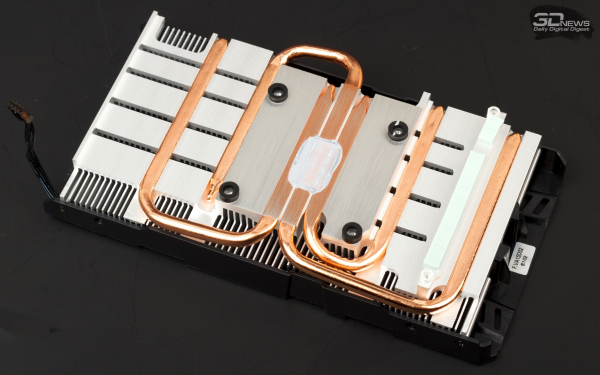
Thanks to its low energy consumption (120 W according to the reference specifications for the GeForce GTX 1660), the TU116 graphics processor is effectively cooled by a compact radiator of simple design. However, the engineers at Inno3D did not skimp on three 4 mm thick heat pipes that make direct contact with the GPU chip. For instance, GIGABYTE has managed with just one pipe in its budget versions of the GeForce GTX 1660 and GTX 1660 Ti.
Printed Circuit Board
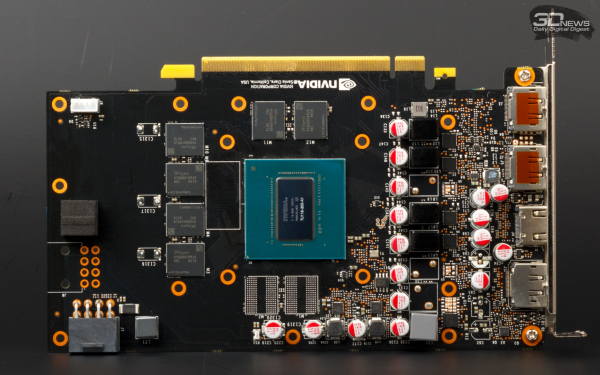
Since the TU116 and TU106 chips are interchangeable from a physical interface standpoint, many versions of the GeForce GTX 1660, 1660 Ti, and even with are built on identical printed circuit boards. Manufacturers only change the GPU itself, the type and amount of memory chips, and the voltage regulator configuration. Judging by external characteristics, all Inno3D Twin X2 models up to the GeForce RTX 2070 are also based on the same PCB. Interestingly, it carries NVIDIA markings: it seems that Inno3D sources Turing chips for this series of devices together with reference boards.
The PCB has contact pads for six phases of GPU power and two phases for the RAM chips, but the GeForce GTX 1660 has only four and one phase soldered respectively. A modest configuration, but since the GeForce GTX 1060 Founders Edition had a total of four phases, the younger model with the TU116 chip should well suffice with five. Thanks to its relation to the GeForce RTX series of graphics cards, the voltage regulator in the Inno3D GeForce GTX 1660 Twin X2 contains field transistors with built-in drivers (known as DrMOS, or power stages). Compared to discrete pairs of driver-transistor, the integrated solution provides improved efficiency and allows the PWM controller to accurately control the output voltage.
Additional power is supplied to the graphics card via a single eight-pin connector, and the set of external interfaces consists of three DisplayPort outputs and a single HDMI. Judging by the contact pad layout, the reference PCB allows for two DisplayPort connectors to be replaced with a DVI block, which would be quite suitable for a budget accelerator, but Inno3D did not take advantage of this opportunity.
Source: 3dnews.ru
