

Kamil Łysik, who works at NVIDIA, presented at the XDC 2026 conference discussing the results of testing output latency in GNOME 49.7 (mutter) and KDE 6.7.4 (kwin) environments using X.Org Server and Wayland. The code used in the study is published under the MIT license.
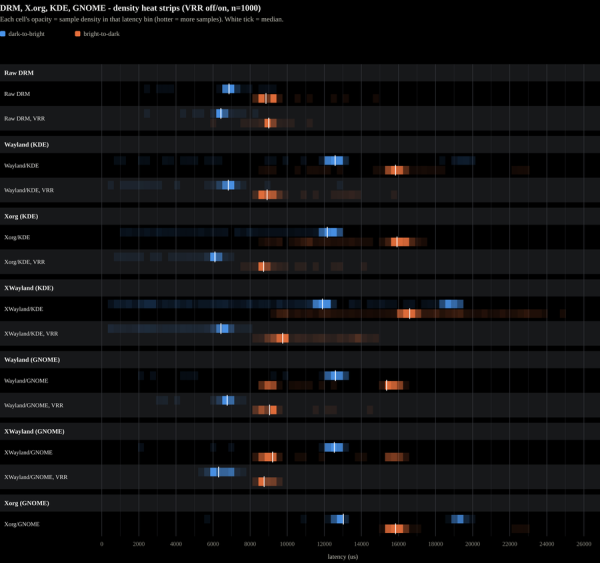
Overall, the findings suggest that the differences in responsiveness are minor, making it difficult to identify a clear winner. Kamil believes that the primary factors influencing latency are input processing and how the output is organized on the monitor. He specifically noted the technology for adaptive refresh rate (VRR), the implementation of which significantly improved responsiveness. Additionally, he mentioned that issues with latency, which appeared in previous tests using XWayland, have not been observed in the new XWayland codebase.
The proposed method for assessing interface responsiveness is similar to a study conducted by Mark Nett back in July. As in the previous research, a specialized hardware device based on the ESP32-S3 microcontroller was used to accurately measure the time from key press to information change on the screen, with a photodiode connected to detect the brightness change of a pixel on the screen, simulating USB keyboard input. The NVIDIA GeForce RTX 5070 graphics card and LG 27GN950 monitor were utilized for output. The system used Linux kernel 7.1.7 and NVIDIA proprietary driver set 610.57.04.

Source: opennet.ru
