

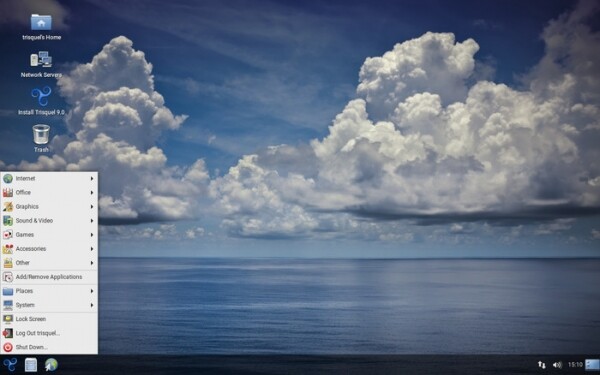
A year after the last release, an update of the fully free Linux distribution Trisquel 9.0.1 has been published, based on the package base of Ubuntu 18.04 LTS and aimed at use in small enterprises, educational institutions, and home users. Trisquel is personally endorsed by Richard Stallman and officially recognized by the Free Software Foundation as fully free, making it one of the recommended distributions by the foundation. Installation images are available for download, sized 2.6 GB, 2 GB, and 1.1 GB (x86_64, i686). Updates for the distribution will be provided until April 2023.
The distribution is notable for excluding all non-free components, such as binary drivers, firmware, and graphical elements distributed under non-free licenses or using registered trademarks. Despite the complete absence of proprietary components, Trisquel is compatible with Java (OpenJDK) and supports most audio and video formats, including working with protected DVDs, all while employing only fully free implementations of these technologies. MATE (default), LXDE, and KDE are offered as desktop environments.
In the new release, the installation images have been updated and new versions of packages with fixes from the Ubuntu 18.04 LTS branch have been transferred. The Abrowser (Firefox with patches) has been updated to version 93. The installation builds have resolved an issue with access to repositories and updates due to the delivery of an outdated root certificate from IdenTrust in the ca-certificates package, which was used for cross-signing the root certificate of the Let’s Encrypt certification authority. The fully free version of the Linux kernel—Linux Libre—has been completely updated, with additional cleaning of proprietary firmware and drivers containing non-free components.
It is also noted that testing of the preliminary builds of the Trisquel 10 branch, based on the package base of Ubuntu 20.04, has begun.
- Inclusion of software with approved FSF licenses in the distribution;
- Prohibition on the delivery of binary firmware and any binary driver components;
- The rejection of immutable functional components, but the possibility of including non-functional ones, provided there is permission to copy and distribute them for commercial and non-commercial purposes (for example, CC BY-ND maps for a GPL game);
- The inadmissibility of using trademarks whose terms of use hinder free copying and distribution of the entire distribution or any of its parts;
- Compliance with the licensing purity of documentation, the inadmissibility of documentation that recommends the installation of proprietary software to solve specific tasks.
Currently, the following projects are included in the list of fully free GNU/Linux distributions:
- Dragora — an independent distribution promoting the idea of maximum architectural simplicity;
- ProteanOS — a standalone distribution evolving towards achieving the smallest possible size;
- Dynebolic — a specialized distribution for processing video and audio data (no longer in development — the last release was on September 8, 2011);
- Hyperbola — based on stabilized snapshots of the Arch Linux package base with certain patches inherited from Debian for improved stability and security. The project develops according to the KISS (Keep It Simple Stupid) principle and aims to provide users with a simple, lightweight, stable, and secure environment.
- Parabola GNU/Linux — a distribution based on the developments of the Arch Linux project;
- PureOS — based on the Debian package base and developed by Purism, which develops the Librem 5 smartphone and produces laptops that come with this distribution and firmware based on CoreBoot;
- Trisquel — a specialized Ubuntu-based distribution for small businesses, home users, and educational institutions;
- Ututo — a GNU/Linux distribution built on the Gentoo base.
- libreCMC (libre Concurrent Machine Cluster), a specialized distribution designed for use in embedded devices such as wireless routers.
- Guix — based on the Guix package manager and the GNU Shepherd initialization system (formerly known as GNU dmd), written in the Guile language (one of the implementations of the Scheme language), which is also used for defining service launch parameters.
Source: opennet.ru
