

NFP founder Sergey Lozhkin told me about simulation modeling, digital twins, why our developers are affordable and impressive for Europe, and why Russia has a high level of digitalization.
Come by if you want to learn how it works, who needs Digital Twins in Russia, the cost of a project, and how to learn it.
A digital twin is an exact virtual copy of a real object or process. They have long been actively used worldwide for saving money and increasing safety. Russia is finally starting to move in this direction, and it's even more pleasant that we have cool companies that are valued in foreign markets.
You can watch the full interview (about an hour long) on my YouTube channel, where everything is very lively and interesting, and the first comment includes time codes.
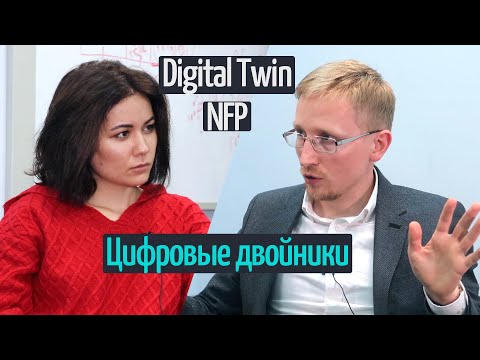
Here, I will briefly provide some points, creatively reworked for print format.
Farya:
— How long has your company had the "Simulation Modeling" division, and why did you decide to embark on this path?
Sergey:
— In 2016, we had an employee who knew what Anylogic was. He said it was a cool topic, let's do it. So we started, having no idea what it was. We started investing, training people, and looking for leads. Then that person left... But since we had already paved some way, we decided to continue.
— Well, look, a new thing emerged that needs to be developed, but you understood perfectly that a large part of the market consists of government contracts with a corresponding mentality and crumbling factories, which you'll have to model somehow. Did you really believe in this technology, or did you just want to pursue something trendy?
— I wouldn't say it was trendy at that time; the idea was very interesting. In my opinion, digital experiments on models await us in all fields; it's a path we should take regardless. The Americans, for instance, model entire military battles, positioning tanks, planes, infantry, and then observing the battle's outcome.
Well, this is in the military sector. In the civilian sector, America and Europe have been modeling for a long time too. China is making strides in modeling at a rapid pace. For example, the German company SimPlan modeled the operation of the Airbus aircraft using Anylogic, Mercedes is actively utilizing it, and any major company is experimenting with modeling. We have advanced companies that are doing this, both commercial and governmental, for which, by the way, digital transformation is one of the key themes right now.
— Well, we know how this goes…
— We know… but they need to deliver some results. It’s not possible to just keep talking about it; soon they will start getting asked questions. So they need to do something.
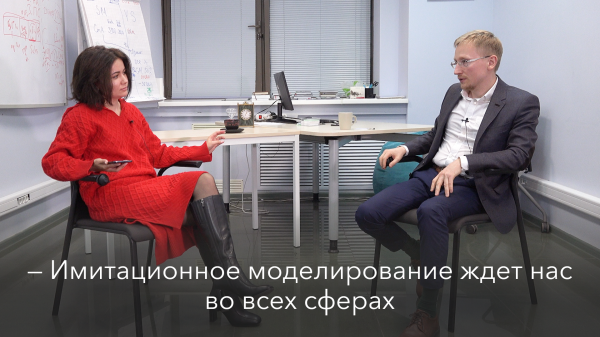
— Who are your clients?
— These are mostly large companies. Conditioned, the TOP-1000 are our target clients. Mainly, these are commercial companies and those with state participation. Among the clients are systemically important companies in energy, gas extraction, and air transportation.
— What are they interested in modeling?
— They are interested in modeling processes that are expensive to experiment with. For example, there is a smelting furnace the size of a house, and any mistake in changing the technological process, which was laid down in the stone back in the 60s, can be very costly. Therefore, despite the fact that the process efficiency could be improved, experiments are not conducted.
In this case, a "digital twin" can be created that takes into account the processes in the furnace and all the auxiliary systems – warehouses, cranes, etc. – and model everything. For instance, to see what would happen if we do not lower the temperature in the furnace.
— So, what distinguishes a digital twin from simulation modeling?
— Simulation modeling is the process of creating and working with a digital twin, i.e., a virtual copy of a physical object or process. This can be a business process, for instance, call routing, the movement of railway transport, vehicles, anything related to logistics, etc.
Overall, the digital twin is a trendy topic, and a lot can be adapted to it. It can be a model of an iron, or we can call the implementation of 1C a digital twin of accounting. We narrow this concept down to certain physical processes.
— Why do you think simulation modeling is a trending topic? I hardly hear about digital twins. Moreover, when I searched for vacancies on hh for Anylogic, which you use, there were very few, and more than half were related to you.
— In the spring, we attended a conference on simulation modeling in Munich, meeting companies that practice it, and I can say that Russia is lagging behind in this regard. The simulation modeling market in the States is substantial; everyone is modeling there. In Europe, for instance, you cannot build infrastructure projects without modeling; they even modeled the Volkswagen plant we have in Kaluga.
Even if we take Anylogic – a Russian software for simulation modeling that is actively used worldwide, the utilization of this product in Russia is less than 10%, according to their statements. This means that modeling is essentially just starting to take off here. And now we are seeing more and more conscious requests from clients.
— When you approach companies with your ideas, do you often encounter resistance?
— Yes, often. Especially in companies where 'old school' people cling to their positions and say that 'this thing' will not allow them to improve efficiency. Moreover, it sometimes happens that management is willing, but we have to work at a lower level, with foremen and dispatchers, and there is resistance on their part as well.
However, there is now a noticeable trend towards change, and it is becoming increasingly clear. 'Old-timers' are leaving, and those who come in think differently. Additionally, as I mentioned, everyone is being almost shoved into digital transformation, with training being conducted, and even in remote enterprises, there are often advanced individuals. Sometimes, Muscovites are sent there on business trips to develop everything.
— Do you feel a shortage of workforce?
— It depends on the situation; we are a project organization. If many projects come in, then the shortage is felt because developers need to be prepared over several months. Currently, I wouldn't say there is a shortage; we are hiring about one person a month due to the increase in the number of projects, but there isn't a huge scramble in this regard.
— How much do you pay?
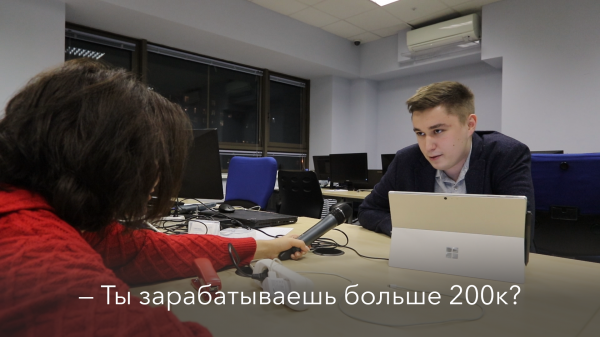
A Junior can earn about 50k rubles. In general, we have quite standard rates. Normal salaries start from 80k and can go up further. If clients like the person and he improves well, he can quickly reach a good salary starting from 120k.
So, someone who has programmed for several years, learned Java, comes to you, and has the prospects to reach 200k.
— Yes.
(A significant look into the camera)
I noticed that on your YouTube channel, some videos are in English. Later, I find an article stating that you are entering the British market. Why?
We are indeed planning to enter the British market; our goal is for half of our revenue to come from abroad. We want to work globally. Currently, we have very few such projects, but we want to make this a regular occurrence.
Is there a sense of prospects and interest in you from Europe?
It depends on what we offer. For example, we are currently conducting training in simulation modeling and RPA for Europe, and we are gathering groups of 20-30 people who then want to stay in touch with us.
I also liked in the article that there are fewer checks there, better legal and judicial systems, and developer costs are very high. Am I correct in understanding that developers will sit here but work abroad?
Yes, well, that's classic genre.
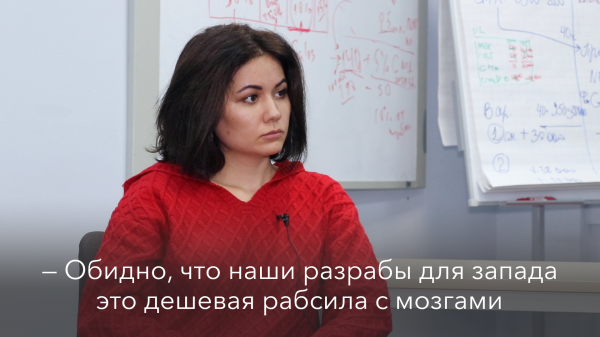
I just notice for the first time that new companies are emerging here, creating hyped businesses that are very popular abroad but have not yet gained traction in Russia. Consequently, they start projects for foreign markets, and I feel a bit sorry for our developers, as this is essentially cheap labor with brains that can be exploited to sell cool projects abroad.
Here, I don’t quite agree that it’s exploitation because such a developer receives very good bonuses. Yes, he won't earn as much as someone living in the UK, but the cost of living there is higher.
So, basically, you are just competing on price?
It's worth noting that we are not cheaper than Indians. It turns out we can only offer what Indians cannot do, where real expertise, engineering, and complex things come into play which we handle better.
How much does your model cost?
— From half a million rubles and up to infinity. We have reached up to 10 million.
— How much can a model worth 10 million save your client?
— Billions. Infrastructure projects are very expensive.
— How do you convince clients that it's beneficial for them to buy your model?
— The simplest option for us is when the company understands the need for simulation modeling and just engages us as executors. Another level is when we can propose efficiency ourselves, which is essentially consulting. In this case, simulation modeling is just one of the tools, like RPA, 1C, or just some technical regulation. Behind the tool is an idea, and behind the idea is a strategy.
So, when we communicate at the level of ideas, there are places where we can sell, and places where we can't just yet — we aren't mature enough from that perspective. And here we delve into a particular industry, as it is impossible to be an expert in everything.
— Do you approach them yourselves?
— Nowadays, they mainly approach us.
If you liked it, I invite you to watch the . You will also learn how digital twins are created and what they actually represent, how to learn to develop them, and what machine learning and science have to do with it.
Share your thoughts in the comments about simulation modeling and Sergey’s words.
Source: habr.com
