

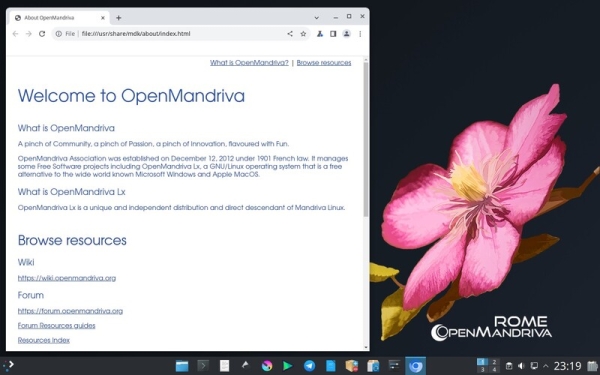
The OpenMandriva project has released OpenMandriva ROME 26.09, a version of the OpenMandriva distribution that uses a rolling release model for continuous updates. This version provides access to new package versions being developed for the OpenMandriva Lx 7 branch without waiting for a traditional distribution build. The project has been community-driven since Mandriva S.A. handed over the project management to the non-profit organization 'OpenMandriva Association' in 2013. ISO images sized at 3.2 GB have been prepared for download and include desktops KDE, GNOME, LXQt, MATE, and Xfce, supporting live mode booting.
Release Features:
- Support for Snap package format has been added (in addition to Flatpak and AppImage).
- The package manager has been upgraded to a new branch RPM 6.1.0, which was supplemented with a patch to support the %pgo section in spec files to simplify the inclusion of profile-guided optimizations (PGO). Almost all packages are compiled with LTO (Link-Time Optimization) and for certain packages, PGO optimizations are included.
- Components of the KDE desktop environment have been updated to versions KDE Plasma 6.7.5, KDE Gear 26.08.1, and KDE Frameworks 6.29.0. KDE can be used with graphical stacks based on X11 and Wayland. Versions of GNOME 50.3, Xfce 4.20, LXQt 2.4.0, MATE 1.28 (with experimental Wayland session), hyprland 0.56.2, cosmic 1.7.0, niri 26.04, sway 1.12, i3-wm 4.25.1, icewm 4.1.0, qtile 0.36.0, labwc 0.20.2, miriway 26.08.1, enlightenment 0.27.1, and enlightenment e16 1.0.32 have been updated. The Spectrwm window manager has been added.
- The HPLIP and Clementine applications have been ported to Qt6. The graphic editor Krita has been updated to the 6.0 branch, which uses Qt6.
- New releases of MESA 26.2.3, Qt 6.11.2, GTK 4.22.5, ROCm 10.0.0, GStreamer 1.28.6, and PipeWire 1.6.9 have been engaged.
- User applications have been updated: Firefox 156.0, Thunderbird 155.0, LibreOffice 26.8.0.3, Audacity 4.0.0, Blender 5.2.2, VLC 3.0.24, OBS 32.2.2, GIMP 3.2.4, Amarok 3.3.3, Kitty 0.48.2, and Inkscape 1.4.4.
- An updated selection of AI-related packages has been added: llama-cpp 0.4.1, ollama 0.34.3, whisper-cpp 1.9.4, koboldcpp 1.119, hermes-agent 2026.9.21, opencode 1.18.22, aider 0.86.2, goose 1.50.0, bark-cpp 1.0.0, stable-diffusion.cpp 0.841, and comfyui 0.37.1. Many of these packages use GGML 0.24.0 and are built for acceleration with GPU using ROCm, Vulkan, and OpenCL.
- Packages for running Windows games have been updated, including Wine 11.18, DXVK 3.0.2, vkd3d 2.0, vkd3d-proton, proton, and proton-experimental. The non-free repository has added the Steam installer 1.0.0.86.
- System components updated: Linux kernel 7.2.7 (optional package with kernel 7.3.0-rc4 available), LLVM/Clang 23, GCC 16.2.0, glibc 2.44, grub2 2.16.
- Preparation has been carried out for the ability to switch between different implementations of the memory allocation functions malloc in the standard C library Glibc. It is noted that choosing the optimal malloc implementation for the tasks at hand can improve performance by up to 20%.
- Work is underway to separate kernel packages to extract individual modules. The idea is to minimize the size of the base kernel package by moving kernel modules into separate packages, which can be installed only when necessary, depending on the existing hardware.
- A new bootstrapping toolkit has been prepared, supporting the building of OpenMandriva in a chroot environment. Patches for building the distribution for RISC-V and LoongArch64 platforms have been added to the experimental branch OpenMandriva Cooker.
- NVIDIA drivers have been updated to version 610.57.04. Open modules for NVIDIA GPUs have been incorporated into the kernel package to prevent failures due to version mismatches when updating the kernel and NVIDIA drivers. Proprietary modules and GUI for configuring NVIDIA drivers remain in the nvidia package available in the non-free repository.
- The build with GNOME includes the UPDragora graphical interface, developed as part of the Tears of Mandrake initiative, providing features for updating packages and the entire system, as well as installing and removing packages. New modules for resource management (System Resources), backup, and sound management are also being developed by the Tears of Mandrake initiative.
- As the default browser in the KDE and LXQt editions, Helium has replaced ungoogled-chromium, based on the developments from ungoogled-chromium and restoring some features removed during the cleaning process from Google services. The development toolkit CEF (Chromium Embedded Framework) has been transitioned to Helium, enabling the use of the CEF plugin in OBS Studio based on Helium.
Source: opennet.ru
