

The release of the Kali Linux 2024.2 distribution, based on the Debian package base, has been presented. It is designed for testing systems for vulnerabilities, conducting audits, analyzing residual information, and identifying the consequences of attacks by malicious actors. All original developments created within the framework of the distribution are distributed under the GPL license and are available through a public Git repository. Several ISO image options have been prepared for download, sized at 495 MB and 4 GB. The builds are available for i386, x86_64, ARM (armhf and armel, Raspberry Pi, Banana Pi, ARM Chromebook, Odroid) architectures. The default desktop offered is Xfce, but KDE, GNOME, MATE, LXDE, and Enlightenment e17 are also supported as optional.
Kali includes one of the most comprehensive collections of tools for computer security specialists: from web application testing and penetration into wireless networks to programs for reading data from RFID identification chips. The package includes a collection of exploits and about 400 specialized utilities for security checks, such as Aircrack, Maltego, SAINT, Kismet, Bluebugger, Btcrack, Btscanner, Nmap, p0f. In addition, the distribution includes tools to accelerate password cracking (Multihash CUDA Brute Forcer) and WPA key cracking (Pyrit) using CUDA and AMD Stream technologies, which allow the use of NVIDIA and AMD graphics cards' GPUs for performing computational operations.
In the new release:
- To address the year 2038 problem, packages for 32-bit architectures armhf and armel have been transitioned to using a 64-bit time_t type.
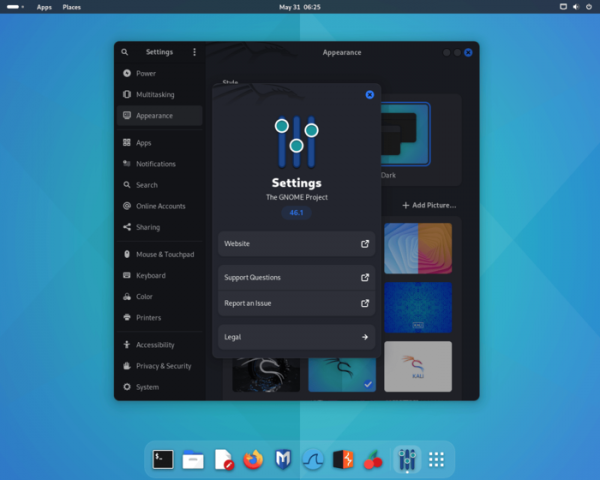
- The user environment has been updated to GNOME 46.

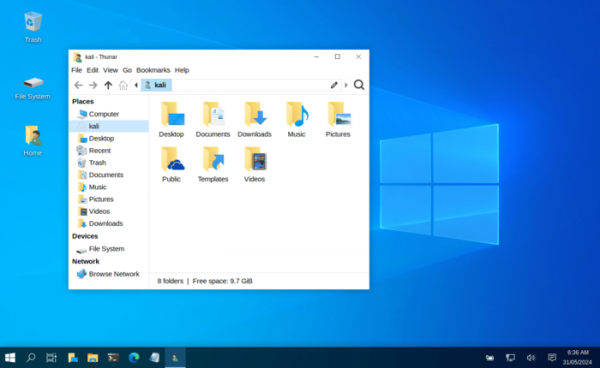
- The implementation of the Xfce-based 'Kali Undercover' mode, which simulates a Windows appearance so as not to raise suspicion while using Kali in public places, has been updated. The performance of Xfce on high-density pixel screens has been improved.

- The package includes 18 new utilities:
- autorecon — a tool for determining available network services in multithreaded mode.
- coercer — checks a Windows server using 12 authentication methods.
- dploot — an alternative to SharpDPAPI, written in Python.
- getsploit — a utility for searching and downloading exploits.
- gowitness — creates screenshots of sites using the Chrome engine.
- horst — a wireless network analyzer.
- ligolo-ng — a utility for traffic tunneling.
- mitm6 — implementation of an attack on Windows using DHCPv6.
- netexec — toolkit for automating attacks on large networks.
- pspy — monitoring process activity in Linux without requiring root privileges.
- pyinstaller — converting Python programs into standalone executable files.
- pyinstxtractor — PyInstaller Extractor.
- sharpshooter — Payload Generation Framework.
- sickle — a utility for developing Payload.
- snort — intrusion prevention system.
- sploitscan — searching for information by CVE identifier.
- vopono — launching applications in a separate namespace of the network stack with traffic routed through a tunnel.
- waybackpy — library and CLI for accessing the SavePageNow and CDX page saving service APIs.
- Added the ability to run the nmap utility in stealth scan mode using TCP SYN (‘nmap -sS’) without root privileges.
- Updated the mobile device environment based on the Android platform — NetHunter, with a toolkit for testing systems for vulnerabilities. With NetHunter, it is possible to test for mobile-specific attacks, such as emulating USB device operation (BadUSB and HID Keyboard — emulation of a network USB adapter, which can be used for MITM attacks, or a USB keyboard performing character substitution) and creating rogue access points (MANA Evil Access Point). NetHunter is installed in the standard environment of the Android platform as a chroot image, running a specially adapted version of Kali Linux. The new version adds support for Android 14, implements a module loader, improves access control management, and supports Huawei P9 devices with LineageOS 16, Nothing Phone 1 with Android 12/13/14, and Poco F3 with Android 14.
Source: opennet.ru
