

The release of the Delta Chat messenger version 1.42 is available, which operates without dedicated servers and uses email as transport (chat-over-email, a specialized email client functioning as a messenger). The application code is distributed under the GPLv3 license, while the core library is available under the MPL 2.0 (Mozilla Public License). The release is available on Google Play and F-Droid, as well as in builds for Linux (AppImage, pacman, rpm, deb), Windows, and MacOS.
Delta Chat does not use its own servers and can work through virtually any email server that supports SMTP and IMAP (Push-IMAP technique is used for quickly identifying the arrival of new messages). It supports encryption using OpenPGP and end-to-end encryption through the Autocrypt standard or decentralized SecureJoin protocols. Traffic is encrypted using TLS in the implementation of standard system libraries.
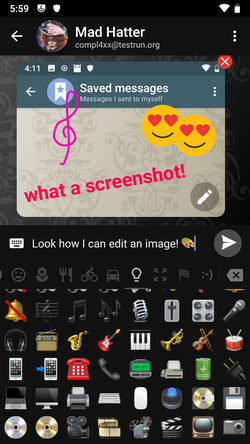
Delta Chat is fully controlled by the user and is not tied to centralized services. No registration with new services is required — an existing email can be used as an identifier. If a correspondent does not use Delta Chat, they can read the message as a regular letter. Spam is mitigated by filtering out messages from unknown users (by default, only messages from users in the address book and those to whom messages have previously been sent are displayed, as well as responses to one's own messages). Attachments and attached images and videos can be displayed.
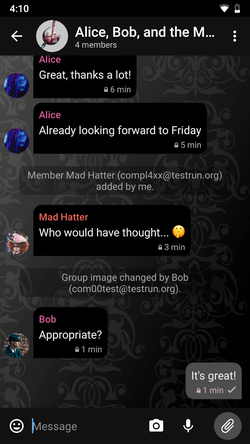
Group chats are supported, allowing multiple participants to communicate. There is the possibility of linking a verifiable list of participants to the group, preventing outsiders from reading messages (participants are verified via a cryptographic signature, and messages are encrypted using end-to-end encryption). Connection to verified groups is done through an invitation sent with a QR code.
The core of the messenger is developed separately in the form of a library and can be used to write new clients and bots. The current version of the base library is written in Rust (the old version was written in C). There are bindings for Python, Node.js, and Java. Unofficial bindings for Go are in development. There exists DeltaChat for libpurple, which can use both the new Rust core and the old C core.
Version 1.42 introduces a new implementation of end-to-end encryption based on decentralized SecureJoin protocols, which guarantee protection against interception of initial keys by internet service providers or administrators. serversPreviously used end-to-end encryption was based on the Autocrypt automatic key exchange mechanism, which bypasses the need for key servers by sending the key in the first message. Consequently, during the transmission of the first message, the key could be intercepted during a MITM attack or through actions taken on the email side. server.
SecureJoin addresses the issues of compromising end-to-end encryption sessions during MITM attacks and provides protection against malicious actions at the level of transit networks and email servers. The new method is based on using QR codes for user verification and encryption key setup. After scanning the QR code, a chat is created in the app with a group of two participants (1:1), marked with a special 'green label' that allows sending and receiving encrypted messages protected from transit interception. Subsequently, additional participants can be connected to the group via invitations sent with the QR code.
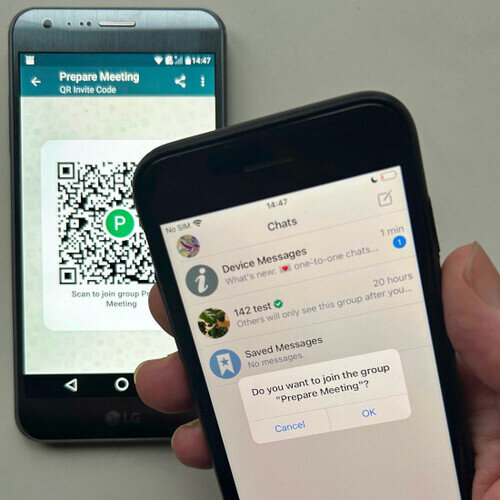
Other changes:
- All user devices are synchronized in actions related to accepting/blocking, archiving, pinning, and disabling notifications.
- The desktop version includes compression for sent images.
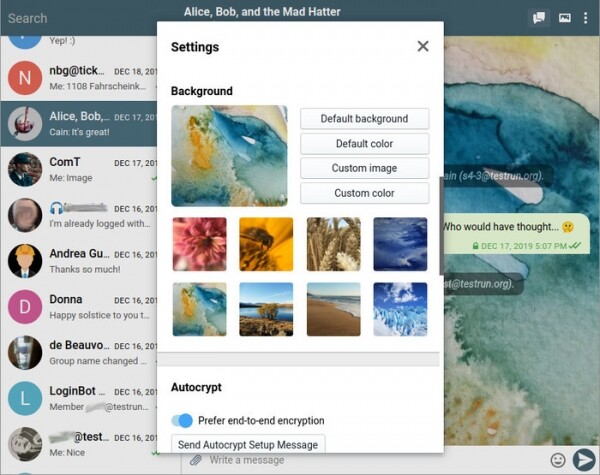
- The desktop version features a Global Gallery with images, documents, and multimedia files from all chats.
- The advanced settings in the Android version now include an option to enable reactions.

Source: opennet.ru
