

Version 1.0 of Portmaster has been released, an application designed to manage firewall operations, enabling access blocking and traffic monitoring at the level of individual applications and services. The project code is written in Go and is distributed under the AGPLv3 license. The interface is implemented in JavaScript using the Electron platform. It supports operation in Linux and Windows.
In Linux, iptables and nfqueue are utilized for inspecting and managing traffic, delegating blocking decisions to user space. In the future, a separate kernel module is planned for Linux. For seamless operation, it is recommended to use Linux kernel versions 5.7 and newer (theoretically, it is possible to operate on kernels starting from the 2.4 branch, but issues are observed in versions prior to 5.7). In Windows, a custom kernel module is used for traffic filtering.
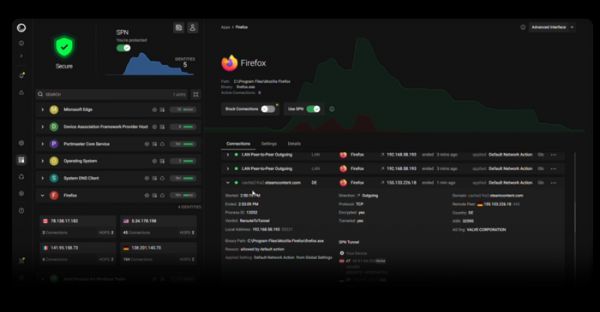
Among the supported features:
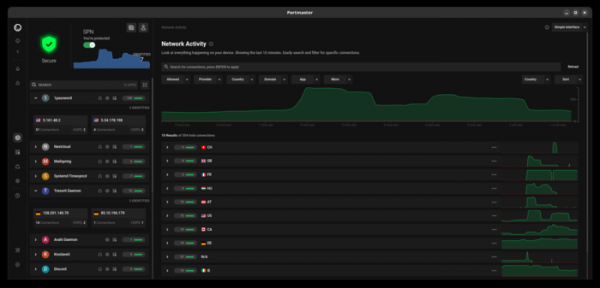
- Monitoring all network activity in the system and tracking the history of network activity and connections for each application.
- Automatic blocking of requests related to malicious code and tracking movements. Blocking is based on lists (the key to connect to is specified, and iroh finds the associated host and establishes an encrypted connection using the QUIC protocol). Direct P2P connections are established whenever possible, but if not, it falls back to using relays, which are also employed for host discovery by keys. You can run your own relay or connect to public relays supported by the community. and domains implicated in harmful activities, telemetry collection, or personal data tracking. It is also possible to use lists to block advertisements.
- Encryption of DNS requests by default, using DNS-over-TLS. A visual representation of all DNS-related activity in the interface.
- The ability to create custom blocking rules and quickly block traffic for selected applications or protocols (for example, P2P protocols can be prohibited).
- The capability to set rules for both all traffic and to tie filters to individual applications.
- Support for filtering and monitoring in relation to countries.

- Paid users are granted access to their own overlay network, SPN (Safing Privacy Network), which is presented as an alternative VPN, reminiscent of Tor but simpler to connect. SPN allows bypassing country blocks, hiding the user's IP address, and tunneling connections for selected applications. The implementation code for SPN is open under the AGPLv3 license.
Source: opennet.ru
