

After 6 months of development, the release of postmarketOS 24.12 is presented, evolving a Linux distribution for mobile devices based on the Alpine Linux package base, the standard C library Musl, and the BusyBox utility set. The project's goal is to provide a Linux distribution for smartphones and tablets, independent of the life cycle of official firmware support and not tied to the typical solutions of major industry players. Builds have been prepared for 54 devices, including the PINE64 PinePhone, Purism Librem 5, OnePlus 6, Google Nexus 10, Nokia N900, Lenovo A6000, ASUS MeMo Pad 7, as well as various models from Samsung Galaxy and Xiaomi. Limited experimental support is provided for over 500 devices.
The postmarketOS environment is unified and extracts all device-specific components into a separate package. All other packages are identical for all devices and are based on packages from the Alpine Linux distribution. Vanilla Linux kernel is used in builds whenever possible, and if not, kernels from firmware prepared by the device manufacturers are utilized. The main user interfaces offered are KDE Plasma Mobile, Phosh, GNOME Mobile, and Sxmo, but there is also the possibility to install other environments, including MATE and Xfce.
In the new release:
- Support for the Google Pixel 3A smartphone and devices on the Qualcomm MSM8953 (Snapdragon 450/625/626/632) platform has been added, among which are the Xiaomi Mi A1, Xiaomi Mi A2 Lite, Xiaomi Redmi 4 Prime, Xiaomi Redmi 5 Plus, Xiaomi Redmi Note 4, and Xiaomi Redmi S2/Y2.
The number of ready builds has decreased from 54 to 53. Compared to version postmarketOS 24.06, the following builds have been added:
- google-sargo (Google Pixel 3a)
- xiaomi-elish (Xiaomi Mi Pad 5 Pro)
- google-asurada (Acer Chromebook 514, Asus Chromebook Flip)
- google-cherry (Acer Chromebook Spin 513, HP Chromebook x360)
- google-corsola (Lenovo 300e Yoga Chromebook Gen 4, Lenovo IdeaPad Slim 3 Chromebook)
- google-peach-pi (Samsung Chromebook 2)
- qcom-msm8953 (devices with Qualcomm Snapdragon 625 chip)
- Xiaomi Mi A1
- Xiaomi Mi A2 Lite
- Xiaomi Redmi 4 Prime
- Xiaomi Redmi 5 Plus
- Xiaomi Redmi Note 4/4X
- Xiaomi Redmi S2/Redmi Y2
- Asus Zenfone 3
- BQ Aquaris X/Aquaris X Pro
- Fairphone 3
- Huawei Maimang 5
- Lenovo P2
- Motorola Moto G5 Plus
- Motorola Moto G6
- Motorola Moto G7 Power
- Samsung Galaxy A6+ (2018)
- Xiaomi Redmi 5
- Xiaomi Redmi 7
The supply of builds has been discontinued: google-nyan-big (Acer Chromebook 13 CB5-311) and google-nyan-blaze (HP Chromebook 14 G3). The builds xiaomi-daisy (Xiaomi Mi A2 Lite), xiaomi-markw (Xiaomi Redmi 4 Prime), xiaomi-mido (Xiaomi Redmi Note 4), xiaomi-tissot (Xiaomi Mi A1), xiaomi-vince (Xiaomi Redmi Note 5 Plus), and xiaomi-ysl (Xiaomi Redmi S2) have been merged.
- The release includes over 200 devices in the 'testing' category, with support levels ranging from boot capability to nearly full functionality. Builds for these devices can be prepared using the pmbootstrap toolkit and the project's repository packages. New devices include support for Fairphone 5 and Amlogic TV boxes.
- The 'Generic x64 UEFI' port, intended for installing the distribution on regular PCs and laptops, now supports the open-source Nouveau driver on systems with NVIDIA GPUs, as well as firmware for Intel GPUs.
- The package base is synchronized with Alpine Linux 3.21.
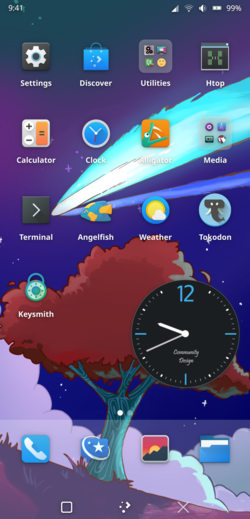
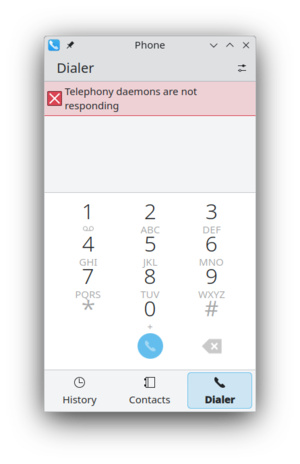
- The KDE Plasma Mobile shell has been updated to version 6.2.4 (previously version 6.0.3). A new interface has been implemented for making calls.


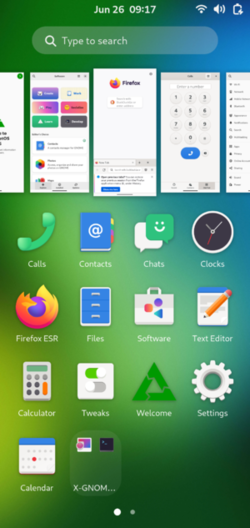
- The GNOME Mobile user environment has been updated, featuring a version of the GNOME Shell interface adapted for use on smartphones and tablets with touch screens. GNOME Mobile components have transitioned to the GNOME Shell 46 branch. Improvements related to design, virtual keyboard, and sleep/wait modes have been made.

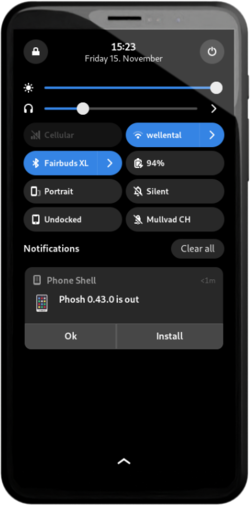
- The Phosh environment, based on GNOME technologies and developed by Purism for the Librem 5 smartphone, has been updated to version 0.43 (previously version 0.39). Changes include a redesign of the quick settings panel; quick settings for activating dark theme, toggling mobile data on/off, and enabling Wi-Fi Hotspot; accent color support; lock screen adaptation for small screens; and enhancements to the notification system.

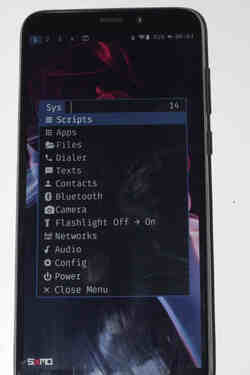
- The Sxmo (Simple X Mobile) graphical shell, based on the Sway window manager and adhering to Unix philosophy, has been updated to version 1.17 (previously 1.16.3). It provides the ability to use the wofi application menu instead of bemenu; a new screen locker (peanutbutter) has been integrated; a 'busy' mode has been added to silence the ringer and vibration; the notification system has been rewritten; an LED indicator handler has been included; a section has been added to the menu for all installed applications; and smooth scrolling in the menu has been implemented.

- New wallpapers have been included.

- The GNOME technology builds include the Snapshot camera application and the Weather forecast viewing interface by default. The Evince PDF viewer has been replaced with the Papers application, and the Lollypop audio player has been replaced with Decibels.
- The MATE desktop environment interface has been adapted for touchscreen management — padding has been increased, and a larger font is used. The MATE and Xfce environments have been translated for the slick-greeter login screen.
- A plugin for handling apk package formats used in Alpine Linux has been added to the Discover application manager used in KDE.
- The initramfs RAM disk image, launched by the kernel at an early boot stage to mount the filesystem, has improved detection of the boot partition and additional debugging features have been added. For example, holding down the volume up button now enables detailed boot logging.
- Camera support in builds using the vanilla Linux kernel instead of the specific Android kernel has been improved. While camera functionality with the vanilla kernel still lags behind that of the Android kernel, the situation is gradually changing. For example, the new version provides support for front and rear cameras on Pixel 3A and Fairphone 5 smartphones, as well as the ability to use one of the two rear cameras on the Pocophone F1.
- Correct PAM (Pluggable Authentication Module) setup is ensured when connecting via SSH, allowing graphical applications to run and enabling pw-dump for debugging PipeWire when working with cameras.
- By default, the doas program (a simplified alternative to sudo from the OpenBSD project) is used instead of the sudo utility, along with the doas-sudo-shim layer implementing the sudo command on top of doas.
- The ZSTD algorithm has been used for compressing linux-firmware.
- Cyrillic script and Greek language fonts are included by default.

The anticipated ability in postmarketOS 24.12 to use the system manager systemd instead of the OpenRC initialization system has been postponed to release 25.06. The complexity of maintaining the OpenRC-based initialization stack in light of the increasing dependency of GNOME and KDE on systemd components is cited as the reason for adopting systemd.
Source: opennet.ru
