

The release of PeerTube 7.1, designed to create independent decentralized video hosting and broadcasting systems as alternatives to services like YouTube, Dailymotion, and Vimeo, has been announced. The network created with PeerTube is based on linking visitors' browsers together and utilizing P2P communications. The project's code is distributed under the AGPLv3 license.
PeerTube allows users to launch their own server for video distribution and connect it to a federated network. Visitors participate in content delivery and can subscribe to channels and receive notifications about new videos, regardless of which server they are using. The PeerTube federated network is formed as a community of interconnected small servers video hosting servers, each with its own administrator and established rules.
Each video server acts as a BitTorrent tracker, hosting user accounts and videos. The ActivityPub protocol is used to facilitate interactions among servers in the federated network. User identifiers are formed as "@username@server_domain". When watching a video, data is preferably loaded through requests to the browsers of other visitors viewing the same content. If no one is watching the requested video, delivery is handled by the server where the video is hosted (the WebSeed protocol is used).
In addition to distributing traffic among users watching videos, PeerTube enables servers to cache videos from other authors. This creates a distributed network not only of clients but also of servers, ensuring fault tolerance. Besides distributing pre-recorded videos, live streaming support is available for P2P content delivery. Common software like OBS can be used to manage the streaming.
To start broadcasting via PeerTube, a user must upload a video, description, and set of tags to one of the servers. After that, the video will be available across the entire federated network, not just on server initial loading. To work with PeerTube and participate in content distribution, a standard browser is sufficient. You can distribute videos using P2P communications by adding a special widget with an embedded web player to your website, similar to how videos are embedded from YouTube. You can track video uploads by subscribing to selected video channels in federated social networks (for example, in Mastodon and Pleroma) or through RSS.
Currently, the federated network consists of 1,317 servers supported by volunteers and organizations. If a user is not satisfied with the video hosting rules on a particular PeerTube server, they can connect to another server or launch their own. For quick server deployment, a preconfigured image in Docker format (chocobozzz/peertube) is provided.
Initially, the PeerTube platform was based on the use of the BitTorrent client WebTorrent, which runs in the browser and uses WebRTC technology to establish a direct P2P communication channel between browsers. Later, instead of WebTorrent, the HLS (HTTP Live Streaming) protocol was used in conjunction with WebRTC, allowing for adaptive stream management based on bandwidth. The web interface is built using the Angular framework.
Key innovations in PeerTube 7.1:
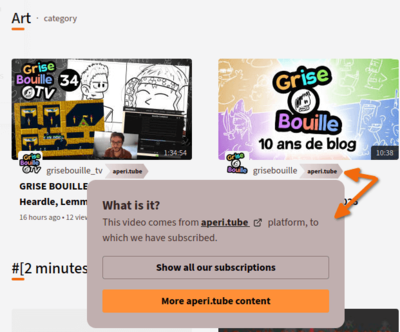
- Improved identification of nodes in the federated network—now, under the thumbnails, information about the server used by the video author is displayed. When clicking on this information, a dialog appears with more detailed information about where the video was sourced.

- Enhanced support for the Podcast 2.0 specification. The ability to use content from PeerTube as podcasts has been added—users can subscribe to podcast channels and separately play the audio stream from videos, using standard podcast apps such as AntennaPod and Podverse. Podcast feed compatibility with Apple Podcast has been ensured.
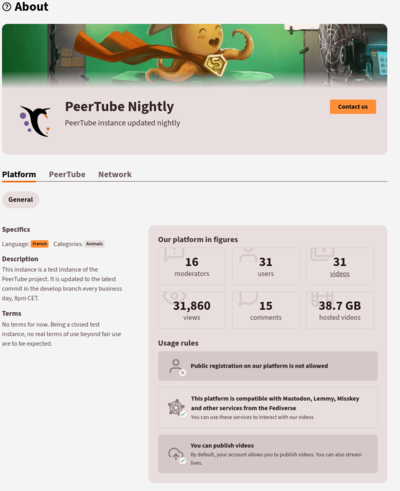
- The layout of the 'About' page has been changed. A block with information about the platform instance has been added, such as the number of users and uploaded videos, a description of the platform, and usage rules.

- The upgraded protocol has been enabled, allowing an increase in the number of users simultaneously viewing content by reducing the number of messages sent to the federation network.
- Support for verification in Mastodon microblogs has been added — users can link their PeerTube channels and platforms to their Mastodon account and provide a button for subscribing to their blog on Mastodon.
- The p2p-media-loader library has been updated, enabling P2P mode in the video player to enhance content playback stability. The changes are particularly noticeable when watching streams configured for low-latency operation.
- Support for adding subtitles to videos in object storage has been introduced.
- Administrators have been provided with settings to define the default behavior of the player.
- Support for client plugins to insert external links in the left panel menu has been added.
- Support for Node.JS 18 has been discontinued.
Source: opennet.ru
