

The release of the mobile platform LineageOS 23 has been announced, based on the Android 16 codebase. It is noted that the LineageOS 23 branch has reached feature and stability parity with branch 22 and is considered ready for the first release. Builds have been prepared for 104 device models (28 devices fewer than in LineageOS 22). LineageOS can also run in the Android Emulator, in QEMU, and in the Android Studio environment. Additionally, there is the option to build for Android TV and Android Automotive modes.
In addition to the release of LineageOS 23, an update for the LineageOS 22.2 branch has been published, for which additional builds have been created for 39 devices. The LineageOS 20 branch has also been updated, incorporating security vulnerability fixes. When installing on all supported devices, the custom Lineage Recovery is offered by default, which does not require a separate recovery partition.
The release of Android 16 supports Linux kernels starting from branch 5.4, but the necessary changes have been ported by LineageOS developers for kernels up to version 4.14. Components necessary for kernels 4.4 and 4.9 have not yet been ported, resulting in a loss of compatibility with devices based on the Qualcomm MSM8998/MSM8996, Qualcomm MSM8953, and Qualcomm SDM845 SoCs. However, porting is potentially possible and depends on the availability of enthusiasts willing to do the work. For owners of devices that only have old Linux kernels available, it is recommended to use the LineageOS 22.2 update, which provides kernels 4.4 and 4.9.
Compared to LineageOS 22, in addition to improvements specific to Android 16, the following changes have been proposed:
- The capabilities for using vanilla Linux kernels (mainline) have been expanded, rather than just modified versions of the kernel provided by the Android platform. Compatibility has been ensured with devices that are supported in the main Linux kernel and can boot using unmodified kernels.
- Security vulnerabilities patched from September 2024 to August 2025. Google has transitioned from monthly to quarterly release of bug and vulnerability fix in the AOSP (Android Open Source Project) repository, so Android-specific fixes in LineageOS will now be delayed. Additionally, LineageOS 23 is currently based on the original Android update 16 QPR0, not the already available QPR1, as the source code related to QPR1 has not yet been publicly released.
- The camera application has been completely rewritten — Aperture (Camera), which has expanded its functionality and simplified code maintenance. Support for capturing images in JPEG Ultra HDR, RAW, and simultaneously in RAW and JPEG has been added. Notification display has been improved. New indicators for HDR, RAW, battery charge, and resource limitations have been added to prevent overheating.
- The functionality of the Twelve (Music Player) has been expanded: A button for playing a random track has been added. Statistics on the currently playing track have been added to the information page. The ability to rescan music in local storage has been implemented to display manually added music files without a reboot. Integration with the Jellyfin service has been enhanced (support for recommendations and favorite tracks has been added, and thumbnail handling has been improved). MIDI playback support has been added.
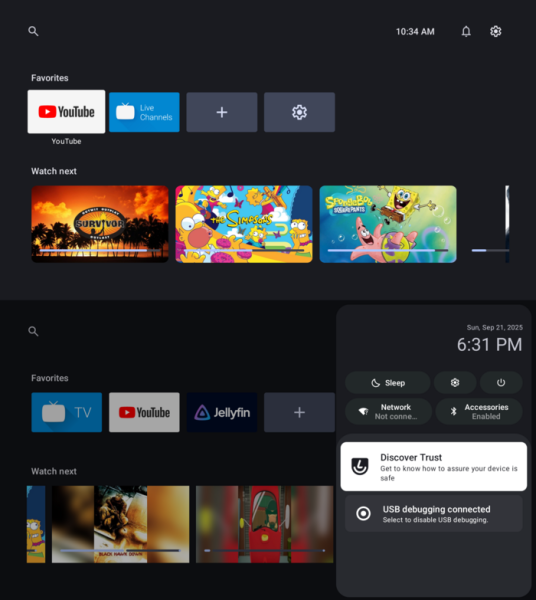
- The Catapult package has been included, implementing a content interface for Android TV, designed in the LineageOS style, easily customizable and focused on applications and content. Unlike the original Android TV and Google TV interfaces, the proposed interface eliminates uncontrolled advertisement displays and forced recommendations.

- Support for installing LineageOS in virtual environments with VirtIO created based on QEMU, crosvm, UTM, and libvirt has been improved. The launch of LineageOS in virtual machines based on QEMU has been simplified. The capability to run LineageOS in a virtual machine UTM on Mac computers with Apple Silicon processors has been added. Support for launching using the open virtual device Cuttlefish, which provides additional peripheral device emulation and allows working with the virtual device as if it were real, has been added.
- The build system is almost free from dependency on Android.mk files due to the transition of Android from the make utility to the soong toolchain and Android.bp build files.
- The functionality of components for managing both standard and fast charging has been expanded.
- New ringtones and alert sounds have been migrated from KDE Plasma Mobile.
- The WebView browser component has been updated to Chromium engine version 140.
- The SeedVault backup application and the Etar calendar-scheduler have been updated to current releases.
Source: opennet.ru
