

After six months of development, the GNOME 46 desktop environment has been released. To quickly assess the capabilities of GNOME 46, specialized Live images based on openSUSE and an installation image prepared as part of the GNOME OS initiative have been offered. GNOME 46 is also included in the experimental builds of Ubuntu 24.04 and Fedora 40.
In the new release:
- A global search feature has been added, triggered by the keyboard shortcut Ctrl+Shift+F or through a new 'Search' button in the file manager. This feature allows simultaneous searches in several pre-defined locations set up in the settings (besides the home directory, you can specify other directories for searching), as well as using previously available functionalities for searching file content and filtering files by type and last modified date.
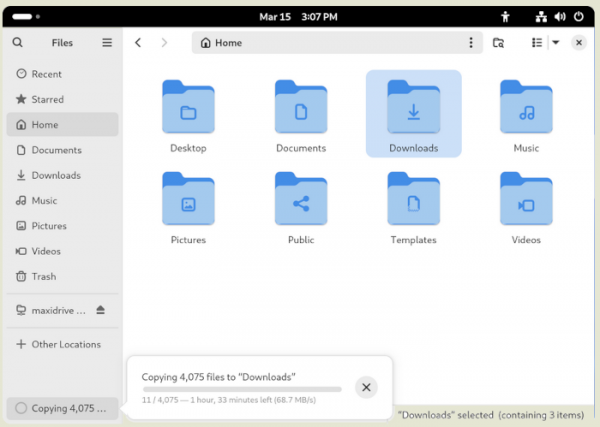
- Significant code refactoring and performance optimization have been carried out in the Nautilus file manager (GNOME Files). The issue of progressive rendering on the screen has been resolved — the window content now updates instantly. A new progress indicator has been added to the bottom of the sidebar for tracking lengthy operations, allowing users to monitor work in the context of individual operations and see at a glance which operations are in progress and which have already completed.

The file manager settings interface now includes a search function and an option to show more detailed information about date and time. For quick navigation to the address bar, you can now simply click in the area showing the file path. In thumbnail navigation mode (grid view), visual markers have been added to highlight favorite files marked with a star. The sidebar in the 'Other Locations' section now displays available network devices.
- The 'Online Accounts' interface, designed for managing connections to external services, has been significantly updated. Support for connecting to Microsoft OneDrive and setting up accounts for Microsoft 365 has been added. After connecting, a 'OneDrive' button appears in the file manager sidebar, allowing users to view the contents of their 'OneDrive' storage similarly to navigating local files.
The interface design for managing Online Accounts has been revamped. A new type of account—WebDAV—has been added, providing tools for accessing external calendar planners and address books. When connecting to accounts, the default web browser is utilized, enabling support for additional authentication methods, such as USB tokens.
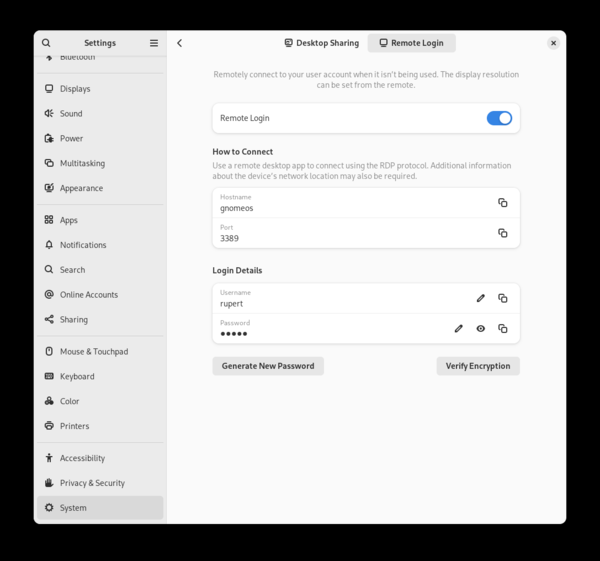
- A setting has been added that allows remote desktop connections using the RDP protocol, enabling the use of an external system as a fully functional workstation. Among other things, it is possible to connect to new systems and remotely configure screen parameters.

- The GNOME settings interface has been updated. Navigation through the settings has been simplified. A new System section has been added, consolidating options for localization, language, date/time, SSH, user accounts, and remote desktop connections. Settings for external drives and default application selection are now under the Apps section. Descriptions of settings have been expanded, and tooltips have been improved. Keyboard navigation has been enhanced, and content loading speeds for appearance settings have been optimized.
Touchpad settings have been expanded, adding options to configure actions for right-clicking, two-finger tapping, and corner clicks. A toggle has also been added to disable touchpad locking while typing, which may be necessary for some applications and games. Control settings for pressure sensitivity for Wacom styluses have been improved.
- Accessibility features have been enhanced. A temporary disable function for the Orca screen reader has been added, activated by pressing Ctrl+Alt+Shift+Q. A command has been added to Orca for providing system status information. Keyboard navigation through tables has been improved. Experimental support for the Spiel speech synthesis framework has been added.
- An updated set of placeholder avatars has been added for users who have not explicitly uploaded an avatar for their account.
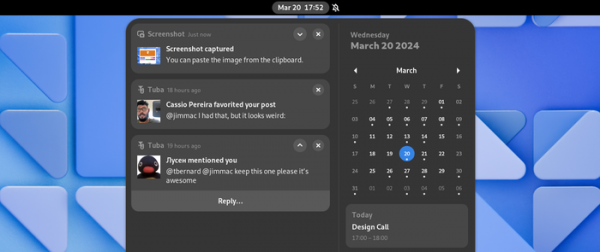
- The notification system has been improved. The header of each notification now includes information about the application that sent the notification. Notifications can be expanded in the list to perform related actions (such as quickly replying to a message).

- New keyboard shortcuts have been added to launch applications. You can use the Super+ and Super+Ctrl+ shortcuts to launch pinned applications by their number in the list (the second shortcut will launch the application in a new window).
- The on-screen keyboard has been enhanced with separate layouts for entering phone numbers, email, and URLs. The automatic capitalization mode has been added.
- Tap to click gesture processing is enabled by default.
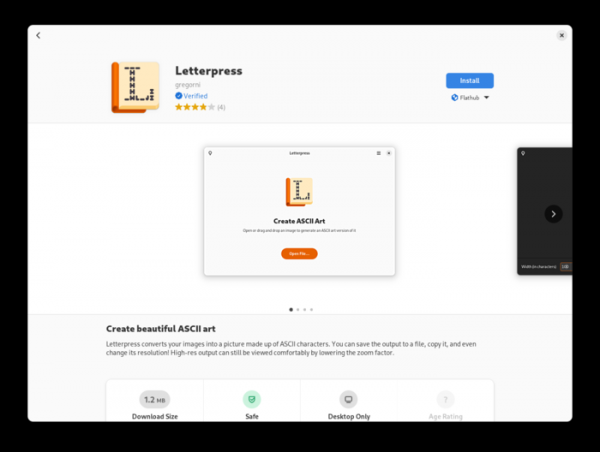
- The application manager (GNOME Software) has been improved to display special labels for verified applications from Flathub, which are published by the main project developers instead of third parties. The settings section interface has been changed. The ability to merge metadata in AppStream format from different sources has been added.

- In GNOME Maps, the interface for editing points of interest on OpenStreetMap has been revamped, route construction has been improved, dark theme support has been added, a new map display style has been introduced, and floor information is now displayed.
- The interface for managing GNOME Shell extensions has been revamped. Navigation through the list of installed extensions has been simplified. There is now the option to disable extensions that have been automatically deactivated.
- The design has been improved and the performance of the calendar-planner has been enhanced.
- A quick launch mode for the timer in the clock has been added (just click on the area with the time duration).
- The address book has been improved. The ability to import multiple VCard files at once has been added. A preview of the names of the contacts being transferred is provided in the import confirmation dialog.
- A new chart with statistics on input/output intensity has been added to the disk space monitoring program.
- Performance optimization has been conducted, and resource consumption has been reduced. For example, memory usage during searches has decreased, the performance of screen recording has increased, resource usage in the image viewer has become more efficient, and the terminal emulator has been significantly sped up.
- Malware protection has been enhanced in the image viewer and search system.
- Interface element rendering has been improved, text clarity has been enhanced, and output quality during fractional scaling has been upgraded. A new rendering engine based on the Vulkan API has been implemented in GTK, providing contour smoothing, support for an unlimited number of colors in gradients, and fractional scaling support.
- Experimental support for the Variable Refresh Rate (VRR) mechanism has been added. This allows for adaptive changes to the monitor refresh rate, ensuring smooth performance without tearing during gaming and video playback. To activate experimental VRR support, execute the command ‘gsettings set org.gnome.mutter experimental-features «[‘variable-refresh-rate’]»‘ and then enable VRR in the display settings.
- In the GNOME Web (Epiphany) web browser, closing attached tabs is now allowed; support for smart card authentication (PKCS #11) has been added; the context menu shown for links now includes an option to send the link via email (“Send Link by Email…”); support for accessing Google Safe Browsing servers has been discontinued; default actions for developers are now hidden in the context menu.
- Versions of GTK 4.14, Libadwaita 1.5, and WebKitGTK 2.44 have been updated.
- Dependencies in the Mutter window manager have been reduced. Dependencies like zenity, libcanberra, gnome-desktop, gnome-settings-daemon, gtk, json-glib, gdk-pixbuf, cairo, and X11 have been removed or classified as optional and are no longer required for building Mutter.

Source: opennet.ru
