

The AERIS-10 project has developed a fully open modular radar station that can be used as a platform for experiments with phased antenna arrays, pulse compression, Doppler signal processing, and target tracking. Complete schematics, circuit board layouts, Bill of Materials (BOM), Gerber files for board production, 3D printing models, and hardware block descriptions in Verilog/VHDL are distributed under the CERN-OHL-P (CERN Open Hardware Licence). The firmware code for the STM32 microcontroller, auxiliary utilities in C, and the graphical interface in Python are provided under the MIT license.
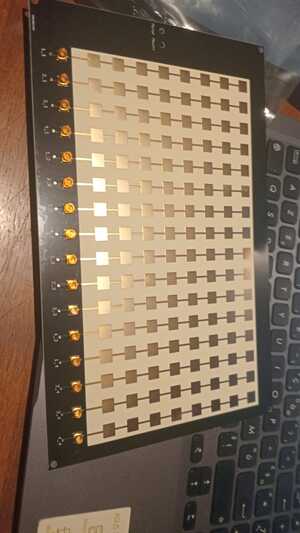
Two versions of the phased array radar station have been prepared — AERIS-10N (Nexus) and AERIS-10E (Extended). Both versions operate at a frequency of 10.5 GHz and utilize linear frequency modulation (LFM). The differences are in the power output (1W x 16 and 10W x 16), as well as the use of an array of planar 8×16 antennas and a slotted waveguide array filled with dielectric 32×16, providing a range of up to 3 km and 20 km, respectively.
The system is modular with separate boards for power management, frequency generation, and RF blocks. For signal processing, pulse compression, calculating the speed of an object using Doppler Fast Fourier Transform, excluding stationary objects (MTI), and maintaining a constant false alarm rate (CFAR), the FPGA XC7A100T is used. Control and configuration of peripheral devices are managed by the STM32F746xx microcontroller.
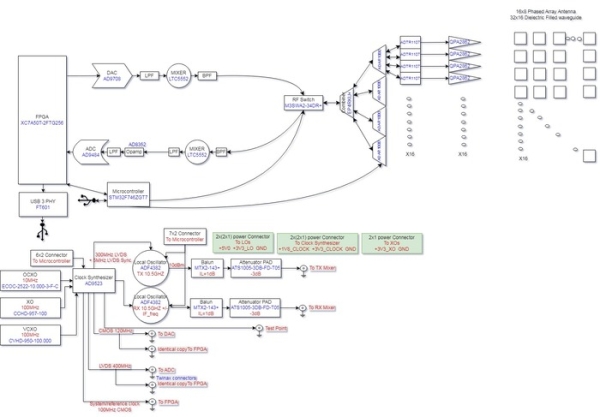
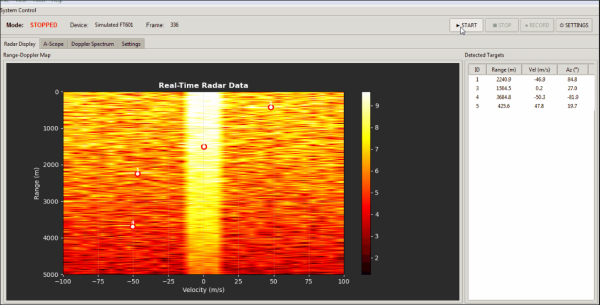
Real-time position and orientation adjustment is provided through GPS and inertial sensors (accelerometer, gyroscope). Electronic control of the scanning beam is implemented within ±45° in elevation and azimuth. A stepper motor enables 360° rotation of the antenna. Simultaneous tracking of multiple objects' movements is possible. A graphical interface has been implemented for radar control, visual tracking of moving objects, and their matching with a map.
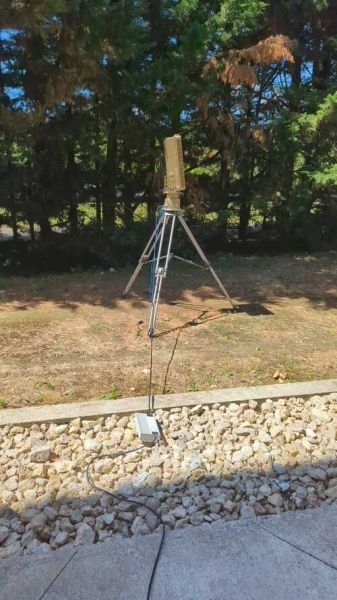
The radar assembly is made from standard components readily available on the market. The cost of chips and components for manufacturing a radar in its simplest configuration is estimated at approximately $5,000. In comparison, the price of commercial radars of the same class starts at $250,000.
Source: opennet.ru
