

Hello! Our third book has been released, and in the comments to the post, you asked why a publisher is actually necessary. In our case, it's doubly important because we work with print and have a distribution network — so why do we need a publisher?
The answers are pretty obvious on the surface — well, this isn't our business. But if you dig deeper, you can discover a lot of fascinating insights. I did some digging, uncovering half of what's going on at MIF. It turned out they quite openly share data and stories about what they do with books. It seems that we have somewhat similar launch processes (only they have books and we have games), but there are nuances.
So welcome to the post 'what you didn’t know about the Russian book market.' And yes, there are a couple of strange things.
An innocent question: so what does a publisher do?
Assumes the risks, provides services for book and layout preparation, distribution, PR, and promotion.
What kind of risks?
If you bring a manuscript to a publisher and it catches the editorial board's interest, the publisher may offer you to publish the book under the scheme 'we take the license, you get royalties.' That is, the standard story. Royalties, by the way, are 10% for print and significantly higher for the digital version. It's calculated from the publisher's shipping cost, which is approximately half the shelf price. When there are two authors, royalties are split in half, but it adds up to slightly more than 10%. I heard from Max Kotin about a maximum of 15% in other publishers, but I haven’t seen that. It might have been during the wild '90s.
So the publisher invests in preparing the book for print (which takes just under six months), the cost of the print run, and promotion. Altogether, it totals to over a million rubles (though most of this comes from labor). If the book doesn't succeed, you lose nothing because you didn't pay for the editor, proofreader, preprint, or printing of the run. You only receive a small amount in royalties.
For now, everything is as it is in the tabletop world. The entry rate for MIF in non-fiction literature is slightly higher, whereas the 'success' rate is slightly lower. Their approximate evaluation is 10:1, meaning that out of 10 books, one remains for a reprint. Recently, they updated their statistics for the 1st and 4th quarters of 2018 — every fourth book has a reprint. However, there are periods that are less fortunate.
Our exact estimate for last year is that 27% of games go for a reprint, with projections for this year at 34%.
What constitutes a good book in Russia?
Selling 3,000 books in a year is impressive. 10,000 is a bestseller (I previously mentioned 20,000, both estimates are subjective and derived from different experts). This refers to print, as print is the primary publishing format. However, in our specific case with 'Business on Your Own,' thanks to your unwillingness to compromise on delivery for a minimum of 1,500 rubles, electronic versions of the book sold three times more than physical copies. This is an extremely rare case for the market.
In the case of a board game, the story is quite similar, but we think in cycles. For us, the turnover of the print run is crucial, and in rare cases, the portfolio. This year, we aim for 1,000 boxes to be sold in the first month after the product launch (which occurs two weeks after the boxes arrive in the first store, as they have to travel all the way to Yuzhno-Sakhalinsk). Previously it was three weeks; now, specifically for Yuzhno-Sakhalinsk, Vladivostok, and Novosibirsk, the launches happen slightly later. So, selling 1,000 copies in the first month of promotion means intensifying the marketing efforts, essentially moving into category A. The print run over six months is similar. If a print run isn't sold within six months, and we don't need the game to build our lineup — we discontinue production. An example of a game we keep despite relatively low sales is 'Project Manhattan' (but right now, the last print run has passed, and there is no new one yet).
We print the first runs of 2,000 to 5,000 copies for games. For books, MIF typically prints 3,000 to 5,000 copies for business and self-development topics, and slightly more (4,000 to 6,000) for children's and parenting subjects. In the fiction segment, the print runs are larger, especially for top authors. For example, Pelevin might have an initial print run of up to 70,000 copies, depending on the promotional budget. If a book has already performed exceptionally well in Western markets and there are strong expectations from networks, the first print run for non-fiction can reach up to 10,000 copies.
What are the book and layout preparation services?
These are services that can be purchased separately on platforms like Ridero, from freelancers, or at advertising agencies, but they are included in the publishing package. They are done more qualitatively and with accountability for the final result compared to external sources (as there are no 'gaps' at the intersections).
Function editor — he acts like a product manager. In our case, he keeps track of the logic ('this chapter goes here, this one is out, this part is unclear, and here's an additional chapter that needs to be written, on page 115 give a table with numbers instead of poetry, oh, not that large, let’s use smaller numbers') and so on. He is the most useful person if you are not writing popular science. The editor ensures that the finished book is good for the reader, not for you. According to the contract, there are sometimes misunderstandings with the author, which is why the basic version includes strict clauses stating that the editor is always right from the third round of edits. My editor for the third time was Tatyana Rapoport, and everything went perfectly. Special thanks to Olga Svitova; it seems she was the one who analyzed individual sentences in the style of: 'this is what you wanted to say, but this is what the reader will think.'
Scientific editor — so, if you're writing popular science, you always have a major companion breathing down your neck. More precisely, someone who knows the subject matter. MIF finds university instructors on the topic (usually PhDs) and negotiates with them. You could probably find a scientific editor on your own, but there will be some kind of guarantee that you both are responsible for the text's accuracy. Here are books with scientific editors.
Then proofreader — he checks for errors and corrects them. My experience with proofreaders has always been disappointing due to the colloquial language that just drives them crazy. They also love to replace precise terms with synonyms (which happens after the third proofreading pass post-editor), introducing sweet notes of madness into the text. Keep an eye on the proofreader's hands. He can be dangerous. However, often it is the proofreader who helps gain another perspective and untangle very complex phrasing. So when the urge to kill him passes, you start to realize that he is a good person. Sweet and kind. This cycle happened all three times: at first, you see a bloody mess of edits where your text was, and then you understand how much they helped you. The proofreaders in this book are Nadezhda Bolotina and Anna Ugryumova. Two, because I’m a grumpy geek who can drive anyone mad. Thank you. And sorry for the battle over the economic term 'butt.'
Cover Designer — a subordinate of the art director (whom you won’t see) who draws the cover according to your wishes — if lucky — and fits it into the publisher's style, series, and customer expectations. Our practice is to walk around bookstores with our books and place them on shelves, then observe. For example, our Elina, who wants to write a book about sales, recently experienced a mental trauma at 'Chitai-Gorod' due to the illogical layout. When she tried to arrange the book mockup, choosing between a blue and a red cover. It was Darya Kazakova who worked on it, and Alexey Bogomolov approved it — we didn’t communicate much, but everything went very quickly and professionally.
Typesetter — he is just a typesetter. I also have a grudge against him for the missing letters ё and жёсткие from the text and the awkward line breaks (some of which are not very good for the language) in the electronic version. All books on the tablet are like books with logical formatting, but my third one has a hardcover style. Perhaps this is because the tables were inserted as text rather than images. And it was important for him to maintain the pages. But overall, the typesetting at MIF is quite good, according to Chikhold with its modern adaptations. This book was done by Ekaterina Matusovskaya. Our communication was limited to a nod at the end of the typesetting.
Author Relations Manager This is the main person on the project who is responsible for interacting with the authors. This is a new role; when we published for the first time, we didn’t have this. The manager ensures that you fill out the brief for the cover, sends the book to your friends for reviews before it’s published, collects your biography, oversees the iterations of edits, and so on. I also send all the bug reports to this wonderful person, and then the magic happens. In general, it’s just a single point of contact. Instead of waiting two weeks for tedious approvals, they arranged a meeting to find out how everything is going on your end. This person is the best in the project. Taking this opportunity, I want to thank Anastasia Dyachenko.
Illustrations If you need illustrations in the book, it’s better to bring good ones along with the manuscript or later. But sometimes they are ordered within the publishing house. Then the retail price jumps because the cost of the images has to be spread over the first print run, and the printing cost will also increase. Sometimes images are needed for the text, and sometimes the author simply requests drawings. The latter is discussed. In our case, we go without illustrations. In the tabletop world, we usually order good art 99% of the time because books are chosen for the text, while tabletop games are chosen for the atmosphere. Therefore, expenses for artists and management of the process occupy a large portion of the budget. We can afford very good artists, not just from Russia. When we browse social networks and look at images, sometimes when we see the right setting, the script “find the author and send to the publisher” kicks in.
Preparation of the print run This includes prepress and other related tasks, but we will skip them because they are usually part of the printing service itself. I haven’t seen anyone or anything there.
UPD: Here’s more about how the publisher legalizes your profit. This means you don’t need to register as self-employed, set up an LLC, or deal with accounting.
And since I started with thanks, I’d like to give a special thanks to the lead editor Renat Shagabutdinov (who is responsible for the overall concept), Vera Yozhkina, without whom the first book wouldn’t exist at all (I mistakenly thought she had left MIF, but she has been promoted), and Artem Stepanov (the head of the editorial team, who openly answered all questions five years ago).
Stop whining. Let's get back to business!
What is important in distribution from the publisher?
So, you've produced the goods. They are stored in your warehouse in boxes. You can sell a portion yourself, but in most cases, you don't have a proper retail outlet, and you need to hand them over to someone for stores. Naturally, retailers will try to pressure you because they want to profit from the goods themselves rather than share a significant portion of the money with you. If your product is in demand and indispensable — you can push back against the retailers. However, more often than not, it happens the other way around, as you know there are millions of alternatives on the market. All purchasing negotiations are conducted on this fragile equilibrium.
We cheated a bit and implemented vertical integration, as about 40% of the tabletop games (revenue share, less than 5% by product matrix) are produced in-house at our publishing house. This means we've addressed the retailers' main fear — being left without products — right away. However, Monopoly, for instance, is supplied with a very small markup; it is needed in stores, and people would be puzzled if it were missing, but we don't earn the majority of revenue from it.
So, professional players already have an established equilibrium where shares are distributed, and everyone in the chain is satisfied. First, there are agreements with retailers, meaning there are formal supply contracts allowing for immediate shipments. Concluding a supply contract with a small chain takes about 2 months and at least 50,000 rubles in expenses (including legal fees), whereas with a larger chain, it can take six months, and you need a dedicated person to oversee the terms (because they typically impose hefty penalties for every little mistake). Supplying goods to us versus Auchan is two very different things. In our case, if you shoot yourself in the foot, you'll find a lot of shrapnel in your ankle. In the case of a large chain, you're shooting yourself in the foot with a W-54 round from the 'Davy Crockett'.
The third feature is that publishing managers can explain to all market players why they should specifically take your book. But more on that later. In general — people take specialized products from those who know their stuff. That means they buy a lot. Because the main thing in this field is trust in processes and people. It usually establishes over a period of 3 to 5 years. Without this timeframe, you simply cannot reach full volume.
We especially feel this acutely in our work with Germans, because for them you are just noise for the first 6-8 years. Only then do they start to notice you.
What about the promo and PR that are included in the package?
If you have read and thought carefully about everything above, you may have noticed that you won’t be paid much for the book. I mean, it's clearly not a source of income. Thus, the budget for promo will be even less. Significantly less. Or the book will become a golden spine on the shelf and won't sell at all.
Therefore, content marketing methods remain, including SEO, co-branding, guerrilla marketing, mediators (now called influencers), and classic PR. A certain amount of the budget goes into performance (like contextual advertising), but the main work is done far from there.
MIФ has a huge readership base on social networks and in their newsletter thanks to their excellent content marketing. Just over a million reads per month on the blog, 450,000 contacts in the newsletter, 330,000 followers on VK, about 225,000 on Instagram, and around 200,000 on Facebook. And the site's audience. These are the people who should read about the book and buy half of the first print run. Then, if they like it, they can tell others and start a wave.
The second half will go to partners. Yes, MIФ sells up to 50% of the first print run through its own store. No one else in Russia can do that. But still, the audience is quite specific. And sales at the start don’t always determine long-term success. Meaning, the fourth month is telling. That's when the book either 'catches on' in physical stores and starts selling, or when it doesn’t get picked up off the shelves. Stores need to monitor revenue per square meter, i.e., shelf turnover. So if something's off — you get kicked out with a sound 'thud'.
PR really helps offline. It also helps when the book doesn’t reach MIФ's direct audience. There’s quite a lot of lifestyle and popular science content, so books that are further from the mainstream may not hit the target accurately. Therefore, PR. In our case, we have a lot of our own PR and through the publishing house.
Here is a list of publications for 'Just Cosmos' by Ekaterina Lengold at the start.Sorry for the subject matter, but it’s precisely from this book that we managed to highlight the key points initiated specifically by the publisher:
In our case, there were more publications under 'Business as Games', but we worked from both sides there. In the case of 'Business on Your Own', there are fewer publications, but they have not all been released yet, and Forbes is already there. The journalists predictably took the chapter about why we should pay taxes at all, just like last time when they all took the chapter about 'Welcome, not go to hell'.
Mediators: MIF has a readership base capable of influencing others. Most often, these are bloggers and well-known people. They simply send them books. I once came to the office and found a package of business books from them with a note saying, 'You will like this.' The logic with me is simple — I do reviews of useful books for the year, and if you give me about 10, then something might catch my interest that I otherwise wouldn’t have read. For some bloggers, it is important to receive a book before it goes on sale and be the first to talk about it; for others, it’s merely related to their blog topics, and so on. I can say that this part has been perfected over the years at MIF, and they are just market giants. We envy them greatly and now want to emulate them with board games as well.
They have almost no guerrilla methods. In the sense, it usually relies on the author. Right now, you are witnessing one such method through this classification, and have already read more than half of the message.
We had a legendary failure with performance. The book title 'Business on Your Own' appeared to Google's ad-checking neural network as an advertisement for microcredit organizations. And that is prohibited. So it didn't make it into the context.
There can also be peculiarities when the title consists of 7 words — complex search queries.
You will have access to the full range of opportunities under three conditions:
- You appeal to the red council and the promotion team, meaning the publishing house will invest in your promotion.
- You fall into the release matrix (books on the same topic or in the same series but stronger do not get released alongside yours). The release matrix is distributed, of course. This affects the timeline—it may add a month to avoid overlapping with another book aimed at the same audience. Because the average reader can manage no more than 2 books a month. Our games are released less frequently, but we also stagger announcements, trying to focus on no more than 1 children's and 1 adult A-new release in the board game spotlight each month.
- You will grant the publisher exclusive sales rights for the first two weeks. Considering your blog channel and other factors, MYTH prefers to use each book as leverage to gather readers. This means that when you purchased from them, rather than from us during the exclusivity period, the following transaction occurred: we shared our audience with them. In return, they invested more effort into public relations.
The PR service can be purchased separately from the agency, but it will be unrealistically expensive since the agency is not a source of books. In other words, it does not hold the same authority. Additionally, the distribution service cannot be bought separately, or it will turn out to be more expensive than reasonably feasible. Therefore, you have to endure for six months and be with the publishing house.
Why six months?
Because the book publishing process is linear, and there are almost no parts that run in parallel. Unless the cover can be designed while the editor is polishing the text, many overlapping projects require checking at each stage and working with a multitude of external people, such as the scientific editor. Before you know it, you're smoothly entering the four-month mark. Another two months for pre-press, printing, and logistics to the warehouse. It can be done faster, but then the process turns into overnight office sessions. The same applies to us; the timelines for localization and for developing the board game are similar. In localization, the main bottleneck is international coordination, while in development, it's the artwork and component design calculations.
What can the author do?
As I mentioned before, the success of a book depends not only on the quality of information, the level of language, the cover, and such, but also on who the author is and what they can do. If you, like Batyrev, speak at conferences and seminars, and, for example, assign the audience to read your book, there will be hundreds of sales each time. Naturally, printing is profitable.
However, it turns out there are other factors. Firstly, distribution really favors series. Specifically, if the first book of an author sells well, the second will be considered a sequel, and it will be picked up more easily. The third book in a successful series is already a very good plan for everyone. We are currently reaping the rewards of this unexpected bonus. When I mention 'series,' I mean less the likes of 'Secrets of a Gardener' or 'Self-Development,' but rather collections of several books by the same author. A general series also matters, but not as significantly as direct analogs.
Here are the series from MIF (the logical division may differ among other publishers): 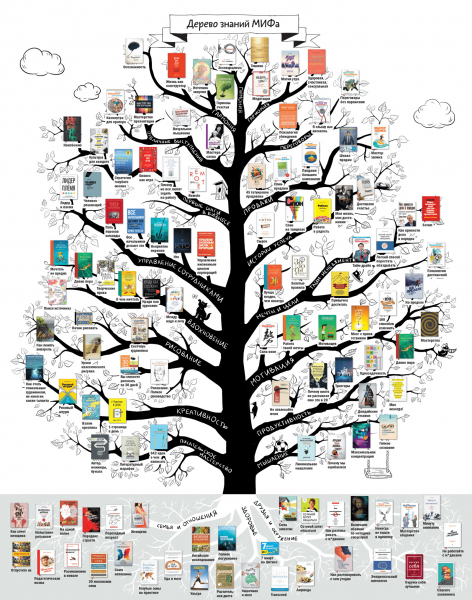
Notice the series 'Mogivlitsia'; it is one of the most important.
Secondly, the author can help with promotion not only through their social media and friends. Sometimes, they also need to review their own book in various stores. It sounds odd, and I haven't done it and don't plan to, but here's an example. Quite ethical and nice: the top review is actually from the author.
"This is done for Labyrinth's own audience. They have a substantial one, with people who buy books exclusively there. Such reviews always appeal to them."
Ray Dalio actually made videos on YouTube about his book, but regarding the English version. It was almost like a course.
It’s important to apply for awards. If it’s popular science, the main one is 'Enlightener,' which attracts a lot of PR. It has a block for humanitarians and a block for techies.
We had no idea about business awards, yet we won 'Best Business Book of the Year' from PWC. There are simply no others, and we learned about this award almost at the moment of winning — I didn't want to attend the invitation to the International Economic Forum; I wanted to finally get to Madagascar. Since then, there has been Ebola, plague, and this year’s expedition fell through, so I never made it. They had to directly say that I, looking this good at the forum, was of no use to anyone, but I would be awarded the prize. Hence, it's important to be involved. The award turned out to be a significant plus: it brought both PR and a cash package. More than royalties for three years. Later, journalists from Astrakhan confused everything and made me out to be almost an oligarch, but that’s a separate hellish story of how I managed to fend off students on Vkontakte.
Where do books end up?
In my estimate, over the past five years, there has been a shift in non-fiction from 1/10 officially purchased electronic versions to a print circulation of about 50%. Right now, that's not the case with us; our electronic sales currently exceed print significantly. This pleases the publisher because the cost of electronic publishing is much lower, leading to higher profits. However, when the book reaches stores and starts selling in retail, this ratio will shift.
There are also online players that sell print books, such as Ozon and Labirint. Labirint are particularly shrewd partners of MIF and step in where MIF is unable to keep up. In our case, many sales were lost due to the minimum order of 1500 rubles from MIF’s website. This is a restriction from the delivery service, and MIF is currently trying to work around it, which has been frustrating for them due to lost orders. So, Labirint simply aggregated these orders. They offered pre-orders with a good discount. When the book arrives, they’ll just send out half of their batch in the first few days. I was also running around in disbelief at the phenomenon of people ready to order products, pay for shipping to the other side of the world, but not wanting more than one book. I prepared a scenario to intercept orders but decided it wasn't very ethical. We promised exclusivity. We promised to adhere to the MSRP policy.
Oh, and one more thing. During the sales of 'Business for Yourself,' many ordered 'Business as a Game,' the first book in the series. But it's sold out. It's only being reprinted now. The Habr effect and surprise. This added a sense of joy while observing Labirint's actions.
So, back to distribution. There are also retail chains and small stores that somehow managed to survive without consolidation (although it’s been a trend in the book market for about five years). MIF partners with EKSMO (for those who didn’t know), so they deliver books to their warehouse, and from there, they are sent across the country to places like Chitai-Gorod, Respublika, Bukvoed, and other wonderful locations. Yes, here's a on Kommersant about the development of the book network for the next 5 years, with an interesting ownership structure.
Online distribution is like LitRes, where electronic versions of books are available.
Different publishers have varied networks. For example, Alpina isn't available on Labirint, while MIF isn't found on subscription services like Bookmate. By the way, the reason is due to complex royalty calculations, where accounting is based on read chapters (a percentage of the book), and the subscription amount is divided by the number of chapters read. Given that this model is not very widespread in Russia, revenues are currently minimal, while the accounting hassle is significant.
Print books resonate better with the older audience, who buy at bookstores. The electronic version appeals more to the younger crowd and those familiar with IT.
In offline retail, the price of a physical book often exceeds the recommended retail price.
Moreover, books end up in the hands of pirates. In the publishing house, there is a dedicated person who monitors the first three months of new releases on pirate trackers and file-sharing sites like VKontakte, and then checks the entire site upon finding a copy, taking legal action to try and halt the distribution. Unfortunately, they haven’t been able to shut down VKontakte. As the employees commented: 'There is only one—unique case—when the author does not attempt to fight against piracy.' That’s about me. Pain, confusion, and this phrase were evident in their eyes:

But they were very correct and polite.
What will people say about your book in the distribution network?
The process is similar to ours, but the details differ.
An important part is here at the 'battle card' stage, where materials are compiled into something a seller can work with on the ground:
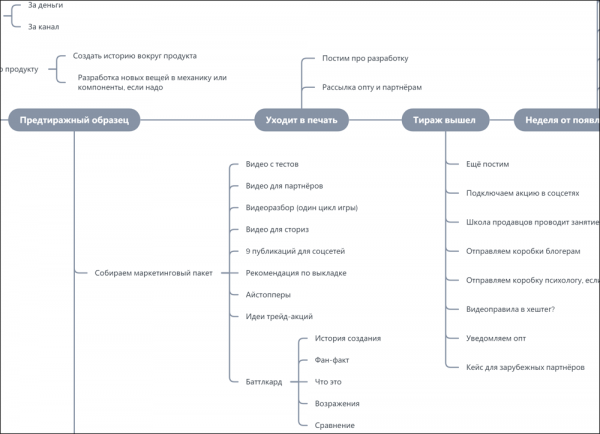
We can influence the sellers. The publisher cannot. We can go somewhere and play a game, but collective reading of a book won't work. Therefore, they influence distribution (as do we, but their process is more complex and refined).
In the book world, managers will create a presentation about your book, send it to networks (for major networks, separate versions with details of interest, for smaller ones—a general version), noting whether it's a focus project or not, what the print run is, what promo is planned, what PR there will be, what to expect, which series, who the author is, why they are great, and so on.
Trends are always highlighted (this is requested by networks to understand where to position the book). Here’s a quote from the brief about us:
MIF Theme: Management
Tags: Company Management, Management, Small Business Development, Entrepreneurship
Who writes the book card for the website? If it's the MIF site — they do. If it's a store's site — the store does. But MIF has a unique thing. They find and verify all descriptions of their books from all online stores. And they ask for additions, send content, and so on. We don't do that, for example, but I feel like we should.
Seasonality also plays a role. Releasing a business book in summer is not a great idea (we did this), because everyone is on vacation. But we will have paper on shelves across the country in August, so it's not the worst that could happen.
Some books are clearly gift-worthy, it's better to release them in December.
Also, regarding seasonality, exhibitions are important for focal projects. There is the "non/fiction" exhibition in Moscow, where it's important to stand with a booth and present new releases to journalists. It takes place at the end of November. There is also an exhibition in Frankfurt in the fall (this is like our Essen, the main event about partners), but currently MIF is mainly buying licenses there and selling very little. I mean, only children's books are succeeding abroad for now. This makes sense. A book with the subtitle "The Pitfalls of Russian Business" is unlikely to be needed in France. In mid-spring, there is a big exhibition in London as well.
Renat:
"Publishers from Russia and other countries have always bought and continue to buy there, and it will always be this way. But we, like colleagues from other publishing houses, have already started selling rights for books by Russian authors into other languages. Mostly for children's books, but we've had some success with adult books too. This year we had our first booth — at the international exhibition in Bologna, which is the number one exhibition for children's books."
What's next for promo?
If a book 'sticks', then people will recommend it to each other, gift it, and so on. If not — well, oops. The life cycle is several years because the older the book, the harder it is. A continuation of the series or some actions by the author help. It's hard to promote old books without the author's involvement. Sometimes certain books get a boost on the site during sales or in the promo block for a week, but that's probably the maximum.
How to check if your envisioned book is great?
A standard method is to count your subscribers, assess their interests and language, and then send the table of contents along with five characteristic chapters to the publisher. However, there is another way: blog testing. If your posts are well-received on Habr, that indicates a certain level of coolness. Moreover, MYTH suggests writing for their blog after their editor, and if it does well there, it's a signal for them that the first print run will go to their audience. This means you can write several posts and see what captures their audience's interest. Poorly received likes mean don't include it in the book. Well-received ones mean do include it. This is how Larisa Parfentieva wrote two bestsellers on ways to change one’s life. It suggests to me that she changed at least one life (her own) thanks to such calibration for the audience.
Just keep in mind that some books are targeted towards a different audience. They are promoted through other channels primarily.
Total
Yes. The book has arrived at Mosigra. We have a 10% discount on everything, including books, for the keyword 'Habrhabr'. This applies in any store in any country, but the book is only available in Moscow and for delivery from Moscow's online store. We can ship globally via EMS, there is no minimum order volume, but the shopping cart is a bit poorly designed (because we haven't yet rolled out a new major version of the site, sorry). And this is what the Habr invasion looked like. . But this time it will be calmer; the main blow fell on the publisher. So, here is .
And the moral of everything stated above is this: you can quickly print a print-on-demand run of 5 copies, get a proofreader and an ISBN from Yekaterinburg's Ridero. They are cool and unexpected, better than the local print shops. I even printed a semi-annual report there. If you just need a book 'to have' — any publisher willing to take you will do. But it’s better to choose based on distribution network and promotional opportunities. Promotional capabilities depend on the profile of the publisher and the audience. I would say you should consider MYTH, Alpina, and Peter Press for hardcore IT non-fiction.
Enjoy.
Source: habr.com
