

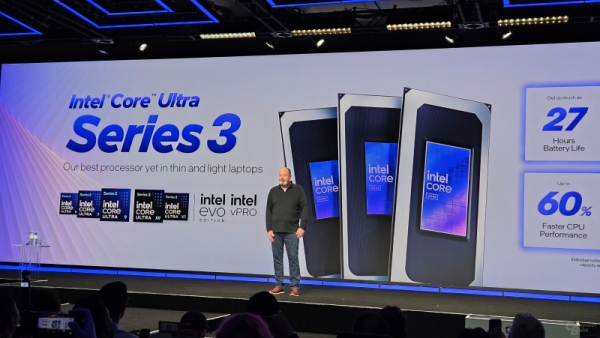
Today, the first independent reviews of Intel's new mobile platform, Panther Lake, have been released. The processors are built on Intel's proprietary 18A technology process (1.8 nm). Some models suggest feature the next-generation Xe3 integrated graphics. Today's reviews primarily focus on this aspect.
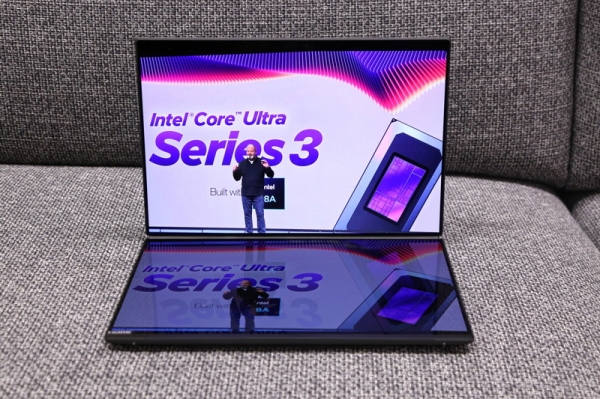
Most reviewers tested the hybrid laptop model Asus Zenbook Duo, equipped with two screens and the flagship 16-core Core Ultra X9 388H processor. The chip comprises four P-cores (up to 5.1 GHz), eight E-cores (up to 3.8 GHz), and four LP E-cores (up to 3.7 GHz). The processor also features a 12-core Intel Arc B390 graphics accelerator based on Xe3 cores (up to 2.5 GHz). One of the laptop configurations offers the Core Ultra 9 386H processor with the same number of P-cores (up to 4.9 GHz), E-cores, and LP E-cores, but with Intel Arc graphics based on four Xe3 graphics cores (up to 2.5 GHz). The configurable TDP of the Panther Lake processors ranges from 25 to 80 W.
The Asus Zenbook Duo model with Core Ultra X9 388H, which has participated in many reviews, does not feature discrete graphics, meaning reviewers conducted tests using the integrated version. The results showed that the new Intel graphics outperform the integrated AMD Radeon 890M found in Ryzen AI 300 at the same power consumption. Furthermore, in some cases, it reaches the performance level of the mobile GeForce RTX 4050.
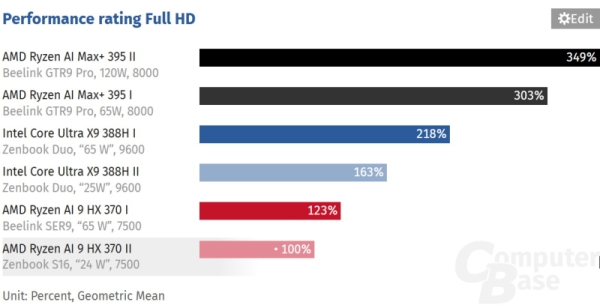
The Computer Base portal tested the Core Ultra X9 388H with the integrated Arc B390 on a laptop with LPDDR5X-9600 memory. On average, in gaming at Full HD resolution, the Arc B390 graphics proved to be significantly faster than the Radeon 890M, both at a power consumption mode of 25 W and at higher set TDP values. The portal also noted slight changes in performance when the laptop operated on battery power versus plugged in. Overall, the Arc B390 was up to 63% faster in the 25 W mode compared to the Radeon 890M in the 24/25 W and even 65 W modes found in AMD Ryzen AI 9 HX 370.
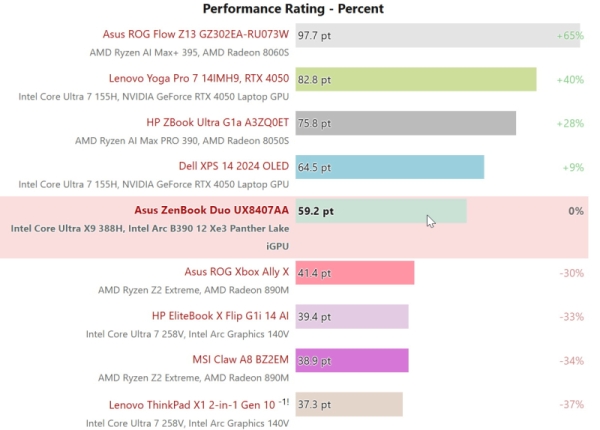
In several tests by Notebookcheck, the Arc B390 graphics card showed results close to those of more energy-efficient GeForce RTX 4050 configurations for laptops, depending on the game and power limit. The Arc B390 significantly outperformed the integrated graphics Arc 140T and Arc 140V found in Core Ultra 200 processors, as well as outperforming the Radeon 890M. The integrated graphics processors in AMD Strix Halo chips (Ryzen AI MAX) remain faster but operate at much higher power (up to 120W).
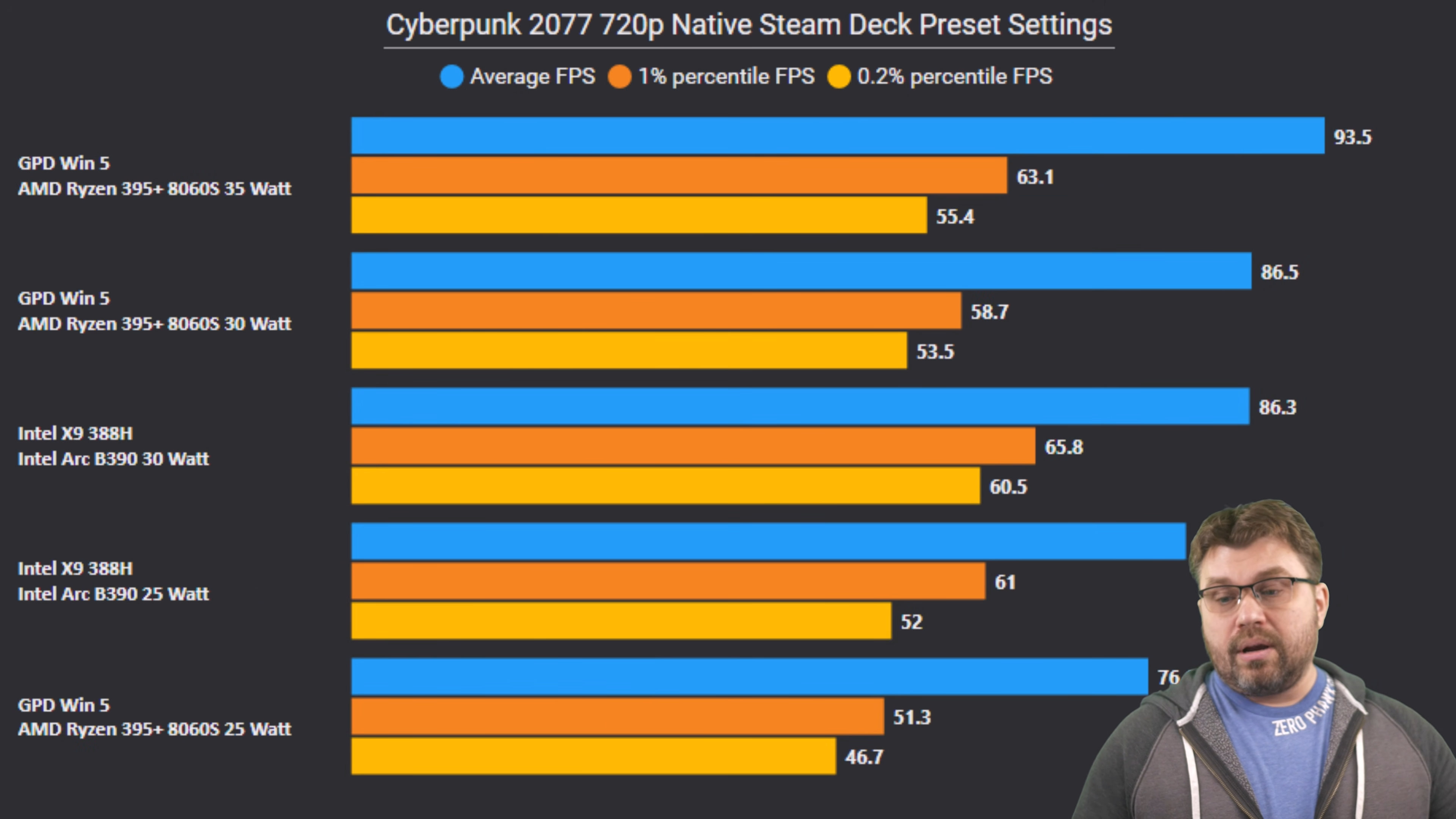
Blogger Phawx emphasized in his tests the importance of power limit (power consumption) modes for portable gaming devices. He conducted tests on the Intel Arc B390 integrated graphics at power consumption levels ranging from 10 to 35W. At the same power consumption, the Arc B390 outperformed the iGPU in the Ryzen AI 9 HX 370 in several games, including projects with low settings, and predictably increased the gap at power consumption levels above 20W.
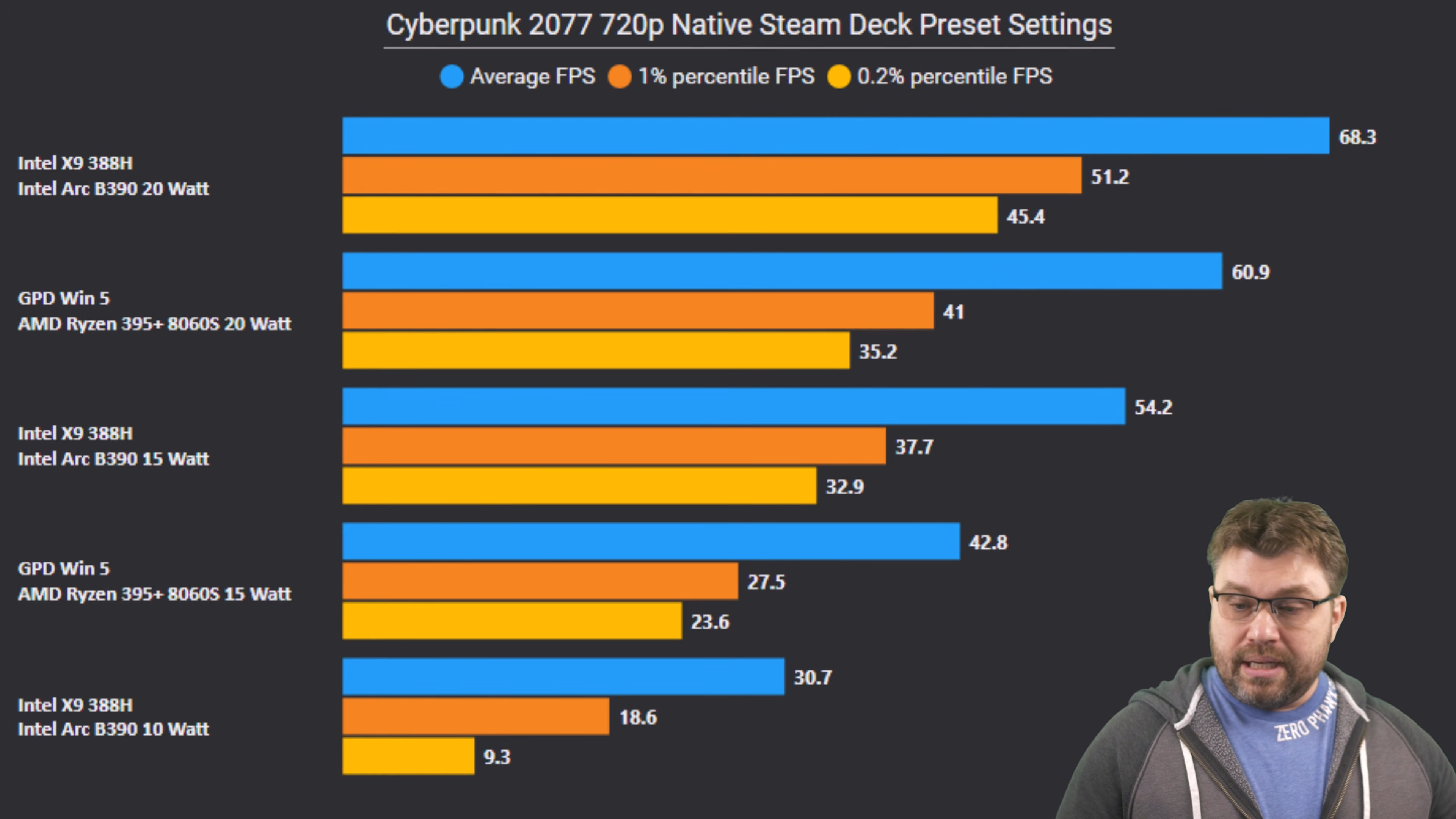
Similar results were obtained by the YouTube channel Hardware Canucks:
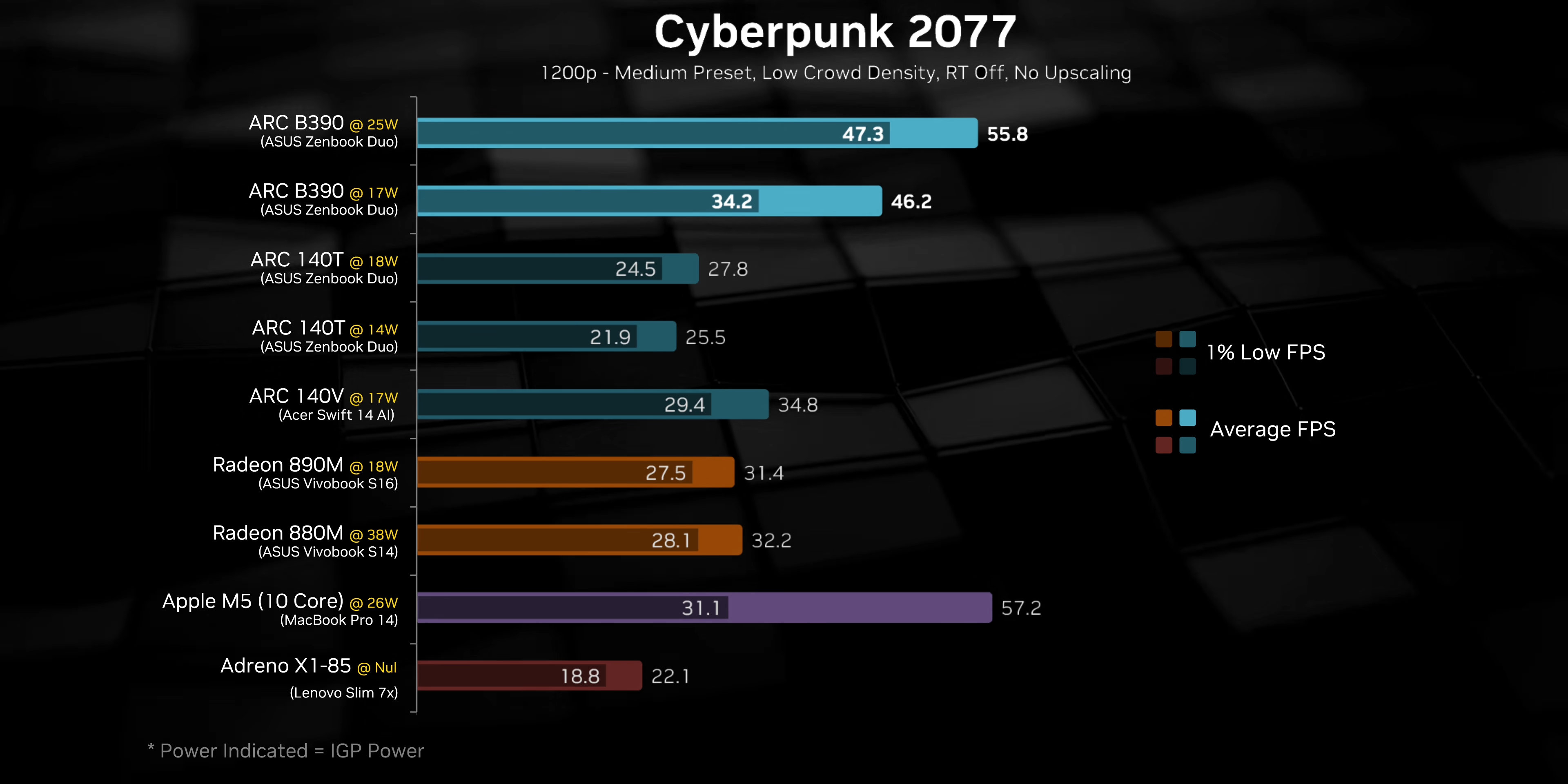
It should be noted that these comparisons cover only the flagship integrated graphics of Intel on the Xe3 architecture. The Panther Lake processor family also utilizes the Arc B370 integrated graphics based on 10 Xe3 cores, as well as offering 'integrated' configurations with four or even two Xe3 cores, which will clearly demonstrate lower performance than the Arc B390.
Leaks suggest that Intel will continue to develop the Xe3 architecture. It will not stop at Panther Lake. Next year, the Xe3P graphics architecture will debut with Nova Lake processors, often described as a 'full implementation of Xe3.'
Source:
Source: 3dnews.ru
