

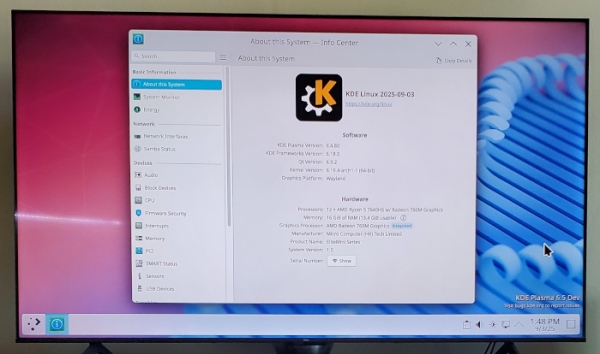
The KDE project has released the first alpha version of its own KDE Linux distribution, which is positioned as a reference implementation of a Linux distribution for the desktop and KDE applications, optimally integrated with KDE technologies and developed directly by KDE developers without intermediaries. System images (5 GB) are available for installation to create bootable USB drives that operate in Live mode.
The distribution is based on the Arch Linux package base but is presented as an indivisible image that does not use separate package segmentation, mounted in read-only mode and updated atomically. Components, besides the basic system environment, are built from source code using kde-builder or provided as Flatpak packages. The distribution supports reproducible builds, allowing anyone to verify the build process of the distribution. All user (/home) and mutable system data is stored in encrypted partitions. The bootloader used is systemd-boot, which supports booting only in EFI mode.
For updates, two disk partitions are used — the update is loaded into a passive partition, which becomes active after a reboot, while the previous active partition is switched to passive mode and awaits the next update installation. In case of issues after an update installation, there is the option to roll back to the previous system state. Switching between different system states is implemented through the Btrfs snapshots mechanism. The system uses the systemd-sysupdate component and the updatectl utility for installing updates with an atomic partition replacement mechanism.
The system is separated from the applications — additional applications can be installed in the home directory in Flatpak, AppImage, Homebrew, or Snap formats. Additionally, it includes the Distrobox and Toolbox tools, which allow the creation of containers in the home directory for installing arbitrary packages from other distributions. Users can also utilize the systemd-sysext utility to install system extension images (System Extension), whose contents overlay on the /usr hierarchy using OverlayFS.
The Alpha release continues the development of the KDE Linux Testing Edition established in early August, designed for testing, quality control, and tracking the development process of the next KDE release. This edition is aimed at KDE developers and users who wish to participate in quality control, testing new features, and identifying bugs. In the future, there are plans to create an Enthusiast Edition for enthusiasts and experienced users, providing access to the latest releases and beta versions of KDE Plasma, as well as a Stable Edition offering final releases after additional testing and stabilization.
The Alpha version has certain limitations, including support only for UEFI systems, lack of a UEFI Secure Boot loading option, inability to load new kernel modules during operation, an incomplete interface for system and application updates in Flatpak format, and the absence of support for older NVIDIA GPUs (only GPUs based on the Turing architecture (GTX 16xx) and newer are supported, as licensing restrictions prevent including proprietary modules for older GPUs). Only a graphical session based on Wayland is available for use.
Source: opennet.ru
