

The first public release of the VitruvianOS project has taken place, which has been developing an operating system based on Debian/Linux since 2019, bringing the simplicity, responsiveness, and flexibility of BeOS to modern hardware and achieving API compatibility with applications created for Haiku and BeOS. The project code is written in C++ and distributed under the GPLv2 license.
VitruvianOS uses user space components from Haiku OS. Instead of traditional window managers like X11 and compositing servers Wayland, VitruvianOS employs app_server — a graphics server from Haiku, adapted to work over Linux KMS/DRM. The graphics toolkit uses the Interface Kit implementation from Haiku. Instead of systemd, it is planned to use the initialization system janus_daemon in the future, which will function like launch_daemon in Haiku.
To implement most of the BeAPI, a custom version of the libroot library is used, which wraps many non-standard Haiku/BeOS functions on top of Linux, allowing applications to run and higher-level Haiku OS components to be utilized on a standard Linux kernel. To achieve specific Kernel Kit functions from BeAPI, a kernel subsystem Nexus is developed, implementing the node_monitor API, device tracking, and messaging in the BeOS style, enabling all specific Haiku/BeOS technologies to function on a Linux kernel.
Currently implemented:
- Booting from XFS and SquashFS file systems with full support for extended attributes (xattr).
- Modified Linux-rt kernel for improved responsiveness during desktop tasks.
- Compatibility layer with BeOS/Haiku API supporting native applications.
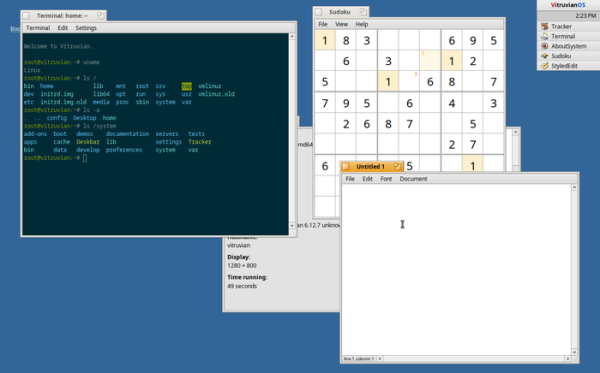
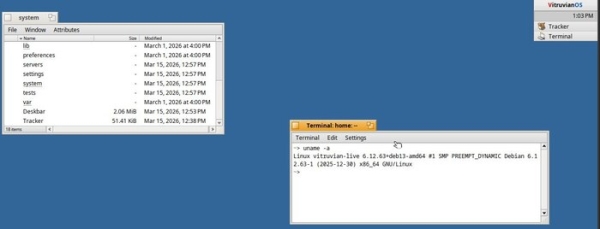
- Deskbar, Tracker, and key components of the Vitruvian desktop.
- Input system supporting mouse, gestures, tablets, and more.
- A specially designed graphics layer (without using X11 and Wayland).
Planned:
- Version 0.3.1 will include many missing components and fix bugs based on early user feedback.
- Version 0.3.2 is expected to create a self-sufficient system where VitruvianOS can compile itself.
- Version 0.4 will focus on stabilization and expanding hardware support, including continued development of the ARM version (arm32 and aarch64).
Source: opennet.ru
