

After five years of development, the Linux Foundation has introduced the release of SEAPATH 1.0, a virtualization platform designed to meet the requirements of information systems for digital substations in power grids. The platform takes into account the specifics of power networks but can also be applied in other areas that require high reliability. The platform's code has been released under the Apache 2.0 license. SEAPATH 1.0 has been recognized as ready for industrial use and for application in mission-critical systems. The platform is already operational within the infrastructure of the energy company RTE and is undergoing pilot implementation at companies such as GE Vernova, Alliander, ABB, Red Hat, and Enedis.
For monitoring, automation, support, and management of energy flow distribution at digital substations in modern power grids, specialized applications from various providers are used, which are recommended to run in isolated virtual machines. SEAPATH implements a platform for organizing the operation of such of virtual machines, virtualized applications (vPAC — Virtualized Protection, Automation and Control) that can run in real-time.
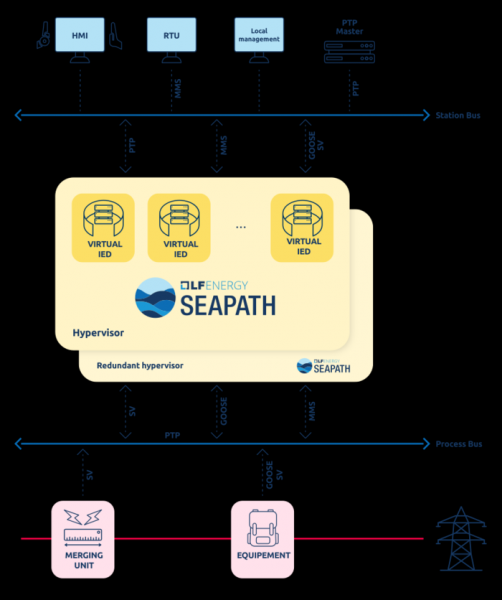
To deploy nodes with the SEAPATH host environment, two distributions based on Debian GNU/Linux 12 and Yocto Scarthgap are provided. The platform is not tied to any specific hardware, is independent of individual vendors, and can be used on various types servers and hardware architectures. Applications for electrical substations that support the IEC 61850 standard are permitted.
Fault tolerance is ensured by using clustered configurations with hardware redundancy and by placing data and virtual machine images in distributed storage, replicated across different cluster nodes. Updates are automatically installed from an external server. Configuration management and administration are centralized using the infrastructure as code concept.
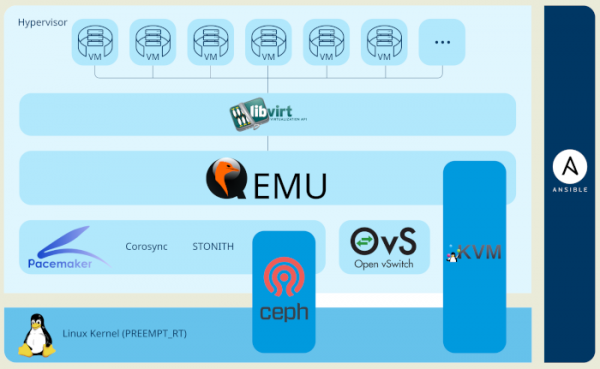
The platform is built using existing open-source projects, for which a reliability test suite has been prepared, including over 700 unit tests. Virtualization is implemented using the KVM hypervisor and a Linux kernel compiled with the PREEMPT_RT option for real-time operations. Ceph is used as a distributed storage solution covering the entire cluster. QEMU is employed for device virtualization, while Open vSwitch is used for network virtualization. The Libvirt toolkit is utilized for managing virtual environments. Pacemaker and Corosync are used to manage resources in the cluster, ensure fault tolerance, and facilitate interaction between nodes. Centralized infrastructure management and orchestration of virtual machines are achieved using Ansible.
Source: opennet.ru
