

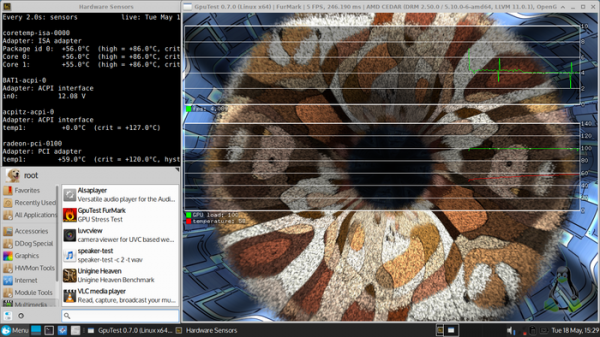
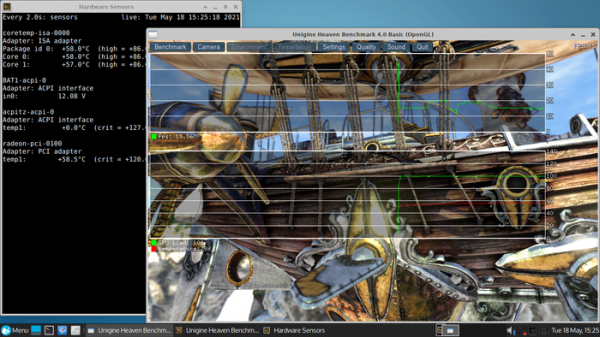
The first release of the specialized DogLinux distribution assembly (Debian LiveCD styled like Puppy Linux) has been published, built on the package base of Debian 11 'Bullseye' and intended for testing and servicing PCs and laptops. It includes applications such as GPUTest, Unigine Heaven, ddrescue, WHDD, and DMDE. The system environment is based on Linux kernel 5.10.28, Mesa 20.3.4, Xfce 4.16, Porteus Initrd, syslinux bootloader, and sysvinit initialization system. Instead of Pulseaudio, ALSA is used directly. The mounting of drives is handled by pup-volume-monitor (without using gvfs and udisks2). The size of the Live image, bootable from USB drives, is 1.1 GB (torrent).
Features of the assembly:
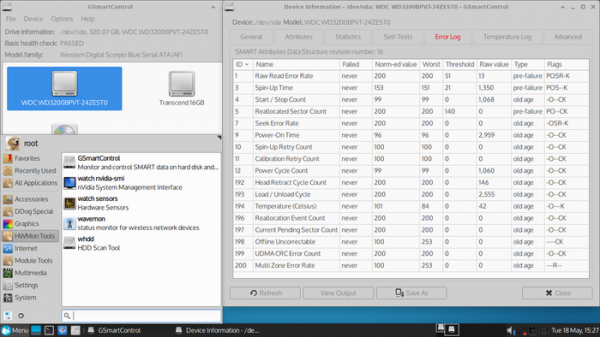
- Allows users to verify/demonstrate hardware functionality, stress the CPU and GPU, monitor temperature, and check SMART HDD and NVME SSD.
- Supports booting in UEFI and Legacy/CSM mode.
- Includes a 32-bit version for compatibility with older hardware.
- Optimized for booting into RAM. After booting, the USB drive can be removed.
- Modular structure. Only the modules that are used are copied into memory.
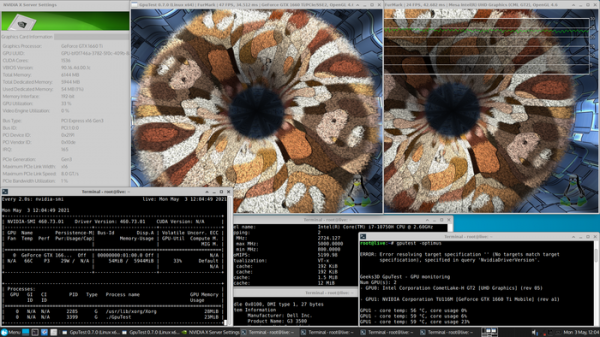
- Contains three versions of proprietary NVIDIA drivers — 460.x, 390.x, and 340.x. The required driver module is determined automatically during boot.
- Includes the testing suite Geeks3D GPUTest.

- The performance testing suite Unigine Heaven can be fully loaded into RAM.
- When launching GPUTest and Unigine Heaven, configurations of laptops with hybrid graphics systems Intel+NVIDIA, Intel+AMD, and AMD+NVIDIA are automatically detected, and the necessary environment variables are set for launching on the discrete GPU.
- Contains software for copying faulty hard drives ddrescue and HDDSuperClone, as well as WHDD for assessing linear reading delays of sectors in the style of MHDD.
- Contains software for recovering lost/damaged partitions/filesystems testdisk and DMDE.
- Any software from Debian repositories can be installed, and modules with necessary additional software can be created.
- To support new hardware, new versions of the Linux kernel and third-party kernel modules may be added as they are released, without the need to rebuild the entire distribution.
- Shell scripts and configurations can be copied to Flash in the live/rootcopy directory, and they will be applied at boot without the need to rebuild modules.
- Ability to install using the installdog script on the hard drive/SSD of a pre-sales PC/laptop for demonstration purposes. The script creates a 2GB FAT32 partition at the start of the disk, which can then be easily deleted, and makes no changes to UEFI variables (boot order in the UEFI firmware).
- From the Flash bootloader, UEFI PassMark memtest86 and UEFI Shell edk2, as well as Legacy/CSM memtest86+ freedos mhdd and hdat2 are available.
- The operation is performed with root privileges. The interface is in English, and translation files are omitted by default to save space, but the console and X11 are configured to display Cyrillic and switch layouts using Ctrl+Shift. The default password for the root user is dog, and for the puppy user is dog.
Source: opennet.ru
