

first release , a very fast intermediate code interpreter for WebAssembly, primarily designed for running WebAssembly applications on microcontrollers and platforms where there is no JIT implementation for WebAssembly, insufficient memory for JIT operation, or where executable memory pages required for JIT implementation cannot be created. The project code is written in C and is licensed under the MIT License.
Wasm3 passes for compatibility with the WebAssembly 1.0 specification and can be used to run many WASI applications, achieving performance only 4-5 times slower than JIT engines (, ) and 11.5 times slower than native code execution. Compared to other WebAssembly interpreters (, , ), wasm3 turned out to be 15.8 times faster.
To operate, wasm3 requires 64Kb of memory for code and 10Kb of RAM, which allows the project to run applications compiled to WebAssembly on , such as Arduino MKR*, Arduino Due, Particle Photon, ESP8266, ESP32, Air602 (W600), nRF52, nRF51 Blue Pill (STM32F103C8T6), MXChip AZ3166 (EMW3166),
Maix (K210), HiFive1 (E310), Fomu (ICE40UP5K), and ATmega1284, as well as on boards and computers based on x86, x64, ARM, MIPS, RISC-V, and Xtensa architectures. Supported operating systems include Linux (including routers based on OpenWRT), Windows, macOS, Android, and iOS. It is also possible to compile wasm3 into WebAssembly intermediate code for running the interpreter in a browser or for self-hosting.
High performance is achieved by employing the (M3) in the interpreter, where ahead-of-time translation of bytecode into more efficient operations generating pseudo-machine code reduces overhead on bytecode decoding, and the execution model of the stack virtual machine is transformed into a more efficient register-based approach. Operations in M3 are C functions, with arguments being the virtual machine's registers, which can map to CPU registers. Frequently occurring operation sequences are optimized into consolidated operations.
Additionally, it can be noted distribution
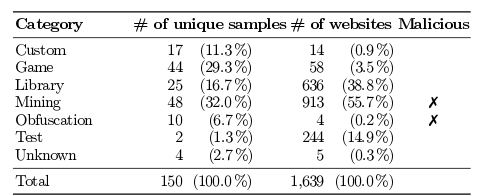
WebAssembly in the Web. Analyzing 948 thousand of the most popular websites according to Alexa rankings, researchers found that WebAssembly is used on 1,639 sites (0.17%), meaning 1 in every 600 sites. A total of 1,950 WebAssembly modules were identified on these sites, of which 150 are unique. When examining the application of WebAssembly, unfortunate conclusions were drawn — in over 50% of cases, WebAssembly was used for malicious purposes, such as cryptocurrency mining (55.7%) and hiding malicious script code (0.2%). Among legitimate uses of WebAssembly, library execution (38.8%), game development (3.5%), and execution of custom code not written in JavaScript (0.9%) were noted. In 14.9% of cases, WebAssembly was employed for environment analysis to identify users (fingerprinting).
Source: opennet.ru
