

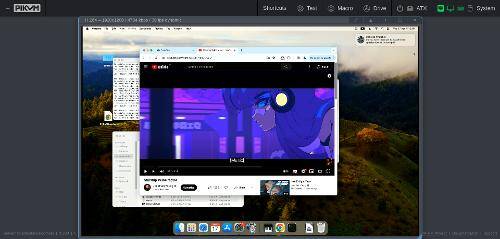
Four years after the first release, the PiKVM project is proud to present release 3.333 codenamed It will (not) pass.
PiKVM is a project that combines software and instructions that allow you to turn a Raspberry Pi into a fully functional KVM-over-IP device. This device connects to the HDMI and USB ports of a server or workstation, enabling remote management over the network, regardless of the operating system. You can power the host on and off, configure the BIOS, and even fully reinstall the OS using a CD-ROM emulator or a flash drive. All functionality is accessible via a web interface that requires no additional plugins or applets and is implemented solely with HTML5.
List of the most important changes:
- The video transmission mode over WebRTC/H.264 has received a significant performance boost and is now used by default. For 1080p, the latency is about 150ms at a stable 30fps. The MJPEG mode, still available as a fallback, has also been significantly accelerated.
- The ability to copy text from the screen using image recognition has been added.
- Two-factor authentication based on TOTP has been added.
- The virtual flash drive emulator now supports write mode to images from the host. NFS support has been added for organizing a centralized storage of system images.
- A new utility has been added for configuring EDID, facilitating the tuning of key parameters of the display emulator (resolutions and audio).
- An experimental feature has been added for dynamic USB emulator configuration, allowing components like keyboards, mice, USB network, and others to be turned on and off.
- Step-by-step instructions for DIY builds have been completely rewritten and improved: for Raspberry Pi 2-3 and Sisyphus.. Support for Raspberry Pi 5 is not planned yet due to the lack of hardware video encoders.
- A new HID emulator based on Raspberry Pico has been introduced to replace the outdated one based on Arduino. In addition to USB, PS/2 keyboards and mice are now supported.
- New GPIO modules have been added for integration with switches to implement multi-port KVM over IP.
- Patches from PiKVM that improve the operation of virtual HID devices and Mass Storage have been accepted into the Linux kernel. The kernel in the PiKVM distribution has been updated to the 6.6.x branch.
- Branded devices PiKVM V3 and PiKVM V4 audio capture and transmission support from the host in OPUS format has been received.
- PiKVM V4 Plus has received support for HDMI video passthrough through the device, and can now be inserted between the monitor and the host without interfering with local operation.
Source: linux.org.ru
