

A project's solution or startup funding can hinge on just one presentation. This is especially compelling when the speaker is a professional who could be dedicating that time to development. If your company lacks dedicated managers for marketing and sales, you can master the speech pyramid, the method of non-directive audience impact, and the rules of business presentation development in just an hour. Read more in this article.

Speech Pyramid
When preparing a presentation for a conference or another event, remember that the audience is typically not motivated to agree with everything you say. That’s normal—everyone has their own experiences and beliefs. Before you say, ‘Do this…,’ the author of SpeechBook, Alexey Andrianov, recommends preparing the audience. For this, he provides the speech pyramid. Experienced managers may recognize it as Robert Dilts' pyramid of logical levels.
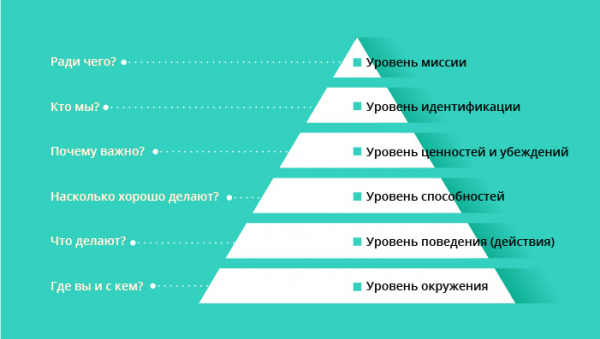
1. Level of Environment
To engage the audience, a couple of phrases about their surroundings are enough. The phrases should be obvious and understandable to everyone present. For example: 'Colleagues, it's the middle of the month; we have gathered to discuss the results' or 'Friends, today we will analyze a case from the company…'.
2. Level of Behavior
Briefly mention the audience's actions. Formulate actions using verbs in the present tense: ‘we do’, ‘we decide’, ‘we change’. For example: 'We meet with clients daily' or 'The market situation is changing every minute'.
3. Level of Capabilities
Statements at this level reflect your assessment of the mentioned actions. Speak in adjectives: ‘quickly’, ‘better here — worse there’, ‘lower’, etc. Examples: 'The results of the departments vary; here’s the ranking' or 'This product hit the market in 3 months, while this time, the launch dragged out for a year'.
4. Level of Values and Beliefs
A transition from lower-order levels to essences. A single short sentence is enough to indicate value. Marker words include: 'We believe', 'Important', 'Main', 'Valuable', 'We love'. For instance, 'Nothing is more important than the company's independence' or 'I believe this approach will help us defeat competitors'.
5. Level of Identification
The shortest in speech. To which group do you relate the attendees? "We are HR professionals," "We are salespeople," "We are investors," "We are marketers." Remember for whom you created the conference presentation, or assess who is in front of you. Perhaps an even more powerful identification will emerge: "We are experts in selling unique equipment."
6. Mission Level
This is where you need to talk about the purpose behind everything being done. Remind the audience about this and activate them to act. "Today, we determine what tomorrow's company will be," "For the launch of a new technology to treat children," "So our loved ones live in prosperity" — here are a few examples.
7. Rapid Descent
Only after raising the audience through all the levels can you call for action. What do you want the audience to do? Slightly raise your voice and state it. Start with a verb in the imperative mood.
Non-directive impact
What other non-directive impact? There are numbers, data, graphs! Certainly, but they only suffice for one part of the hemisphere, while a person also makes decisions on an emotional level. To engage them, address the listener's representative system, allowing the audience to visualize your information in their minds. A story accomplishes this best, as it helps the listener find examples from their own experience and connect them with the data during the presentation.
Do you remember Steve Jobs' famous speech to Stanford graduates? He told three stories from his life, justifying his position and his call to action for the listeners. Using only business language, such an effect cannot be achieved. We make decisions with our brains but filter them through emotions. A story quickly elevates the listener to the level of personal values.
To prepare a presentation for a public speech with a story, the author suggests using the structure:
- Introduction
- Character
- Setup (problem, crisis, obstacle)
- Rising tension
- Climax
- Denouement
The logic of a business presentation
The logic of a business presentation depends on its goal, subject matter, target audience, and context. The author offers two templates that will generally work: the sequences of 'Past-Present-Future' and 'Problem-Proposal-Plan.'
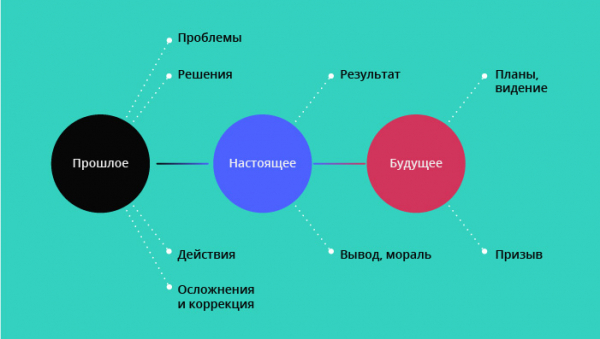
Structure of the 'Past - Present - Future' template
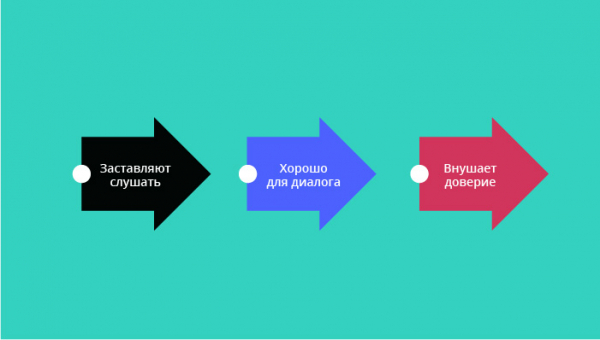
Structure of the 'Problem-Proposal-Plan' template
Write in the comments about what you would find interesting to read regarding creating presentations.
Source: habr.com
