

If a corporate blog publishes 1-2 articles a month with 1-2 thousand views and only a handful of likes, it means something is going wrong. However, practice shows that in most cases, blogs can be both interesting and useful.

Perhaps many opponents of corporate blogs will rush in now, and I agree with them on certain points. But first, let me provide a few positive examples.
We can start with "", useful things , salary rankings of "», . Off the top of my head, I can name another dozen companies that occasionally feature outstanding posts. Additionally, there are many professionals who write for corporate blogs and post transcripts of their hit talks. By the way, digging into the 2018 statistics, I pulled out this table of corporate posts that gained over 150 likes.
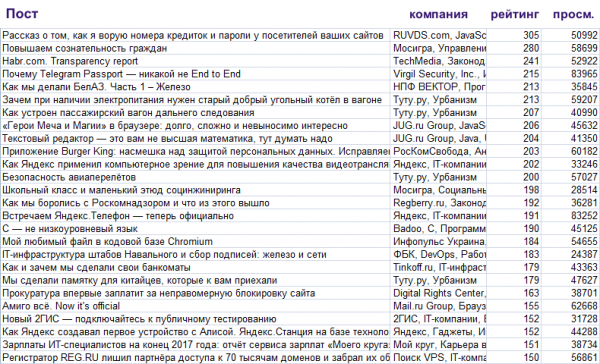
In general, things can go well (until 'young marketers' get their hands on them). Personally, it makes me sad to see Habr filled with mediocre content that gets upvoted by directive.
Knowing the inside scoop, I have no intention of blaming anyone or, even more so, pointing fingers. Sometimes, all you can do is take a deep sigh.
This was a disclaimer. The post is aimed at those who oversee company blogs and have the chance to make changes.
Next is a selection of factors that lead to poor readership of blog articles, as well as observations on why some posts do not bring any benefit to the company.
The team or contractors have burned out
When a journalist spends a couple of years delving into the same topic unrelated to their personal calling or outside their hobby circle, burnout will occur. No, the work may still be done somewhat well, but without passion. Boring topics, reluctance to bother the speaker for details. And over time, the perspective indeed becomes dull – it starts to seem that there's nothing interesting here, and everything has already been written about.

In general, a reboot is needed. You can try to experiment with motivation by setting bonuses for achieving certain KPIs. However, this won't work in all cases, and it's better to start with something else.
Try to bring fresh ideas into the development of a content plan. Brainstorm. After all, a great idea for a post can spark inspiration not only in a tired journalist's or expert's soul.
However, the reasons could be different. For instance, a simple overload. An artist is not a machine that prints masterpieces. They cannot produce hits consistently within strictly defined timeframes and themes.
Carpet bombing with announcements and translations
Marketing within the company tells the blog editor that another announcement of a meetup (or a new product version) is needed. And to prevent the blog from turning into a bulletin board, posts are interspersed with translations. In other words, the blog is used solely for utilitarian purposes, lacking soul. And this is precisely the situation where... everyone already understands everything. Therefore, there will be no advice here.
Content merely entertains the audience
There are blogs on Habr where news materials or articles resonate with readers but have no relation to the company or its field.
Why, and how? Probably, this is how agencies utilize budgets that do not have close contact with their clients, making the best use of the budget as they can.
However, there are examples where companies cleverly exit this rut by adding a small separate block of a couple of sentences at the end of posts. There, they casually inform about their news or place promo codes, linking them to the stories discussed in the article.
The reader has their own pain
You can talk for a long time in the blog about the advantages of your product, its low price, and other 'perks', but if you forget about the pain of your potential customer and do not offer simple and clear solutions in the style of 'how to do this and that' (based on your own components), consider that you are shooting sparrows with a cannon. Someone knowledgeable may get hooked.
Posts not for everyone
B2B-oriented content often targets the end consumer with various guides, FAQs, reviews, and life hacks. However, this audience usually does not directly purchase these products. Instead, they procure them at a higher level to address some tactical or strategic issues within their companies. Typically, there's little to no relevant content for these individuals in blogs.
Artistic Headlines
Ask yourself: can you understand what interesting content will be in the article just by reading the headline? When scrolling through feeds, readers typically glance at headlines and images. If they don't provide a clear picture of the content, most will scroll past.

The same applies to search engine indexing. Habr holds significant weight among other websites, and articles from it are easily selected for the first page of search results. However, if the headline does not indicate the subject matter, only a few will find the article.
Moreover, this issue becomes even more pronounced in Habr's email newsletters, which only feature post headlines. This, by the way, is a small point against Habr itself.
The Race for Hardcore
When people share deep expertise in a field, it's very beneficial. Primarily for their image, and also for the advanced reader, who sometimes has no other source for expert knowledge.
But this 'medal' has a flip side. In the old days, we joked that every formula in an article cuts the number of its readers in half. This has become even more relevant today. It's not just about the ability to explain complex things in simple terms; it's that for every cool expert, there are a dozen newcomers. Therefore, an article titled 'How to Start Learning JS' will attract many more grateful readers than a sophisticated tale about writing your own static type checker.
P.S. Ideally, it would also be worth mentioning marketing, whose ears sometimes stick out so much that they hinder text readability, but that's another story.
Source: habr.com
