

Learning English through games and books is enjoyable and quite effective. And if the game and the book are combined into a single mobile application, it’s even more convenient. Over the past year, I've been slowly getting acquainted with the genre of mobile ‘gamebooks’; having explored this genre, I must admit that it's an interesting, unique, and not widely known branch of either games or literature. In this experimental article for Skyeng, I will revisit the ‘game journalism’ of old, reviewing the most intriguing representatives of the genre and their publishers.
But first, a little history.
Long ago, back in the last century, to reinforce the English language knowledge I acquired in school, I used books and computer games. It was a time before the internet, so the books were physical, and the games were on floppy disks. Each method had its pros and cons. Books were relatively easy to find, rich in vocabulary, and could be read anywhere and anytime; on the other hand, they had a certain casualness — if I didn’t understand something, I would skip it, hoping to figure it out later: after all, I couldn’t just pull out a dictionary on the subway. Games (which were quest-based) didn’t forgive such carelessness — if you didn’t understand something, you couldn’t progress, wasting precious game time; as a result, you paid maximum attention and memorized new words much more effectively. Moreover, commands had to be entered in text, so getting words wrong was not an option. The flip side was that there was less text in games, and its quality was not always ideal.
Now, with computers in our pockets that are hundreds of times more powerful than those good old 286s, we can easily read and play anywhere. Additionally, we have the opportunity to combine the advantages of language learning from books and games by using 'gamebooks' — books with game elements. Here, after each chapter, you choose how the story continues, and to make the right choice, you need to understand what’s happening. This is what we will discuss.
Terminology Issues
There are two very similar genres — interactive fiction (often referred to as 'text quests' among us) and gamebooks (also known as choose your own adventure books, branching storyline books). Recently, these phenomena have almost merged into one, but their roots are fundamentally different.
Interactive fiction was created by programmers, and it all started with Adventure, which named the genre. After Adventure came 'Zork', then Kings and Space Quests, and gradually all of this evolved into Full Throttle. In classic 'text quests', instead of images, there is text, and rather than clicking on the screen, you need to type text commands ('open door', 'take shovel'), and they still exist in one form or another today. I will write an article about their current state sometime, but for now, I can direct interested readers to my work from twenty years ago for the 'Game Country' magazine, which can be found in (warning: a lot of text!).
Gamebooks emerged as a literary genre, created by writers; they were sold in bookstores as early as the 1930s. These are regular paper books that give the reader some freedom to choose the direction of the story. At the end of each chapter, the reader decides what happens next and finds the corresponding page. In the 1970s, they also evolved towards tabletop role-playing games, introducing dice battles, maps with token movement, and other gaming attributes, but the literary plot (even if not a masterpiece) remained at the core, which was entirely absent in Adventure.
This lineage led to yet another distinction between IF and gamebooks. In IF, the player had a certain freedom of action at each specific segment of the game (they could explore locations, move between them, use items, and solve puzzles), but overall, the story remained linear and eventually led to a single ending. In gamebooks, there is almost no freedom of action within chapters, but decisions must be made between them that branch the storyline, and there are always multiple endings.
Currently, the paths of these two different directions have crossed and intertwined, but for clarity in this text, I will only discuss gamebooks.
So, let's go!
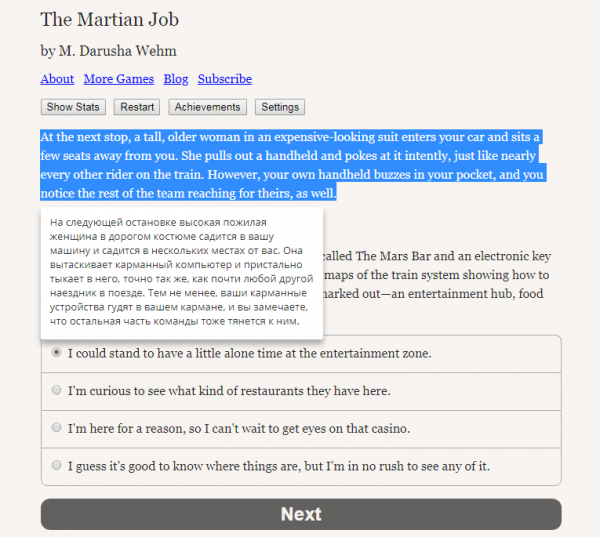
A small American company specializing in text-based stories with minimalist designs. The literary aspect is at the forefront here; these are true books where your choices influence the plot's development, but you can't 'lose'; you can only reach different endings. This approach leads to a strong focus on the quality of the plot and the language. A side effect is that if you don't understand what it's about, there's not much for you here, so they are more suitable for advanced language learners.
Choice of Games has opened up its own scripting language for anyone interested in writing such 'branching books', and a noticeable number of people have taken advantage of this. Their books are sold or distributed for free under the brand .
Gamebooks are available for all platforms, and the first chapters can be read for free in the browser — which is convenient if you have for Chrome: you can translate texts and add words to study.
In general, all Choice of Games books are good. You can start with their first creation , or with the philosophical ; choosing a couple of recommendations here is not easy.
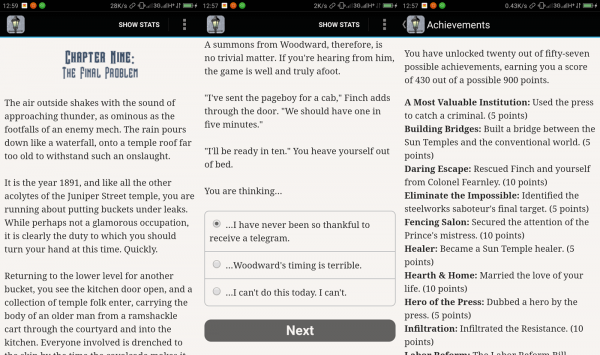
a work from Hosted, meaning it was written by a freelance author, but this author, Heather Albano, has previously managed to write several 'official' CoG books. A wild and surprisingly successful mix of Sherlock Holmes, Jack the Ripper, Jekyll and Hyde, classic fantasy, Victorian England, and steampunk. The story is captivating, full of unexpected twists and narrative forks. A wonderful choice for starting to explore the genre, which you will want to read and reread, each time changing the story. To add motivation for repeated playthroughs, there are 'achievements' unlocked by certain actions you take.
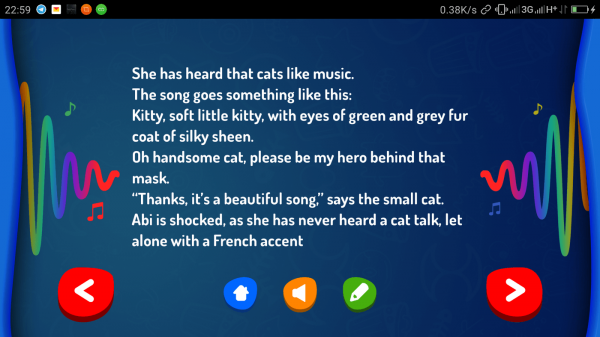
is a gamebook that tells the story of a cat (or kitten) taken home from a shelter. You will have to decide whether to use the litter box or shoes, knock a vase off a shelf or purr on someone's lap, agree to eat kibble or wait for foie gras. It might seem that a cat's life is hardly full of events, but this is the most extensive gamebook in the CoG catalog: it has 600,000 words, more than 'War and Peace'. A must-read for cat lovers.
A Mexican company that has invested a lot of effort and love into the development of its engine, but is seriously behind its competitors in terms of content. The books (referred to here as pathbooks) start with exciting setups that promise something big and interesting, but right after the setup, there is a sudden, disjointed ending. Additionally, readers have limited opportunities to influence the plot — there are about five or six forks in each book, which occur in strange places, and their impact on the story is not obvious. However, all these books can be read for free once (and sometimes more), and their small size might appeal to language learners. Plus, there are gamebooks for kids here!
For Adults: Past Mistakes (, ) — a noir set in a bleak future after the Third World War, with a setting partly reminiscent of Dick's 'The Man in the High Castle.' Unfortunately, the setting is where it all ends. — a story about a strange adventure in a forest, which again has nothing to do with the setup.
For Kids: — an unexpected demonstration that a very short and simple plot works perfectly in a children's book.
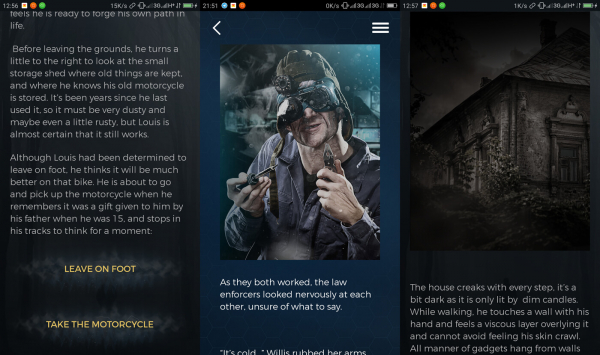
Creators from Barcelona who, besides gamebooks, also engage in interactive museum tours. They started with classic 'branching books' (Deadman Diaries) but with music and rich design, and now they have developed their own role-playing system with dice and write fantastic action stories (Heavy Metal Thunder). Although a third part seems to be planned, these action stories do not work on the seventh Android, so I won't write about them. Moreover, Cubus has a truly unparalleled work without any combat systems and random number battles.
The Frankenstein Wars
/
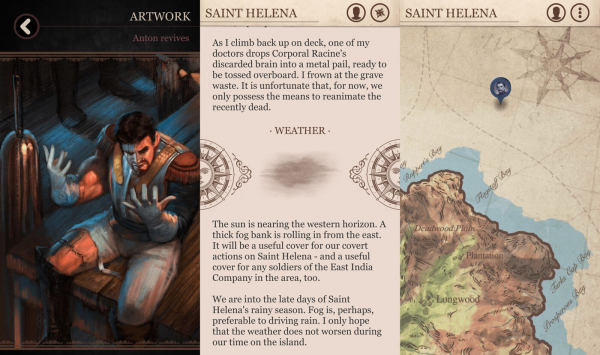
Perhaps the best gamebook in this selection tells an alternate history of 19th century France, where revolutionaries have acquired Frankenstein's diaries, learned to make monsters from fallen soldiers, and resurrected Napoleon, turning him into Darth Vader in a fish tank. The two main characters are brothers, fate has placed them on opposite sides of the front. Or on the same side — that’s for you to decide, as much in this work can radically change based on the reader's choices. Additionally, there are text shootouts, text tactical battles, and a fantastic soundtrack. Sometimes a timer kicks in: some sections must be completed quickly; a lack of language proficiency may complicate this.
Young guys from Cambridge, whose creations are all made to look like 'real' games while being de facto gamebooks. There is much graphics, animation, sound, effects, and all the other bells and whistles impossible in paper books, yet the story is still governed by your decisions, which must be made based on the text you read. Inkle actively collaborates with game producers and publishers — they create projects for Penguin USA, including an app for memorizing English poetry , and also write dialogues for games using their open . Since these guys are young and trendy, their own games initially release for iOS, and only later, if they are lucky, for other platforms.
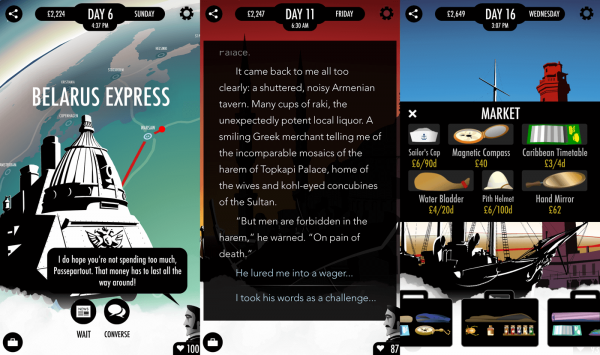
A gamebook inspired by 'Around the World in 80 Days,' taking considerable liberties with the original source. In fact, only the 80 days remain from Jules Verne, along with a variety of adventures drawn from his other works. The world where Passpartout (you) and Fogg travel is rooted in steam-punk tradition — underwater trains run from London to Paris, steam airships fly, robots manage the crews, and dazzling chrome technological wonders are everywhere. Essentially, the main feature of the game is the exploration of its world during the journey. You can lose by failing to reach the finish line or if you run out of money or health — but that hardly matters, as each new journey is radically different from the last, with hundreds of possible routes around the world. By the way, this is the champion in terms of word count in this collection: it features 750,000 words, nearly one and a half 'War and Peace'!
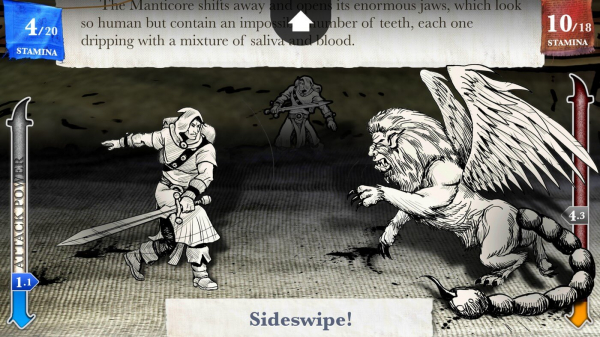
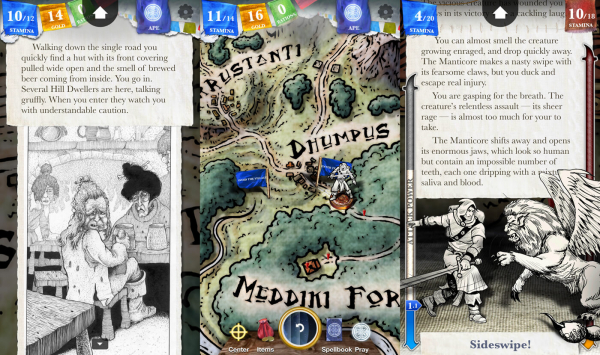
An adaptation of the popular classic book role-playing game from the 1980s by Steve Jackson, part of the Fighting Fantasy series (co-written by Jackson and Ian Livingstone, one of the founders of Games Workshop). The gameplay elements take up a lot of space, requiring you to monitor health and fight enemies with sword and magic, but the text remains at the core; many battles can be avoided by carefully reading the story, and even in combat, you need to pay attention to textual hints to determine the best move to use. Magical spells are formed from letters, with many spells to memorize; however, they resemble words, which can be helpful when learning the language (HOT — fireball, FOG — blindness, etc.). The four parts (there were four books as well) are interconnected, so you should start with the first one. It might seem a bit short for five dollars, but it lays the foundation, and things get more exciting from there.
As a bonus — a free desktop demo of the Ink engine called . It is more than a decent gamebook that lasts about half an hour.
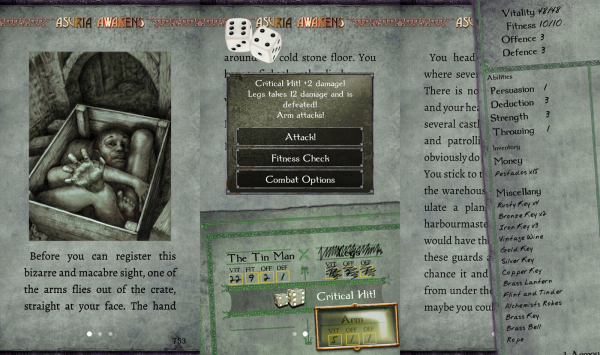
The classic of computer gamebooks is the Australian company Tin Man Games. These guys have a wealth of experience in gamebooks, and while Inkle somehow managed to secure Sorcery!, everything else from Fighting Fantasy can be found here, along with many original games. And these are indeed more role-playing games than books — they feature a basic, albeit primitive, role-playing system where the character has equipment and constantly gets involved in fights (which can be avoided, but requires upgrading certain skills and rolling the dice again). At the beginning of the game, you can choose the difficulty level, from brutal with no option to 'rewind' to 'reader-friendly', where all battles are resolved automatically in your favor. I recommend selecting the middle option (with unlimited 'bookmarks') — the literary merits of these works are not particularly stunning, but they fit well into the game.
GA is the Gamebook Adventures series, the flagship product of Tin Man Games; the games in this series do not have a continuous plot, so it’s best to start with the latest one. The main character, a petty bandit-informer, is sent to uncover the circumstances of the mysterious disappearance of an ambassador in a neighboring principality; upon arrival, he finds himself engulfed in strange events surrounding the resurrection of the god Asuria. The game is extensive, the plot is well-developed, and the setting is unusual (and becomes increasingly bizarre as it progresses). Additionally, there’s a well-developed role-playing system by Tin Man Games, where you can either attempt to mindlessly chop everything with an axe or delve into the texts and seek alternative paths. There are minor plot glitches, but this is expected from such a large and branching work.
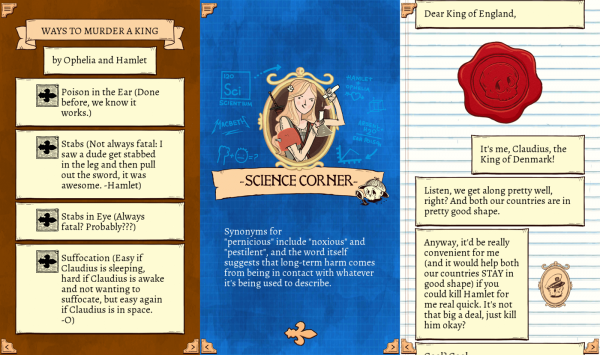
An unexpected classic from Tin Man Games: the electronic version of Ryan North's paper gamebook that he successfully funded on Kickstarter. An absolutely insane and hilariously funny retelling of 'Hamlet', where you can 'play' as Hamlet, Ophelia, and Hamlet's father (who predictably quickly becomes his shadow). This is indeed a literary project rather than a game; however, there are countless plot development options available. Familiarity with the classics is helpful for understanding individual jokes, though for convenience, the 'Shakespearean plot' is marked on the choice screens with Yorick's skull. Additionally, there are over a hundred endings, including Ophelia inventing central heating and underwater adventures with Hamlet's father's ghost, who suddenly decides to become an ichthyologist. By the way, a sequel about Romeo and Juliet .
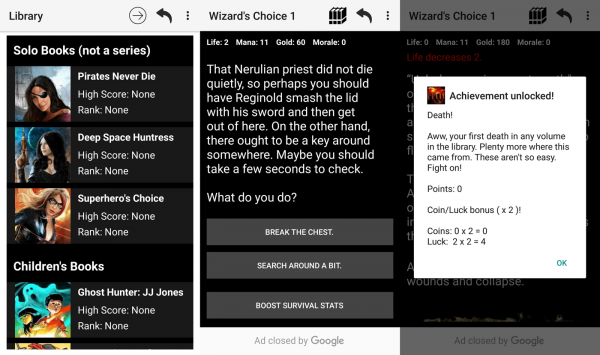
An LLC from Washington, Delight Games by Sam Landstrom is a sort of 'Tin Man for the poor'. These are also book role-playing games, but the grass is a bit lower, the water is thinner. However, everything can be in a 'freemium' mode: complete one part of the series, earn 'coins', unlock the next one — or buy 'coins' for real money (they even get added if you launch the app every day). Sam is a prolific author, he has many series, and he also attracts people from outside. They're far from stars, so don't expect any literary breakthroughs. But where else can you find so many gamebooks of various genres for such diverse audiences, including children?
This concludes today's review. Since this is an experimental article, I would greatly appreciate your comments: we want to understand how interesting such texts are to Habr's readers. Should we continue?
Source: habr.com
