

The Home Assistant project, which develops an open platform for home automation, has announced the creation of a hardware device called Home Assistant Voice, featuring a voice assistant. The device can be used to manage smart homes, perform tasks, and provide answers to user queries through natural language interaction. Schematics, board wiring, and 3D-printable case designs are shared under open licenses. The firmware code is available under the MIT license. The finished device is sold for $59.
Home Assistant Voice is optimized for use with smart homes based on the open platform, Home Assistant. To activate the assistant, simply power on the device, and Home Assistant will automatically suggest integrating it into the home network. Compared to existing commercial systems like Google Mini, Apple HomePod, Amazon Echo, and Yandex Station, the Home Assistant project offers the ability to create a fully autonomous solution that does not rely on external services or internet connectivity. Recognition and voice synthesis, as well as response generation, are performed on a separate server using AI technologies and a large language model.
Users can run their own server within their home network or utilize an external cloud service. For local processing of voice commands, it is recommended to use a system with at least an Intel N100 processor. The software environment is based on the Assist component, which utilizes the Whisper model or the Rhasspy Speech system for speech recognition. A large language model, LLaMA, is employed for generating responses to questions posed in natural language. If users prefer not to set up their server, they can connect the voice assistant to the Home Assistant Cloud service. Furthermore, integration with AI services like OpenAI, Google AI, and Anthropic is also possible.
The user-interactive device measures 9.4 x 9.4 x 3 cm and weighs 120 grams. It is equipped with an ESP32-S3 SoC based on a dual-core XTensa LX7 microcontroller running at 240 MHz, featuring 16 MB of Flash and 8 MB of RAM. An XMOS XU316 chip is utilized for audio processing, providing functions such as echo cancellation, noise reduction, and automatic input signal level adjustment. Connection to home networks and other devices is enabled through Wi-Fi and Bluetooth 5.0. A Grove port is available for connecting additional sensors and accessories. 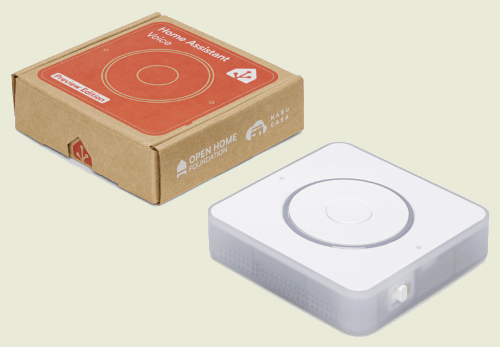
At the current stage of development, a preliminary model of the Home Assistant Voice PE (Preview Edition) has been released for sale. This preview status is due to the desire to consider community feedback and create a fully functional product ready for use in any home around the world. As it stands, not all planned functionalities are ready, and not all languages are supported. For instance, Russian has been confirmed as a supported local language, server and in the cloud, but Ukrainian can currently be used only when connected to an external cloud.
With the assistant, users can utilize voice commands to turn lights on/off, activate household devices, add notes to a shopping list, control the air conditioning, get information about the temperature and time, start a timer, open gates, play music, activate a robotic vacuum, and execute scenarios predefined in Home Assistant. The casing features lighting for visual indication of command reception. A hardware microphone switch is included to ensure privacy when needed by the user. External speakers can be connected via a 3.5mm audio port for music playback.
Source: opennet.ru
