

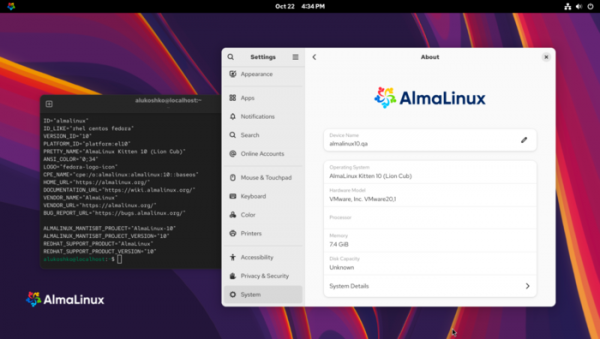
The developers from the AlmaLinux project have released the first version of the new distribution Kitten 10, based on the package base of CentOS Stream 10, which is used for the development of the upcoming significant release of Red Hat Enterprise Linux 10. Kitten 10 is presented as a test distribution that allows users to familiarize themselves with the features being developed for RHEL 10, and serves as a precursor to the future stable release of AlmaLinux 10. Installable builds of the distribution are available for the architectures x86_64, x86_64_v2, aarch64, ppc64le, and s390x.
In the Kitten repository, a continuous package update model is applied. Installable builds will be updated every three months. The Kitten repositories are used as upstream for the AlmaLinux 10 branch - fixes and new features are initially tested in the Kitten repositories and then transferred to AlmaLinux. The Kitten repositories are also used as a platform for integration and collaboration with higher-level projects such as CentOS Stream and Fedora.
Key Differences of Kitten from CentOS Stream:
- The use of the %rbp processor register has been reinstated as the base pointer for the stack frame, containing return addresses and function variables (frame pointer). Using the frame pointer allows for the use of additional capabilities for system tracing and profiling in the distribution.
- Separate builds have been created for the second version of the x86-64 microarchitecture (x86-64-v2), which are maintained alongside the base x86-64 builds optimized for the x86-64-v3 microarchitecture used in RHEL 10. The additional support for x86-64-v2 ensures compatibility with CPUs older than Intel Haswell and AMD Excavator, designed before 2013.
- The ability to boot in UEFI Secure Boot mode for systems with Intel/AMD and ARM processors has been implemented.
- The delivery of server and client implementations of the SPICE protocol, which allows for remote work with desktops operating in a virtual environment managed by QEMU/KVM, has been continued. Unlike VNC and RDP protocols, in SPICE, screen content rendering and audio stream processing is performed on the client side, rather than on the server. server. In RHEL, SPICE support was discontinued in release 9.0.
- The ability to use a hypervisor KVM on systems with IBM POWER processors has been implemented. In RHEL, such support was dropped in branch 9.0.
- Support for over 150 hardware devices not supported in RHEL 10 has been resumed.
- RPM packages for Firefox and Thunderbird have been included in the repository (in CentOS Stream 10 and RHEL 10, it is suggested to install Firefox and Thunderbird from flatpak format packages).
Software Versions:
- Linux Kernel 6.11.
- GCC 14.2, LLVM 18.1, Rust 1.79, Perl 5.40, PHP 8.3, CMake 3.28, Bash 5.2.
- Systemd 256, Anaconda 40.22, glibc 2.39, binutils 2.41, DNF 4.20, RPM 4.19.
- Apache HTTPD 2.4.62, Nginx 1.26, MySQL 8.4, Redis 7.2, Grafana 10.2, OpenSSH 9.9.
- QEMU-KVM 9.1.
- GNOME 47, Qt 6.7.
- The packaging for 32-bit systems (i686) has been discontinued.
The AlmaLinux distribution was founded by CloudLinux in response to Red Hat's premature discontinuation of CentOS 8 support (the release of updates for CentOS 8 was halted at the end of 2021, not in 2029 as users had expected). The project is overseen by a separate non-profit organization, the AlmaLinux OS Foundation, which was created to develop it in a neutral environment with community participation and using a management model similar to that of the Fedora project. The distribution is free for all categories of users. All AlmaLinux developments are published under open licenses.
Source: opennet.ru
