

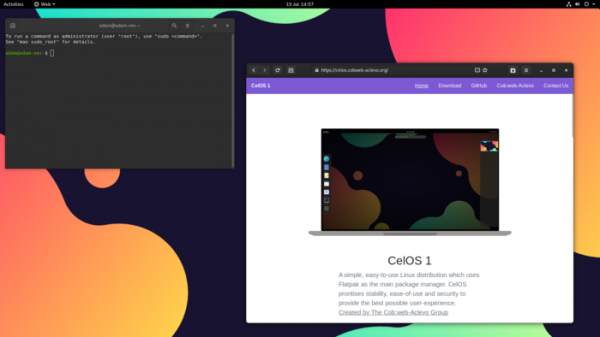
The beta release of the CelOS (Celestial OS) distribution, which is a reworking of Ubuntu 22.04, has been presented, where the Snap package management tool has been replaced with Flatpak. Instead of installing additional applications from the Snap Store, integration with the Flathub catalog is offered. The size of the installation image is 3.7 GB. The project's developments are distributed under the GPLv3 license.
The build includes a selection of GNOME applications distributed in Flatpak format, as well as the opportunity for quick installation of additional programs from the Flathub catalog. The user interface is the standard GNOME with the Adwaita theme, as it is developed by the main project, without using the Yaru theme offered in Ubuntu. The stock Ubiquity installer is utilized.
The base delivery excludes the packages aisleriot, gnome-mahjongg, gnome-mines, gnome-sudoku, evince, libreoffice, rhythmbox, remmina, shotwell, thunderbird, totem, snapd, firefox, gedit, cheese, gnome-calculator, gnome-calendar, gnome-font-viewer, gnome-characters, and ubuntu-session. The added deb packages are gnome-tweak-tool, gnome-software, gnome-software-plugin-flatpak, Flatpak, and gnome-session, as well as flatpak packages Adwaita-dark, Epiphany, gedit, Cheese, Calculator, Clocks, Calendar, Photos, Characters, Font-viewer, Contacts, Weather, and Flatseal.
The differences between Flatpak and Snap boil down to the fact that Snap offers a small base runtime with the contents of a container based on monolithic releases of Ubuntu Core, while Flatpak, in addition to the core runtime, uses additional and separately updatable runtime layers (bundles) with standard sets of dependencies for application operation. Thus, Snap moves most of the application libraries to the package side (recently, the extraction of large libraries, such as GNOME and GTK libraries, into common packages has become possible), whereas Flatpak offers shared library bundle sets for different packages (for example, the bundle includes libraries necessary for the operation of programs with GNOME or KDE), which allows packages to be more compact.
Flatpak packages utilize an image based on the OCI (Open Container Initiative) specification, while Snap uses SquashFS format image mounting. Flatpak employs a Bubblewrap layer for isolation (using cgroups, namespaces, Seccomp, and SELinux), and portals for accessing resources outside the container. Snap implements cgroups, namespaces, Seccomp, and AppArmor for isolation, and plug-in interfaces to interact with the outside world and other packages. Snap is developed under the full control of Canonical and is not community-managed, while the Flatpak project is independent, offers better integration with GNOME, and is not tied to a single repository.
Source: opennet.ru
