

The Sculpt project version released on October 25th develops an operating system based on Genode OS Framework technologies, which can be used by regular users for everyday tasks. The source code of the project is distributed under the AGPLv3 license. A system image of 35 MB is available for download, which can be used on PCs, the PinePhone smartphone, and the MNT Reform laptop. It supports systems with Intel processors and graphics subsystems with VT-d and VT-x extensions enabled, as well as ARM systems with VMM extensions.
Key innovations:
- A new task scheduler has been implemented, aimed at minimizing latency and fairly distributing resources. The implementation of the new scheduler has led to improved performance and responsiveness of the interface on low-power platforms, such as the PinePhone smartphone.
- The performance of the stack for block devices and the package installation mechanism has been optimized.
- Drivers for USB controllers, Wi-Fi, Ethernet adapters, and Intel GPUs have been ported from the Linux kernel and synchronized with kernel 6.12 (previously, drivers from kernel 6.6 were used).
- A new configuration and report format has been proposed, featuring a readable syntax that is convenient for editing and user analysis. The old XML-based format continues to be used by default, while the new option is available (it is planned to include it by default in the next version). The system update mechanism allows switching between the old and new configuration options.
- Support for the seL4 microkernel has been improved, and issues with its use with dynamically loadable Genode drivers have been resolved.
- In the implementation of the base API, explicit error handling with error encoding in Σ-types (sum type) has been used instead of the C++ exception mechanism. Changes have also been made to prevent accidental pointer leaks and to explicitly define object ownership and lifecycle.
- GCC 14.2 and binutils 2.44 have been updated.
- The ability to run the Goa SDK (the development toolkit for Genode applications) in a sandbox environment has been implemented.
- The integration of supported network stacks — lwIP and the TCP/IP stack from the Linux kernel — has been unified.
- Graphic drivers for Intel GPUs and VESA have been improved.
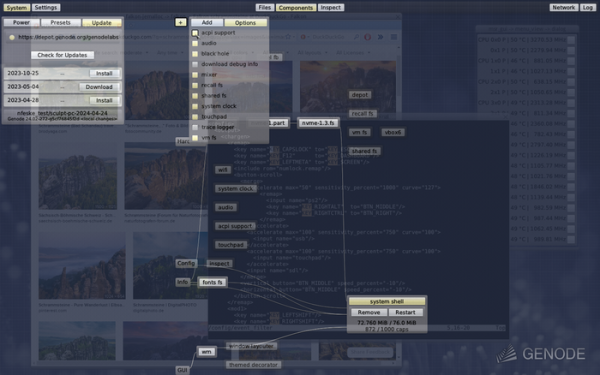
The system comes with the Leitzentrale graphical interface, which allows for typical administrative tasks. In the upper left corner of the interface, there is a menu with tools for managing users, connecting storage devices, and configuring network connections. In the center, there is a configurator for determining the system's components in the form of a graph that shows the relationships between system components. In interactive mode, components can be added or removed to shape the system environment. of virtual machines.
Users can switch to a console management mode if desired, providing greater flexibility in management. The traditional desktop can be accessed by launching the TinyCore Linux distribution in virtual machine Linux. In this environment, browsers Firefox and Aurora, a Qt-based text editor, and various applications are available. The command-line utilities can be accessed through the 'Noux' environment.
The Genode framework provides a unified infrastructure for creating user applications that run on top of the Linux kernel (32 and 64 bit) or microkernels such as NOVA (x86 with virtualization), seL4 (x86_32, x86_64, ARM), Muen (x86_64), Fiasco.OC (x86_32, x86_64, ARM), L4ka::Pistachio (IA32, PowerPC), OKL4, and L4/Fiasco (IA32, AMD64, ARM). It includes a paravirtualized Linux kernel, L4Linux, operating on top of the Fiasco.OC microkernel, allowing standard Linux programs to run in the Genode environment. L4Linux does not interact directly with hardware but instead uses Genode services through a set of virtual drivers.
Various components of Linux and BSD have been ported to Genode, supporting Gallium3D, integrating Qt, GCC, and WebKit, and making it possible to create hybrid Linux/Genode software environments. There is a port of VirtualBox running on top of the NOVA microkernel. Many applications have been adapted to run directly on the microkernel and the Noux environment, which provides OS-level virtualization. For non-ported applications, a virtual environment system is available, operating at the level of individual applications and allowing programs to run in a virtual Linux environment using paravirtualization.
Source: opennet.ru
