

Till Kamppeter, the leader of the OpenPrinting project, announced that due to Apple’s lack of interest in maintaining the CUPS printing system, the fork created last year can be considered the upstream project for patch submissions and inclusion in distributions. Michael R Sweet, the original author of CUPS who left Apple a year and a half ago, is involved in the development of the fork.
Since early 2020, no updates have been made in the Apple-supported CUPS repository, and the project is in deep stagnation. Considering the importance of CUPS for the Linux ecosystem, the OpenPrinting team decided to take over the maintenance of the CUPS code and established the fork last fall. Six months have passed since the creation of the fork, and Apple has not resumed work on CUPS.
In response to a request from Michael Sweet, Apple confirmed its lack of interest in further developing CUPS functionality and plans to restrict itself to maintaining the codebase for macOS, including transferring fixes from the OpenPrinting fork. OpenPrinting developers stated they will continue development independently of Apple and recommended considering their fork as the main project. Future versions of the CUPS fork will be released under the original project name without the previously used ‘opX’ suffix.
Notable changes include the integration of patches accumulated in the Ubuntu package, and the addition of features necessary to distribute the CUPS-based printing stack, cups-filters, Ghostscript, and Poppler in a self-contained Snap package (Ubuntu plans to switch to this snap instead of regular packages). Another area of work involves fixing bugs reported in Apple’s repository over the last 15 months.
Changes are planned to be included in the CUPS 2.4 release, which is also expected to feature compatibility with AirPrint/Mopria, support for OAuth 2.0/OpenID authentication, addition of pkg-config support, improved TLS and X.509 support, support for ‘job-sheets-col’ and ‘media-col’ attributes, and the deprecation of cups-config and Kerberos authentication.
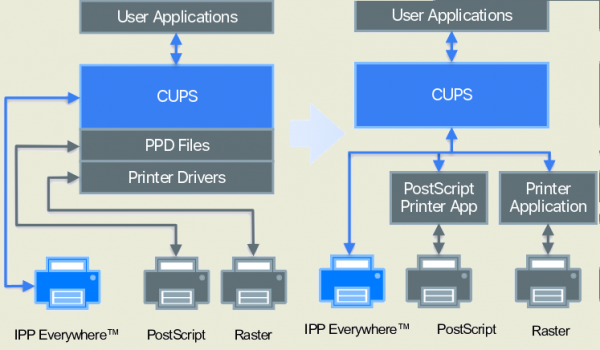
In the future release of CUPS 3.0, it has been decided to discontinue support for the PPD printer description format and transition to a modular architecture for the printing system, completely eliminating PPD and based on the use of the PAPPL framework for developing printing applications (CUPS Printer Applications) using the IPP Everywhere protocol.
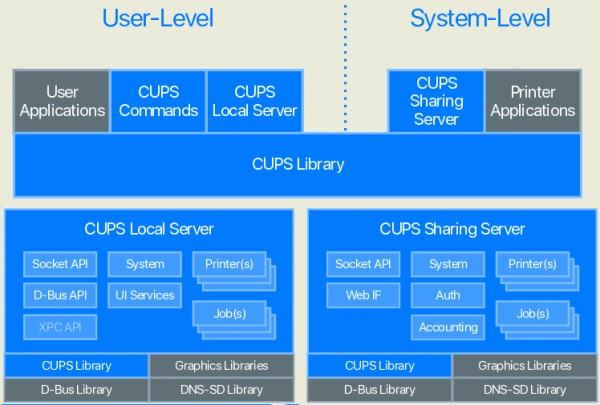
Components such as commands (lp, lpr, lpstat, cancel), libraries (libcups), and local server local printing (responsible for handling local print requests) and a shared print server (responsible for network printing).
It is worth noting that the OpenPrinting organization was established in 2006 as a result of the merger of the Linuxprinting.org project and the OpenPrinting working group from the Free Software Group, which focused on developing printing system architecture for Linux (Michael Sweet, the author of CUPS, was one of the leaders of this group). A year later, the project came under the wing of the Linux Foundation. In 2012, the OpenPrinting project took over the maintenance of the cups-filters package with components necessary for CUPS to function in systems other than macOS, as starting with the CUPS 1.6 release, Apple ceased support for certain print filters and backends used in Linux, which were not of interest for macOS, and also deprecated the PPD driver format. During his time at Apple, Michael Sweet personally made the vast majority of changes to the CUPS codebase.
Source: opennet.ru
