

Within the Raspberry Pi Home Media Center project, several compact open hardware devices are being developed to set up a home media center. These devices are based on the Raspberry Pi Zero board, paired with a digital-to-analog converter that delivers high-quality sound output. The devices support network connectivity via Wi-Fi or Ethernet and can be controlled using a remote. The schematics and layouts of the printed circuit boards, as well as the models for the enclosures, are published under the GPLv3 license. The code for using the digital-to-analog converter with the Raspberry Pi board is open under the GPLv3 license.
The Louder Raspberry Pi device is notable for its use of the TI TAS5805M digital-to-analog converter with an integrated Class D amplifier, capable of delivering 22 watts per channel of surround sound output to speakers. The device comes with an IR receiver for the remote control, USB-C, Wi-Fi, and Ethernet (Wiznet W5500 SPI). Dimensions are 88 x 38 x 100 mm. Cost is $35.
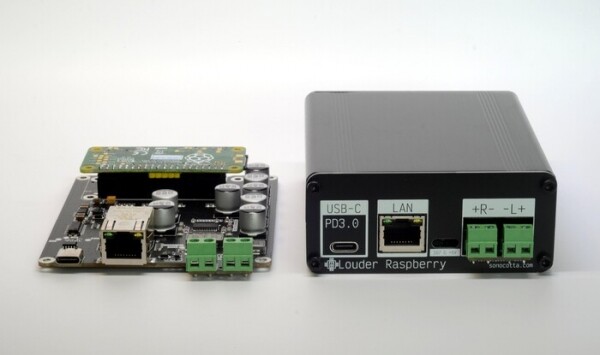
The Raspberry Pi HiFi device is equipped with a simpler TI PCM5100 digital-to-analog converter and is designed to be used with an external amplifier. The device features an IR receiver for the remote control, USB-C, Wi-Fi, Ethernet (Wiznet W5500 SPI), and a line audio output for connecting to the amplifier. Dimensions are 88 x 38 x 100 mm. Cost is $25.
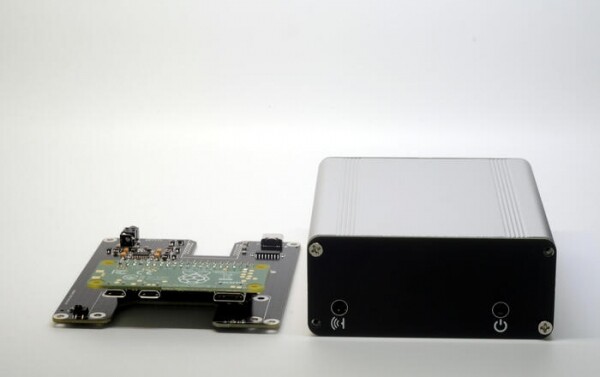
A Loud Raspberry Pi device is in development, notable for its use of two Analog Devices MAX98357 digital-to-analog converters with Class D amplifiers. This device is designed for connecting speakers with a power output of 3 watts.
Source: opennet.ru
