

The Raspberry Pi project has introduced the new Raspberry Pi Pico W board, continuing the development of the Pico mini board, which is equipped with the custom RP2040 microcontroller. This new version features integrated support for Wi-Fi (2.4GHz 802.11n), implemented based on the Infineon CYW43439 chip. The CYW43439 chip also supports Bluetooth Classic and Bluetooth Low Energy, though these are not yet utilized on the board. The new board is priced at $6, which is two dollars more than the original version. Beyond its use with Raspberry Pi computers, areas of application include embedded system development and device management systems; the Wi-Fi variant is positioned as a platform for creating Internet of Things (IoT) devices that interact over a network.
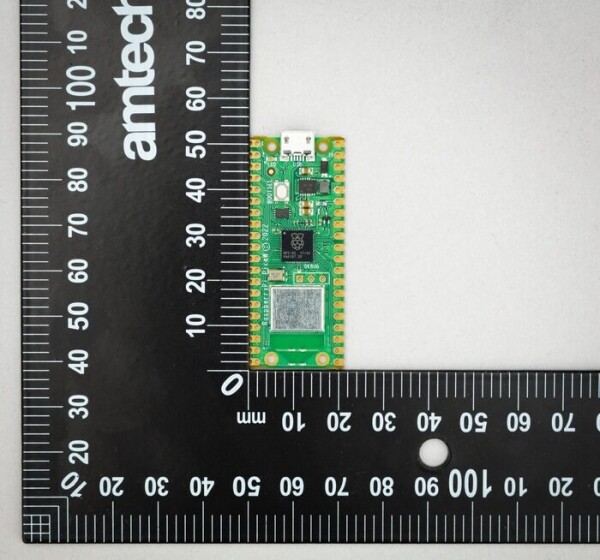
The RP2040 chip includes a dual-core ARM Cortex-M0+ processor (133MHz) with 264 KB of built-in SRAM, a DMA controller, temperature sensor, timer, and a USB 1.1 controller. The board houses 2 MB of Flash memory, but the chip supports expansion up to 16 MB. For input/output, it features GPIO ports (30 pins, with 4 dedicated to analog input), UART, I2C, SPI, USB (client and host with support for booting from UF2-formatted storage), and a specialized 8-pin PIO (Programmable I/O state machines) for connecting custom peripherals. Power can be supplied in the range of 1.8 to 5.5 volts, allowing the use of various power sources, including two or three standard AA batteries or typical lithium-ion batteries.
Applications can be developed using C, C++, or MicroPython. The MicroPython port for Raspberry Pi Pico has been prepared in collaboration with the project author and supports all chip features, including its custom PIO expansion interface. The Thonny IDE has been adapted for developing with the RP2040 chip using MicroPython. The capabilities of the chip are sufficient for executing applications aimed at solving machine learning tasks, for which a port of the TensorFlow Lite framework has been prepared. For network access, it is recommended to use the lwIP networking stack, which is included in the new version of the Pico SDK for C programming applications, as well as in the new MicroPython firmware.
Source: opennet.ru
