

Purism Company announcing the readiness of the first batch of smartphones , notable for its software and hardware features that block attempts to track and collect user information. The smartphone gives users full control over the device and is equipped solely with free software, including drivers and firmware.
Let’s recall that the Librem 5 smartphone comes with a completely free Linux distribution, PureOS, which uses the Debian package base and an adapted GNOME environment for smartphones, and is equipped with three hardware switches that allow you to disconnect the camera, microphone, WiFi/Bluetooth, and Baseband module at the circuit-breaking level. When all three switches are turned off, sensors (IMU + compass & GNSS, light, and proximity sensors) are also blocked. The components of the Baseband chip, responsible for cellular network operation, are separated from the main CPU that runs the user environment. The declared price of the Librem 5 is $699.
The operation of mobile applications is supported by the library , which develops a set of widgets and objects for creating user interfaces for mobile devices using GTK and GNOME technologies. The library allows the same GNOME applications to be used on smartphones and PCs — by connecting the smartphone to a monitor, you receive a standard GNOME desktop based on a single set of applications. For messaging, a decentralized communication system based on the Matrix protocol is provided by default.
Hardware specifications:
- The SoC i.MX8M features a quad-core ARM64 Cortex A53 CPU (1.5GHz), a Cortex M4 auxiliary chip, and a Vivante GPU with support for OpenGL/ES 3.1, Vulkan, and OpenCL 1.2.
- The Baseband chip is a Gemalto PLS8 3G/4G (can be replaced with Broadmobi BM818, produced in China).
- RAM — 3GB.
- built-in Flash 32GB plus microSD slot.
- 5.7-inch screen (IPS TFT) with a resolution of 720×1440.
- Battery capacity of 3500mAh.
- Wi-Fi 802.11abgn 2.4 GHz / 5 GHz, Bluetooth 4,
GPS Teseo LIV3F GNSS. - Front and rear cameras of 8 and 13 megapixels.
- USB Type-C (USB 3.0, power, and video output).
- Slot for reading smart cards 2FF.
Additionally, it is worth noting for the start of production of another smartphone , developed by the Pine64 community. The device is built on a quad-core ARM Allwinner A64 SoC with a Mali 400 MP2 GPU, features 2GB of RAM, a 5.95-inch screen (1440×720), Micro SD (with support for booting from SD card), 16GB eMMC, a USB-C port with a combined video output for connecting a monitor, Wi-Fi 802.11/b/g/n, Bluetooth 4.0 (A2DP), GPS, GPS-A, GLONASS, two cameras (2 and 5MP), a 3000mAh battery, and hardware-switchable components with LTE/GNSS, Wi-Fi, microphone, speakers, and USB.
The first units of the PinePhone for developers and testers will begin distribution in the fourth quarter of 2019, with widespread sales scheduled to start on March 20, 2020. The final price is not specified, but initially, the developers at $149.
The device for enthusiasts who are tired of Android and seek a fully controllable and secure environment based on alternative open Linux platforms. The hardware is designed for replaceable components — most modules are not soldered but connected via detachable ribbons, allowing, for instance, to replace the mediocre camera supplied by default with a higher-quality one. It is claimed that a complete disassembly of the phone can be done in 5 minutes.
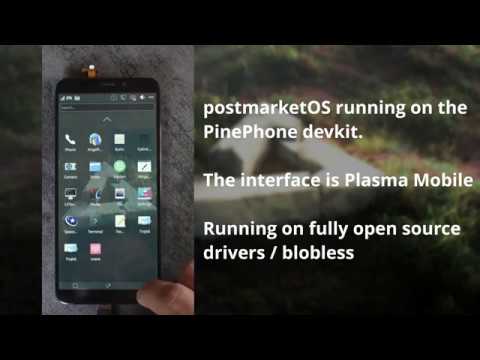
Boot images based on Maemo Leste , KDE Plasma Mobile and , are being prepared for installation on the PinePhone, with efforts underway to create builds with , Sailfish . The software environment can be loaded directly from the SD card without needing to perform a firmware reflash.
Source: opennet.ru
