

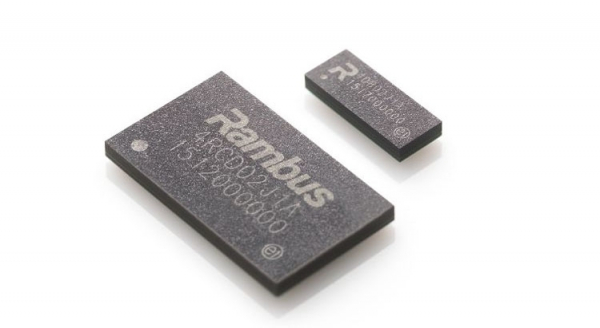
Three and a half years ago, "the most legal company in Silicon Valley," as Rambus is often referred to, decided to work on a new image. Around that time, the company got a new director who promised to transform Rambus into a fabless developer of various innovative solutions. The company's first products were for DDR4 server-class register and standard memory. The company does not disclose details, but only in the last year, quarterly revenue from buffer sales has increased by 40%. Interestingly, the memory module market shrank by up to 30% over the year, which, as we can see, did not harm Rambus. The company continues its buffer production theme by releasing solutions for DDR5 memory, samples of which are already being sent to interested clients.
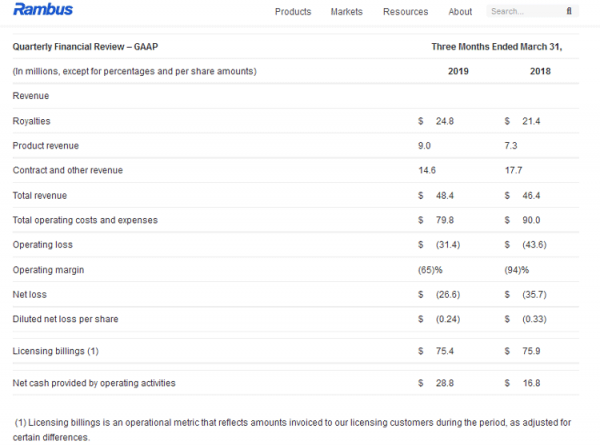
In Rambus's words, manufacturing activity looks appealing, but in reality, this type of business a series of quarterly losses. In the report for the first quarter of 2019, the company noted that against the background of its licensing business, manufacturing revenue continues to incur losses. In total, during the reporting period, the company earned $48.4 million. Of this, licensing fees brought Rambus $24.8 million, while manufacturing contributed $23.6 million. Operating expenses for the company's maintenance and production needs reached $79.8 million, resulting in quarterly operating losses of $31.4 million and net quarterly losses of $26.6 million. At the same time, in the first quarter, the company billed clients $75.4 million, payments for which will ultimately allow it to remain profitable.
Separately, without providing details, Rambus reports that it has achieved record revenue from the sale of various IP blocks. The annual growth rate in this area reached 50%. For external SoC and ASIC developers, the company sells ready-made SerDes interface blocks, the latest 7nm 112G for 400 and 800 GBE ports, as well as 7nm PHY blocks to support GDDR6 memory. Thus, Rambus's latest developments will appear in a multitude of new products from FPGAs to SoCs and GPUs, and will also address capacity scaling issues in the 5G mobile network infrastructure and data processing centers.
Source: 3dnews.ru
