

Unexpectedly for all cybersecurity experts, Google announced that a significant acceleration of the timeline for Q-Day — the moment when quantum computers will be able to crack modern public key cryptography. In a document released on March 25, 2026, the company stated that it now plans to be fully prepared for this event by 2029, rather than in a more distant future as previously believed.
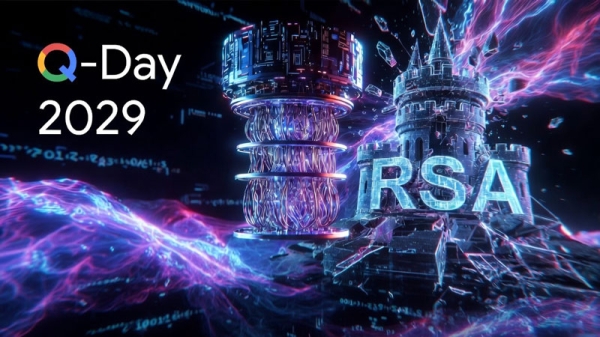
Google's Vice President of Engineering Security Heather Adkins and Senior Cryptographer Sophie Schmieg emphasized that the company is taking on the responsibility of a leader and urges the entire industry to expedite the transition to post-quantum cryptography (PQC) to protect the data of military, banks, governments, and ordinary users.
"As pioneers in quantum computing and quantum computers, we must lead by example and share our ambitious plans," they wrote. "We hope this will provide clarity and give the momentum needed to accelerate the digital transition not only within Google but throughout the industry."
"Q-Day" represents a threshold after which a sufficiently powerful quantum computer will be able to solve integer factorization problems (Shor's algorithm) and discrete logarithm problems, which underpin RSA and elliptic curves (elliptic cryptography) in a reasonable timeframe.
As quantum systems and algorithms have developed, it was believed that achieving "Q-Day" would first require billions of physical qubits, then 20 million physical qubits, and finally, last May, a paper came out, which reported that to break modern cryptography, it would take "only" one million noisy qubits and a week of quantum computer operation, prompting a reassessment of long-term forecasts. Moreover, in recent weeks, something else has occurred that Google is not yet disclosing and which may have led to the sudden revision of the threat timeline.
In principle, the transition to post-quantum cryptography has already begun: new algorithms based on lattices and hash functions (for example, CRYSTALS-Kyber) are being implemented in the Signal protocols, Google services, Apple, and Cloudflare. However, the implementation remains sporadic and incomplete. Google highlights two main dangers: the current "save now - decrypt later" attack for encrypted data and the future threat to digital signatures. That is why the company is prioritizing the transition of its authentication systems, including Android, to PQC.
The company urges all engineering teams to follow its example and accelerate the migration to post-quantum cryptography. In its view, only coordinated industry actions can prevent a cryptographic apocalypse and maintain internet security in the age of quantum computing. Interestingly, U.S. authorities and the NSA in particular are preparing to meet "Q-Day" no earlier than 2031, and most likely after 2033. It is anyone's guess why Google has entered panic mode. While specialists are trying to make sense of the company's warning, developers expect increased load due to the urgent implementation of new security protocols in signatures and applications.
Source:
Source: 3dnews.ru
