

A year and a half ago, while reading papers on vulnerabilities , I found myself not quite understanding the difference between the abbreviations i.e. and e.g. That is, contextually, they seem clear, but later on, they might not feel quite right. As a result, I created a small cheat sheet for myself regarding these abbreviations to avoid confusion. That’s when the idea for this article emerged.
Time passed, I collected a variety of Latin words and abbreviations encountered in English sources, and today I'm ready to share it with the readers of Habr. It's worth noting that many of these phrases are actively used in academic literature in Russian, but in English, they are frequently found even in popular sources. I hope this compilation will be helpful for those who are not engaged in scientific work in the Russian-speaking environment but often encounter serious texts in English where Latin insertions can be confusing.
Commonly Used Abbreviations and Expressions
etc. – et cetera, "and so on." It is pronounced in Latin as [ˌɛt ˈsɛt(ə)ɹə], and unlike most other abbreviations, it is often used in spoken language. You can learn the pronunciation from the excellent Elenore by The Turtles – the only song with etc. in the lyrics that made it to the charts.

♫Elenore, gee I think you’re swell
♫And you really do me well
♫You’re my pride and joy, etc.
et al. – et alii, "and others," pronounced as written [ɛtˈɑːl]/[ˌet ˈæl]. It almost always refers to people (to shorten the list of authors in the body of work), and rarely may imply other locations in the text (Latin. et alibi) during peer review. In very rare cases, it is used to mean "and so on" (Latin. et alia).
Note that these countermeasures only prevent Meltdown, and not the class of Spectre attacks described by Kocher et al. [40].
Note that these countermeasures only mitigate Meltdown and are ineffective against Spectre-class attacks as described by Kocher and others [40].

i.e. – id est, "that is", "in other words." It is pronounced either as the abbreviation IE ([ˌaɪˈiː]), or simply as that is.
To prevent the transient instruction sequence from continuing with a wrong value, i.e., '0', Meltdown retries reading the address until it encounters a value different from '0' (line 6).
To prevent the continuation of the transient instruction sequence with an incorrect value, i.e. with '0', Meltdown attempts to read the address again until it finds a value different from '0' (line 6). (Here, "incorrect value" refers exclusively to "0", and the chapter is titled The Case of 0 – "The Zero Case").
viz. – videre licet, "namely". In most cases, it is read as namely or to wit. From i.e. it differs in that i.e. – this is a clarification, while viz. – is a mandatory comprehensive indication of the object(s) following the declaration of their designation/list. Some sources consider the variant i.e.; indeed, in the works of the second half of the 20th century viz. it appears significantly more often than in modern times.
Since this new class of attacks involves measuring precise time intervals, as a partial, short-term, mitigation, we are disabling or reducing the precision of several time sources in Firefox. This includes both explicit sources, like performance.now(), and implicit sources that allow building high-resolution timers, viz., SharedArrayBuffer.
Since this new class of attacks involves precise timing measurement, as a partial temporary solution, we are disabling or reducing the precision of some time sources in Firefox. These include both explicit sources like performance.now() and implicit ones that allow creating high-resolution timers, namely SharedArrayBuffer.
e.g. – exempli gratia, "for example", "in particular". It is read as for example, less often as the abbreviation EG. Unlike the previous two abbreviations, it is specifically used as an example, rather than a listing of all values.
Meltdown does not exploit any software vulnerability, i.e., it works on all major operating systems. Instead, Meltdown exploits side-channel information available on most modern processors, e.g., modern Intel microarchitectures since 2010 and potentially on other CPUs from other vendors.
Meltdown does not use any software vulnerabilities, i.e., it works on all major operating systems. Instead, it exploits side-channel information available on most modern processors, specifically Intel microarchitecture since 2010 and possibly CPUs from other manufacturers.
N.B. – nota bene, "note well". It is written in capital letters.
vs., v. – versus, "against", [ˈvɝː.səs]. Notably, the borrowed word in Latin had a different meaning – "direction after a sharp turn." In medieval philosophers, the phrase can be encountered versus Deus in constructions like "Petya robbed caravans all his life, and when he was caught and sentenced to the gallows, he suddenly turned to God».
c., cca., ca., circ. – circa, "approximately" regarding dates. It is pronounced [ˈsɝː.kə].
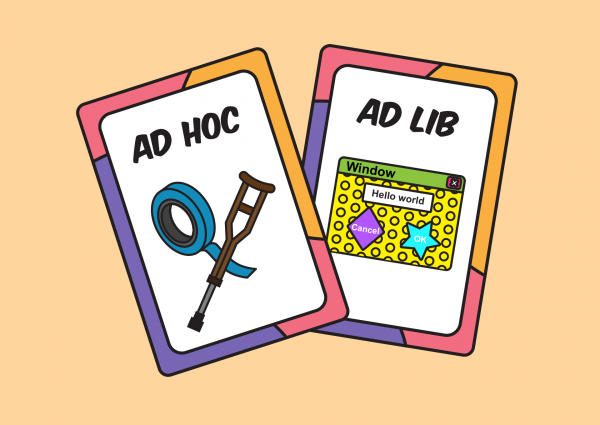
ad hoc – "special", "situational", "temporary", literally translates to "for this". It denotes something that addresses a specific, narrowly defined, and often urgent task. It can be used in the sense of "stopgap".
This observation led to a proliferation of new Spectre and Meltdown attack variants and even more ad hoc defenses (e.g., microcode and software patches).
This observation led to an increase in the number of new variants of Spectre and Meltdown attacks and an even greater number of situational defensive solutions (specifically, microcode systems and patches).
If you don’t have a capacitor to use as a bypass, you may omit it as an ad hoc solution.
If you don’t have a capacitor for isolation, you can do without it as a temporary stopgap.
ad lib – short for ad libitum, "at will", "impromptu". It signifies spontaneity, improvisation, a sudden idea. It differs from ad hoc in that it allows for greater freedom. For example, "Our pipe burst, the emergency service promised to arrive in an hour, so we had to rig something up with buckets" – ad hoc. "I forgot to buy sour cream for the dumplings, so I tried mayonnaise" – ad lib.
I forgot my script, so I spoke ad lib
I forgot the text, so I improvised

[sic] – "thus in the original". In academic texts, it indicates the original spelling (in a dialect, outdated, typographical error, etc.). With the rise of social media, it has gained popularity as a mocking reference to mistakes and typos in tweets and other posts ("look at this fool!").

Freshly elected President Donald Trump risked further escalating tensions between the U.S. and China when on Saturday he accused China via Twitter of a "unprecedented [sic] act" of seizing a U.S. underwater drone this week.
Abbreviations in bibliographic references and footnotes
ibid., ib. – ibidem, there (referring to the source);
id. – idem, the same (referring to the author). By strict rules, ibid. literally means "there" – in the same source on the same page – and does not imply any further specification, while id. refers to another place in the same source and is always supplemented by the page number (or passim). In reality, many authors only use ibid. and freely provide it with new page numbers.
op. cit. – opere citato, "the cited work". It replaces the title of an article or book when ibid. is not suitable, as other works have intervened between mentions of the same work (e.g., in footnotes); it is written after the author's last name:
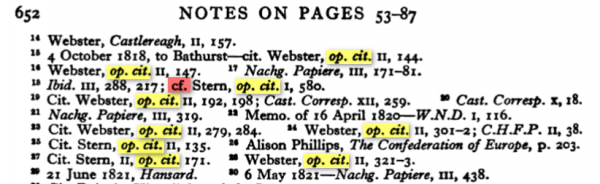
cf. – confer – "e.g.", "compare". Unlike see it points to another perspective for greater objectivity (see example above).
passim – "everywhere". Used when it is impossible to specify a particular page in the source because the sought idea/information permeates it.

et seq. – et sequentes – "and the following" for pages in the source.
f. and ff. – folio – another variant of "and the following", placed immediately after the page number without a space. One f. means one page, two ff. – an indefinite number of pages. ff. quite popular in the German language, as it resembles fortfolgende – "subsequent".
Note: in modern English, it is not recommended to use et. seq. and ff.; it is better to specify the page range directly.
Rarely used abbreviations
inf. and sup. – infra, supra – see below and see above respectively.
loc. cit. – loco citato – analogous to ibid.
sc. – scilicet – "that is", analogous to viz.
q.v. – quod vide – "see", "look at". Always refers to another place in the same work; in classical form it's self-sufficient, as it assumes the reader will find the required chapter. In modern usage, it's preferable to use see with a precise indication of where to look.
s.v. – sub verbo – essentially such <a href=""> before hypertext, indicates a specific dictionary article, the exact title of which follows immediately after the abbreviation.
And a bit more
Q.E.D. – quod erat demonstrandum – "which was to be demonstrated".
s.l. – sensu lato – "in a broad sense".
s.s. – sensu stricto – "in a strict sense".
verbatim – "literally", "word for word".
Source: habr.com
