

In brief
In 2017, an article titled “” appeared on Habr. In 2018, the technical committee “Cyber-Physical Systems” :
GOST R “Information technologies. Internet of Things. Terms and definitions,”
GOST R “Information technologies. Internet of Things. Reference architecture of the Internet of Things and the industrial Internet of Things,” GOST R “Information technologies. Internet of Things. Data exchange protocol for the Internet of Things in the narrowband spectrum (NB-FI).”
In February 2019 PNST-2019 “Information technologies. Internet of Things. Wireless data transmission protocol based on narrowband modulation of radio signals NB-Fi.” It came into effect on April 1, 2019, and will expire on April 1, 2022. During the three years of its operation, the preliminary standard must be tested in practice, its market potential must be assessed, and amendments to the standard should be prepared.
In the media, the document is actively positioned as “the first national IoT standard of the Russian Federation, with the potential to become an international standard,” citing the implemented NB-Fi project “VAVIOТ” .
Wow. So many links in such a short text. Here’s — to the text of the preliminary standard in the first edition for those too lazy to Google. It’s better to view the technical specifications of the standard in this document; we won’t mention them in the article.
About data transmission standards for IoT
You can come across around 300 protocols/technologies for data transmission between devices classified as IoT online. We live in Russia and work in B2B, so we will touch on just a few in this publication:
- NB-IoT
A cellular communication standard for telemetry devices. One of three implemented in LTE Advanced networks — NB-IoT, eMTC, and EC-GSM-IoT. The big three mobile operators in Russia launched segments of networks working with NB-IoT in 2017-2018. Operators do not forget eMTC and EC-GSM-IoT, but we won’t highlight them separately for now.
- LoRa
Operates on unlicensed frequencies. The standard is well described in the late 2017 article “What is LoRaWan” on Habr. It runs on Semtech chips.
- “Strizh”
Operates on unlicensed frequencies. A domestic provider of solutions for the housing and utilities sector and other industries. Uses its own protocol XNB. There are claims of production in Russia, but they promise to ensure mass production of chips in Russia only by 2020, while currently relying on ON Semiconductor (ON Semiconductor AX8052F143).
- Fresh NB-Fi
Operates on unlicensed frequencies. Uses the same chip ON Semiconductor AX8052F143 as 'Strizh', with similar technical specifications and also announces the production of its own chips in Russia. In general, a connection can be seen. The protocol is open.
About integration with billing systems
For those who have tried to set up a 'smart home', it quickly becomes obvious that using sensors from different manufacturers is significantly complicated. Even if two devices have the same labeling about the communication technology — it turns out they do not want to communicate with each other.
In the B2B segment, the situation is similar. Protocol and chip developers want to earn money. Starting a project with LoRa will require purchasing equipment based on Semtech chips anyway. Paying attention to a domestic manufacturer may also lead to the acquisition of services and base stations, and in the future, with the successful launch of chip production in Russia, it might be possible to buy equipment/component bases only from a limited number of vendors.
We work with telecom equipment, and it is common for us to gather telemetry data from the equipment, aggregate, normalize, and transmit it to various information systems. This block of work is handled by Forward TI (Traffic Integrator). In a typical case, this looks like:
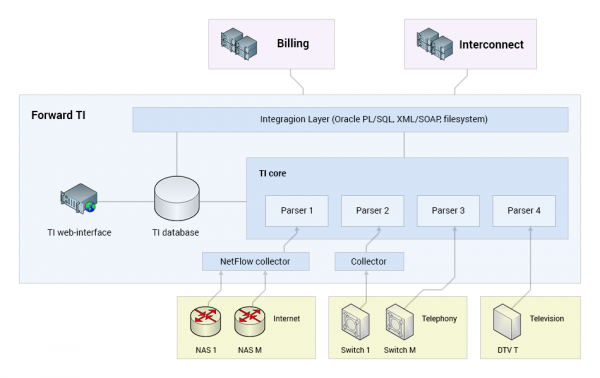
In cases where the customer's data collection needs expand, additional modules are connected:
The projected growth rate of the IoT device market is 18-22% annually worldwide and up to 25% in Russia. In April, at the IoT Tech Spring 2019 in Moscow, Andrey Kolesnikov, the director of the Internet of Things Association, stated an annual growth of 15-17%, but various information circulates online. At RIF in April 2019, slides presented data on the annual growth of the Russian Internet of Things market at 18% until 2022, and the size of the Russian market in 2018 was listed as $3.67 billion. Notably, the same slide mentioned the reason for today’s article: "The first Russian document on IoT standardization has been approved…" In our opinion, there is an urgent need to regularly integrate UNB/LPWAN base stations and telecommunications servers into billing systems.
Reflections
First Line
The data transmission protocol or the implementation of a transport function will not be of significant importance (we are again referring to the fact that IoT is not just an iron connected to the internet, but rather an infrastructure or ecosystem). Data will be collected from completely different devices and the payload will also vary. It is unlikely that an electricity supplier will build a single data collection network, a gas supplier a second network, a wastewater service a third, etc. This is not rational and seems unlikely.
Thus, in a conditional location, the network will be organized according to one principle and data collection will be handled by one organization. Let’s call such an organization a data aggregator operator.
The data aggregator operator can be a service that only transmits data, or a full-fledged intermediary that takes on all the complexities related to billing, organizing payment for services rendered, and interaction with end-user clients and service providers.
I have often seen people digging five receipts out of their mailbox every month; I am familiar with such a situation myself. A separate receipt for gas, another for electricity, one for capital repairs, one for water, and one for house maintenance. This does not include paying the monthly bills that exist only online — payment for internet access, mobile services, subscriptions to various content providers. Auto-payment can be set up somewhere, but not everywhere. However, the overall situation has already become a tradition — sitting down once a month to pay all the bills, a process that can stretch for half an hour to an hour, and if there’s a glitch in the service providers' information systems, one may have to carry over some payments to another day. I would prefer to interact with one service provider for all matters instead of dividing attention among a dozen bills and websites. Modern banks simplify life, but not completely.
Therefore, the automatic collection of data on consumed services and transferring the payment for services to a single "window" is a blessing. The aforementioned data collection through traffic integrators, like our Forward TI, is just the tip of the iceberg. The traffic integrator represents the first line through which telemetry data and payload will be collected, and unlike providers who are only concerned with the volume of traffic consumption for its own sake, in IoT, the priority will be given to the payload.
Let’s take a close example from telecom to illustrate what the first line is engaged in. There is an operator providing communication services. A call lasts 30 minutes. 15 minutes of the call fall into one day, and 15 into another. The telephone exchange at the boundary of the days splits the call and records it in 2 CDRs, essentially turning one call into two. TI will, based on indirect signs, merge such a call and transmit the data about one call into the billing system, even though the data from the equipment came in about two. At the data collection level, there should be a system capable of resolving such collisions. The next system, however, should receive normalized data.
The information in the traffic integrator is not only normalized but also enriched. Another example: data for zonal billing does not come from the telephone station, but we know from which location the call was made, and TI adds geographic zone billing information to the data sent to the next information system. Similarly, any computed parameters can be assigned. This is an example of simple zoning or data enrichment.
Another function of the traffic integrator is data aggregation. For example, data comes from the equipment every minute, while TI sends data to the accounting system every hour. Only the data necessary for billing and invoicing remains in the accounting system, reducing 60 records to just one. A backup of the raw data is also made in case processing is needed.
Second line
Let’s continue developing the idea of the aggregator becoming a full-fledged intermediary. Such an operator will service the data collection network and separate telemetry from payload. Telemetry will be used for its own needs, to maintain the data collection network in good condition, while the payload will be processed, enriched, normalized, and transmitted to service providers.
A moment of self-promotion because it's easier to illustrate with our own software than to come up with abstract examples.
On this line, the aggregator uses in its inventory:
- Billing that accounts for the incoming prepared data from TI, links it to registered consumers (subscribers), properly bills this data in accordance with the used tariff plan, generates invoices and receipts, accepts payments from subscribers, and distributes them to the corresponding accounts and balances.
- PC (Product Catalog) for creating comprehensive package offers and managing services within these packages, setting rules for connecting additional services.
- BMS (Balance Management System), this system must be multi-balance, requiring flexible management of charges for various services. It will also allow the use of several specialized billing systems serving individual services and aggregate the calculations received from them related to the subscriber's overall balance.
- eShop for interaction with end consumers, creating a public service showcase, providing access to the Personal Account with all the modern perks such as service usage statistics, online service switching, and requests for new services.
- BPM (Business Processes) automation of aggregator business processes directed at both servicing subscribers and interacting with service providers.
Third Line
This is where it gets really interesting from my perspective.
Firstly, there is a need for PRM (Partner Management System) class systems, which will allow for flexible management of agency and partnership schemes. Without such a system, managing the work of partners and suppliers will be challenging.
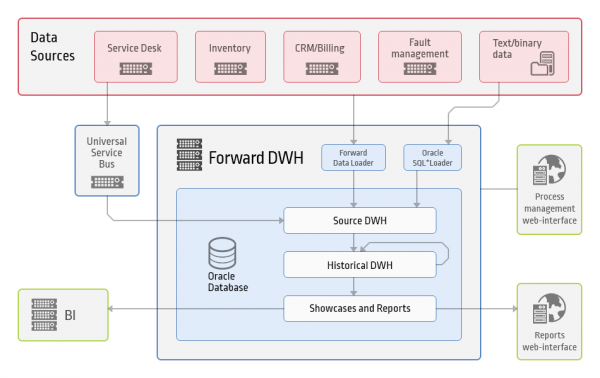
Secondly, there is a need for DWH (Data Warehouse) for analysis. This is where Big Data can expand on telemetry and payload data. It will also contribute to the creation of showcases for BI tools and various levels of analysis.
Thirdly, as the cherry on top, a forecasting system like Forward Forecast can be added. This system will allow for training a mathematical model underlying the system, segmenting the subscriber base, and generating consumption and behavior forecasts for subscribers.
In total, a rather complex information architecture of the aggregator operator emerges.
Why do we highlight three lines in the article instead of combining them? The reason is that business systems usually require several aggregated parameters. The rest is needed for monitoring, servicing, reporting analysis, and forecasting. Detailed information is required for security and Big Data, as we often do not know which parameters and criteria will be analyzed in Big Data analytics. Therefore, all data in its original form is transmitted to the DWH.
In business systems with management functions – billing, PRM, some parameters that came with the equipment, telemetry, are no longer needed. Therefore, we filter out unnecessary fields, removing them. If necessary, we enrich the data according to certain rules, aggregate it, and finally normalize it for transfer to business systems.
As a result, the first line collects raw data for the third line and adapts it for the second. The second line works with normalized data and ensures the operational activities of the enterprise. The third allows identifying growth points from raw data.
What we expect in the future regarding the economics of IoT projects
First, about the economics. We mentioned the market size earlier. It seems that a substantial amount of money is already involved. However, we have seen economic models fail in projects that attempted to implement with our assistance or for which we were invited to assess. For example, we calculated the creation of an MVNO for M2M using SIM cards for telemetry collection from a certain type of equipment. The project was not launched because the economic model turned out to be unviable.
Large telecom organizations are advancing into the IoT market – they have the infrastructure, ready technologies. There are relatively few new human subscribers appearing in Russia. However, the IoT market offers excellent opportunities for growth and extracting additional profit from their networks. While a preliminary national standard is being tested and small enthusiastic companies are choosing different options for implementing UNB/LPWAN, large businesses will inject funds to capture the market.
We believe that over time, some single standard/protocol for data transmission will begin to dominate, as was the case with cellular communication. After that, risks will decrease, and equipment will become more accessible. But by then, the market may already be half-captured.
Ordinary people are getting used to the service; it is convenient for them when automated devices account for water, gas, electricity, internet, sewage, heating, and ensure the operation of security and fire alarms, panic buttons, and video surveillance. People will mature towards the mass use of IoT in the utility sector in the next 2-5 years. A bit more time will be needed to trust robots with refrigerators and irons, but that time is also not far off.
Concerns
The preliminary national standard NB-Fi has made headlines as a contender for international recognition. Among its advantages are the low cost of radio transmitters for devices and the possibility of domestic production in Russia. Back in 2017, the aforementioned article on Habr announced:
A base station for the NB-Fi standard will cost around 100-150 thousand rubles, a radio module for connecting devices to the network will be about 800 rubles, the cost of controllers for collecting and transmitting information from the meter will be up to 200 rubles, and the battery will cost 50-100 rubles.
But for now, these are just plans, and a significant part of the elemental base for devices is produced abroad. The ON Semiconductor AX8052F143 is explicitly mentioned in the PNST.
One can hope that the NB-Fi protocol will indeed be open and accessible, free from speculation on import substitution and imposition. It should become a competitive product.
IoT is fashionable. However, it's essential to remember that first and foremost, the 'Internet of Things' is not about itemization and stacking data transmission to the cloud from everything possible. The 'Internet of Things' is about infrastructure and Machine-to-Machine optimization. Wireless data collection from electricity meters alone is not IoT. However, automated distribution of electricity to consumers from multiple sources—state and private suppliers—for an entire locality resembles the original concept of the Internet of Things.
On what standard would you build your data collection network? Do you have hopes for NB-Fi? Is it worth investing in the development of billing systems for data collection from devices of this standard? Perhaps you've participated in IoT project implementations? Share your experiences in the comments.
And good luck!
Source: habr.com
