

The developers of the SerenityOS operating system reported that the web browser developed by the project has successfully passed the Acid3 tests, which are used to check web browsers for compliance with web standards. It is noted that among the new open-source browsers created after the formation of Acid3, the SerenityOS Browser has become the first project to completely pass the tests.
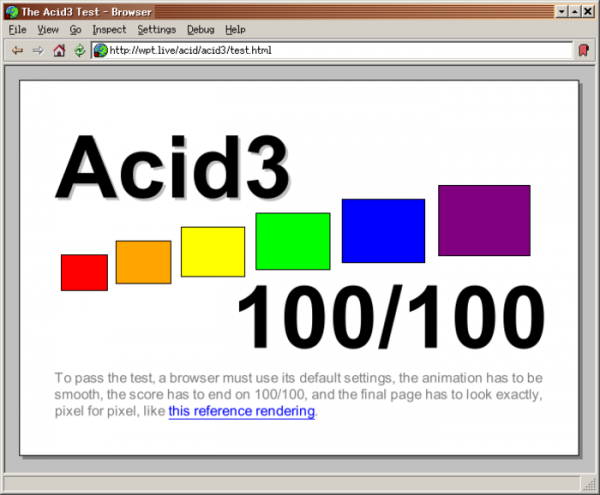
The Acid3 test suite was created in 2008 by Ian Hickson, the initiator of the HTML5 specification and co-author of CSS specifications. Acid3 includes 100 tests designed as functions that return a positive or negative result based on test completion. The tests cover various areas such as ECMAScript, HTML 4.01, DOM Level 2, HTTP/1.1, SVG, XML, and more. The tests were updated in 2011, but due to changes in modern web specifications, current versions of Chrome and Firefox only pass 97 out of 100 Acid3 tests.
The SerenityOS Browser is written in C++ and is distributed under the BSD license. The project uses its own browser engine, LibWeb, and the JavaScript interpreter, LibJS, which have been separated into external libraries. There is support for executing intermediate WebAssembly code. The libraries LibHTTP and LibTLS are being developed to support HTTP and HTTPS protocols.
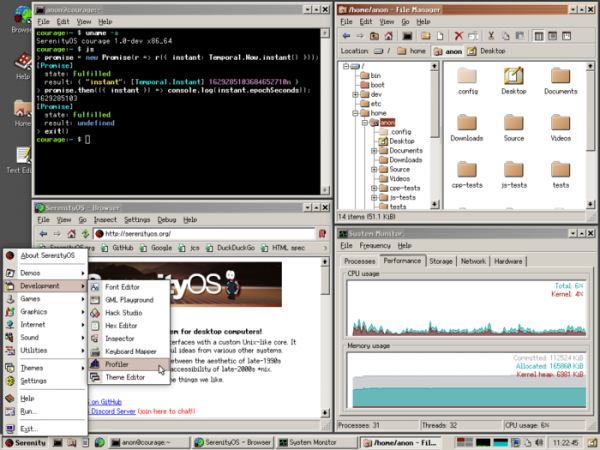
It should be noted that the Serenity project is developing a Unix-like operating system for x86 and x86_64 architectures, equipped with its own kernel and a graphical interface styled after operating systems from the late 1990s. The development is being carried out from scratch, out of curiosity, and is not based on the code of existing operating systems. The authors aim to bring SerenityOS to a level suitable for everyday use while preserving the aesthetics of late 90s systems, supplemented by useful ideas from modern systems for experienced users.
The SerenityOS kernel supports features such as preemptive multitasking, hardware protection mechanisms (SMEP, SMAP, UMIP, NX, WP, TSD), multithreading, IPv4 stack, Ext2-based file system, POSIX signals, mmap(), ELF executable files, pseudo-filesystem /proc, Unix sockets, pseudoterminals, and profiling tools.
The user environment consists of composite and console managers (WindowServer, TTYServer), a command line shell, the standard C library (LibC), a set of utility programs, and a graphical environment based on a proprietary GUI framework (LibGUI, LibGfx, LibGL) and a set of widgets. The suite of graphical applications includes an email client, an interface design environment called HackStudio, a text editor, a sound synthesizer, a file manager, several games, a program launcher interface, a font editor, a file download manager, a terminal emulator, configuration tools, a PDF viewer, the PixelPaint graphics editor, a music player, a spreadsheet editor, and a video player.
Source: opennet.ru
