

Google has released the Chrome 111 web browser. At the same time, a stable release of the open-source project Chromium, which forms the basis of Chrome, is available. The Chrome browser differs from Chromium by using Google logos, having a crash notification system, modules for playing copy-protected video content (DRM), an automatic update installation system, always enabled Sandbox isolation, supplying keys to Google API, and transmitting RLZ parameters during searches. For those who need more time to update, an Extended Stable branch is separately supported for 8 weeks. The next release of Chrome 112 is scheduled for April 4.
Key changes in Chrome 111:
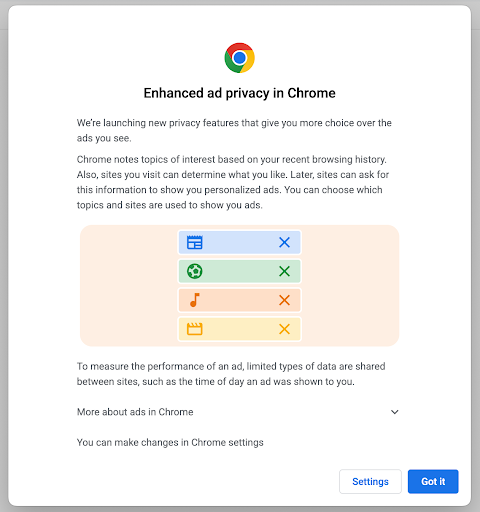
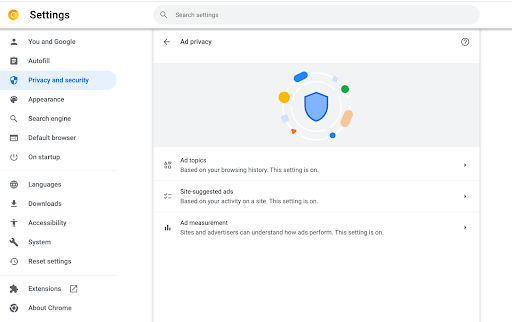
- User interface elements related to the Privacy Sandbox initiative have been updated, allowing the categorization of user interests and the use of these instead of tracking cookies to identify groups of users with similar interests without identifying individual users. The new version includes a dialog informing users about the capabilities of Privacy Sandbox and redirecting them to a settings page where they can configure the information shared with advertising networks.


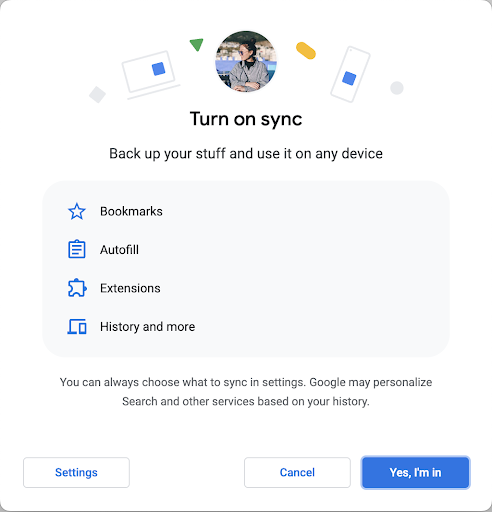
- A new dialog has been introduced, providing information about enabling synchronization between browsers for settings, history, bookmarks, autofill data, and other information.

- On Linux and Android platforms, DNS name resolution operations have been moved from an isolated network process to a non-isolated browser process, as certain sandbox restrictions applied to other network services cannot be implemented when working with the system resolver.
- Support has been added for automatic user sign-in to Microsoft identity services (Azure AD SSO) using account information from Microsoft Windows.
- The Chrome update mechanism on Windows and macOS now handles updates for the last 12 versions of the browser.
- To use the Payment Handler API, which simplifies integration with existing payment systems, an explicit definition of the source of loaded data is now required via the connect-src directive in the Content Security Policy (CSP). domains, to which requests are sent.
- The PPB_VideoDecoder(Dev) API has been removed, as it became obsolete after Adobe Flash support was discontinued.
- The API View Transitions has been added, simplifying the creation of transition animation effects between different DOM states (for example, a smooth transition from one image to another).
- The CSS query '@container' has added support for the style() function to apply styles based on computed values of the parent element's custom properties.
- Trigonometric functions sin(), cos(), tan(), asin(), acos(), atan(), and atan2() have been added to CSS.
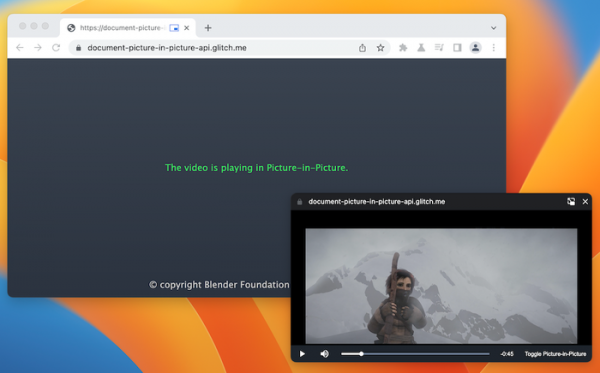
- An experimental (origin trial) API Document Picture in Picture has been added to open arbitrary HTML content in a 'picture-in-picture' mode, not just videos. Unlike opening a window via window.open(), windows created through the new API always appear on top of other windows, do not persist after closing the original window, do not support navigation, and cannot explicitly define the output position.

- The ability to resize ArrayBuffer and extend the size of SharedArrayBuffer has been provided.
- WebRTC has implemented support for SVC (Scalable Video Coding) extensions to adapt the video stream to the client's bandwidth and transmit multiple video streams of different quality in a single stream.
- The Media Session API has added 'previousslide' and 'nextslide' actions to facilitate navigation between the previous and next slides.
- A new syntax for pseudo-classes ':nth-child(an + b)' and ':nth-last-child()' has been introduced, allowing the retrieval of a selector for pre-filtering child elements before applying the main 'An+B' selection logic.
- New units for font size measurements of the root element have been added in CSS: rex, rch, ric, and rlh.
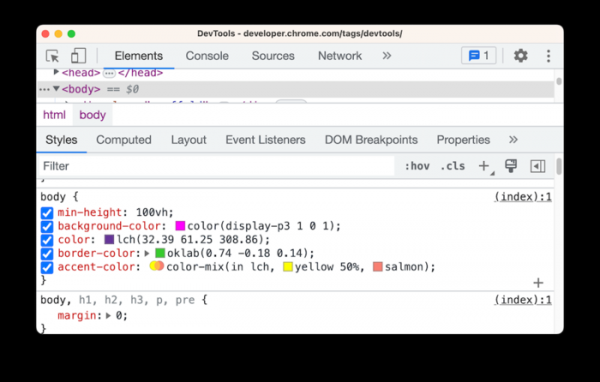
- Full support for the CSS Color Level 4 specification has been implemented, including support for seven color palettes (sRGB, RGB 98, Display p3, Rec2020, ProPhoto, CIE, and HVS) and 12 color spaces (sRGB Linear, LCH, okLCH, LAB, okLAB, Display p3, Rec2020, a98 RGB, ProPhoto RGB, XYZ, XYZ d50, XYZ d65), in addition to previously supported color formats Hex, RGB, HSL, and HWB. The ability to use custom color spaces for animations and gradients has been provided.
- A new function color() has been added in CSS, which can be used to define color in any color space where colors are specified using R, G, and B channels.
- A color-mix() function has been added, defined in the CSS Color Level 5 specification, allowing colors to be mixed in any color space based on a specified percentage (for example, to add 10% blue to white, you can specify "color-mix(in srgb, blue 10%, white);").
- Improvements have been made to web developer tools. The Styles panel has added support for the CSS Color Level 4 specification and its new color spaces and palettes. The color picker tool now supports new color spaces and the ability to convert between different color format specifications. The JavaScript debugger has been revamped. control panel with breakpoints.

In addition to innovations and bug fixes, the new version has eliminated 40 vulnerabilities. Many of these vulnerabilities were identified through automated testing using tools like AddressSanitizer, MemorySanitizer, Control Flow Integrity, LibFuzzer, and AFL. No critical issues that allow bypassing all browser security levels and executing code on the system outside the sandbox environment have been found. As part of the bug bounty program for this release, Google has awarded 24 bounties amounting to $92,000 (one bounty of $15,000 and $4,000, two bounties of $10,000 and $700, three bounties of $5,000, $2,000, and $1,000, and five bounties of $3,000).
Source: opennet.ru
