

The release of Fedora Linux 41 has been announced. The products Fedora Workstation, Fedora Server, Fedora CoreOS, Fedora Cloud Base, Fedora IoT Edition, Fedora Silverblue, Fedora Kinoite, and Live images are prepared for download in the form of spins with desktop environments KDE Plasma, Xfce, MATE, Cinnamon, LXDE, Phosh, Miracle, LXQt, Budgie, and Sway. The builds are created for architectures x86_64, Power64, and ARM64 (AArch64).
The most significant changes in Fedora Linux 41 include:
- The DNF5 package manager is now used by default, which has unified existing low-level libraries and rewritten components that previously used Python in C++. The core functionality of package management has been transferred to a separate library, libdnf5. The use of C++ instead of Python has eliminated a large number of dependencies, reduced the size of the toolkit, and improved performance.
The DNF5 toolkit is also free from its dependency on PackageKit. Instead, a new background process, DNF Daemon, is used to replace PackageKit's functionality and provide an interface for managing packages and updates in graphical environments. Among the visible improvements for users is a more intuitive indication of progress in operations; support for using local RPM packages for transactions; the ability to display in reports on completed transactions information issued by scripts embedded in packages (scriplets); and a more advanced input autocompletion system for bash.
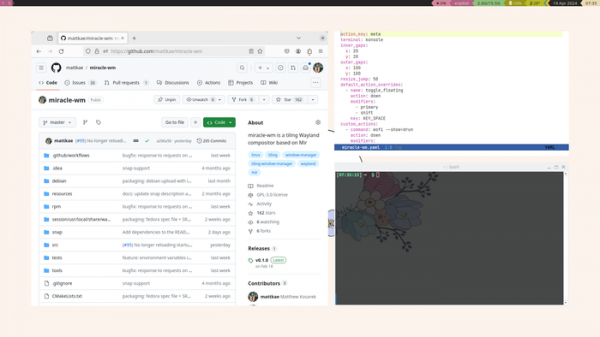
- An official Spin version of Fedora has been created with a graphical environment based on the compositing manager Miracle, which uses the Wayland protocol and components for building compositing managers with Mir. The goal of creating this new build is to provide a functional and elegant user environment with a tiling window layout in the style of the i3 window manager and a more vibrant graphic design with visual effects.

- The GNOME desktop in Fedora Workstation has been updated to version 47, which features a new style for dialog windows, improved performance on low-resolution systems, hardware-accelerated video encoding for screencasting, and completely redesigned open and save file dialogs.
- GNOME Software has restored the ability to install proprietary NVIDIA drivers and simplified the process of adding a digital signature for driver operation when booting the distribution in Secure Boot mode. The option to create and save a digital signature for the NVIDIA kernel module in MOK (Machine Owner Key) has been provided.
- The default Fedora Workstation installation has removed GNOME packages related to the X11 protocol. Among the default supported sessions, only Wayland remains, but packages for setting up an X11 session can be installed separately from the repositories. The main reason for discontinuing X11 support in Fedora is the classification of the X.Org server in RHEL 9 as deprecated and the decision to completely remove it in a future major release of RHEL 10.
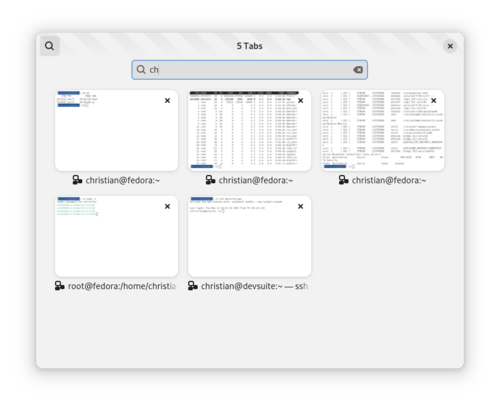
- In Fedora Workstation, the Ptyxis terminal emulator has been implemented as the default instead of GNOME Terminal, providing additional capabilities for working with containers using Toolbox, Distrobox, Podman, and JHBuild tools. Ptyxis is also distinguished by its very high rendering speed, broader configuration options, and the availability of a preview mode for visual navigation among open sessions.

- The KDE desktop edition has been updated to KDE Plasma 6.2. Builds with KDE for the AArch64 architecture have been categorized as blocking the release if serious issues are found.
- A new Spin edition with the KDE Plasma Mobile environment has been added, which can be used on mobile devices. In addition to the classic build, an atomically updated variant with KDE Plasma Mobile is also available.
- The build based on the custom LXQt environment has been updated to LXQt 2.0.
- Package versions have been updated, including GCC 14, binutils 2.42, glibc 2.40, Python 3.13, Go 1.23, Node.js 22, Perl 5.40, and RPM 4.20.
- The network-scripts package, which provided support for classic network configuration scripts based on the use of ifup and ifdown commands, has been removed. Such scripts have been deprecated since 2018. The reason for the removal is the plans to eliminate ISC DHCP, whose maintenance was stopped at the end of 2022. The contents of network-scripts are heavily tied to ISC DHCP, and transitioning to another DHCP client is not feasible due to the cessation of the package's development. It is recommended to use the nmcli utility from NetworkManager or the networkctl command instead of the ifup and ifdown commands.
- Support for ifcfg format connection profiles has been discontinued in NetworkManager.
- Support for Intel IPU6 cameras has been added, and a new open stack for cameras connected via the MIPI (Mobile Industry Processor Interface) has been implemented. The MIPI interface is used in many new laptop models instead of the previously used USB video streaming from devices that support the UVC (USB Video Class) standard. Multimedia can be used to capture video from MIPI cameras. server Pipewire.
- The Firefox package now includes support for operating with cameras through the Pipewire multimedia server by default.
- In builds using an atomic update model (Fedora Atomic Desktops), changes have been made to the Polkit rules allowing ordinary unprivileged users to perform system updates without entering an administrator password. Additionally, the number of privileged operations requiring a password has been expanded for execution by administrators (for additional confirmation of dangerous operations such as changing kernel parameters, installing packages from the local filesystem, and changing the system image).
- Atomic update editions of the Fedora CoreOS and Fedora IoT distributions have been switched by default to the Composefs filesystem, allowing these builds to use a root partition operating in read-only mode, and further utilize verification tools for the system partition to detect emerging issues during operation. The /etc and /var partitions continue to be mounted with write access. The Composefs filesystem is implemented as an overlay on the already present OverlayFS and EROFS filesystems in the kernel, optimized for effective shared storage of content from multiple mounted disk images.
- A new utility, bootc, is introduced in atomic update editions of Fedora, such as Fedora Atomic, CoreOS, and Fedora IoT, replacing rpm-ostree and designed for transactional system updates using images in OCI (Open Container Initiative) format. The bootupd utility is used to update the bootloader in atomic builds.
- In the editions with GNOME, KDE Plasma, and Budgie, a background process called tuned is used to manage power profiles instead of power-profiles-daemon, providing more options for configuring power consumption modes.
- Due to the transition of the Redis database management system codebase to a proprietary license, a fork called Valkey has been proposed instead of Redis.
- Most packages now support reproducible builds, allowing verification that the distributed binaries are built from the provided source texts and contain no hidden changes.
- The installer now includes support for self-encrypting drives (SED) with the OPAL2 TCG interface, where the hardware encryption device is integrated directly into the controller.
- The PyTorch library package has added support for the ROCm stack for hardware acceleration on AMD GPUs. The PyTorch package has been updated to version 2.4, and ROCm to version 6.2.
- The raster graphics editor GIMP package has switched to providing pre-release versions, based on which GIMP 3 will be released.
- A new utility called fedora-repoquery has been added, allowing users to search for packages in the Fedora, EPEL, eln, and CentOS Stream repositories.
- In the OpenSSL package, by default, trust in digital signatures created using SHA-1 hashes has been discontinued.
- Support for using a TLS implementation at the kernel level (kTLS) has been added for accelerating GnuTLS.
- For building CPython in GCC, the optimization mode '-O3' has been enabled instead of the default mode '-O2', which has improved Python performance by about 4%.
- The delivery of packages with Python 2, as well as all packages requiring Python 2.7, has been discontinued.
- The generation of 32-bit PHP packages has been discontinued.
Additionally, it is worth noting the introduction of the 'free' and 'nonfree' repositories for Fedora 41 from the RPM Fusion project, which provide packages with additional multimedia applications (MPlayer, VLC, Xine), audio/video codecs, DVD support, proprietary AMD and NVIDIA drivers, gaming programs, and emulators.
Source: opennet.ru
