

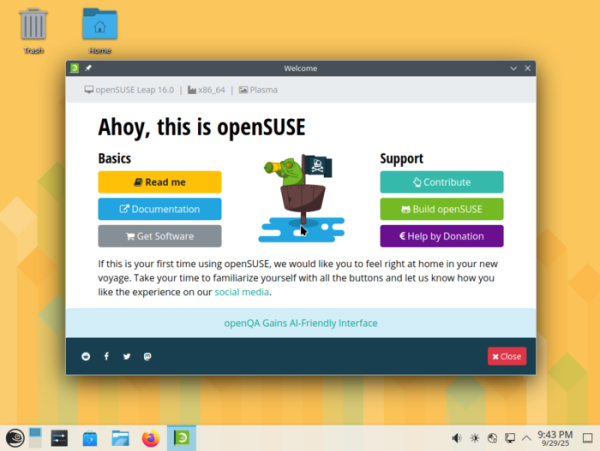
The release of openSUSE Leap 16.0 has taken place, built on the technologies of the next significant branch of the commercial distribution SLES 16, which is transitioning to the new SLFO platform (SUSE Linux Framework One), previously known as ALP (Adaptable Linux Platform). openSUSE Leap 16 retains the features of a classic distribution that uses traditional packages, while those who require an atomically updatable system with a read-only base should use the openSUSE Leap Micro edition. A universal DVD image is available for download, sized at 4.2 GB (x86_64, aarch64, ppc64le, 390x) and a minimized installation image for package download over the network (600 MB).
The time frame for forming updates for openSUSE Leap 16.x releases has been extended from one and a half to two years (two full release preparation cycles). Interim releases in the openSUSE Leap 16 branch, which is developed in parallel with the commercial distribution SUSE Linux Enterprise 16, will be created until autumn 2031 — the final release will be openSUSE Leap 16.6, for which updates will be released until autumn 2033. As before, new significant versions of the distribution will be published once a year.
Key features of openSUSE Leap 16:
- A new installer, Agama, has been implemented, notable for separating the user interface from the internal components of YaST and providing a frontend for managing installations via a web interface.
- The installer offers only desktop environments that use Wayland for installation.
- Instead of the traditional YaST stack for system management, the Cockpit package is used, and a new package, Myrlyn, replaces the YaST Software GUI.
- By default, the SELinux mandatory access control system is enabled. AppArmor support is retained as an option.
- Support for SysV init scripts has been discontinued. Only systemd units can be used.
- Support for the x86-64-v1 architecture has been discontinued. Operation is only possible on x86 systems with x86_64-v2 architecture, which has been supported by processors since around 2009 (starting with Intel Nehalem) and is characterized by the presence of extensions such as SSE3, SSE4_2, SSSE3, POPCNT, LAHF-SAHF, and CMPXCHG16B.
- By default, support for 32-bit x86 systems and the execution of 32-bit binaries is disabled in the kernel. To continue using the Steam application, which exists only in a 32-bit version and requires installed 32-bit dependencies, openSUSE has implemented the grub2-compat-ia32 package, which sets the parameter "ia32_emulation=1" when booting the Linux kernel. The installation of the selinux-policy-targeted-gaming package, which is not included in the base distribution, is also required for Steam to work.
- The Wine package is only available in 64-bit builds, using Wow64 (64-bit Windows-on-Windows) mode to run 32-bit Windows applications on 64-bit Unix systems.
- Repository management utilizes a service based on the RIS (Repository Index Service) protocol. To reduce the size of metadata, repositories are divided for each supported architecture. Instead of multiple repositories, a single shared repository, repo-oss, is used, which includes packages from SUSE Linux Enterprise as well as community-supported packages.
- The Zypper package manager features parallel downloading of packages and metadata, along with a new backend that optimally reuses already established connections, enhancing metadata processing efficiency. During the update of 250 packages with a total size of 100 MB, the download time decreased from 68.7 seconds to 13.1 seconds after enabling the new backend and parallel mode, while updating 407 packages with a size of 1 GB dropped from 281.1 seconds to 119.6 seconds.
- Popular library options have been added, such as boost, openjpeg2, sqlite3, libgcrypt, openssl, and zlib, compiled with optimizations for new CPUs. The optimized options are loaded on systems with new CPUs using a linker from the glibc-hwcaps subdirectories created in file system areas checked for library searches.
- On systems with NVIDIA graphics cards, open kernel modules are enabled by default, and automatic installation of user-space components necessary for accelerating graphics operations is provided.
- By default, multimedia support replaces PulseAudio. server PipeWire.
- Only NetworkManager is retained for configuring network connections.
- To apply patches to user-space libraries without stopping their operation, the libpulp toolkit is utilized. Live patches are used to fix critical bugs and vulnerabilities in glibc and openssl on systems with x86-64 and ppc64le architectures.
- A predictable naming scheme is used for network interfaces, where each network adapter is assigned a fixed name that does not change with the addition or removal of other adapters.
- The default systemd settings have been moved from the /etc directory to /usr.
- SSH access for the root user with password authentication is disabled by default.
- A background process tuned has been included to perform automatic optimization of hardware and kernel settings based on current load.
- Support for NFS over TLS has been added.
- tmpfs is used to store the /tmp partition, keeping data in memory and not preserving contents between restarts.
- Package versions have been updated, including kernel 6.12, glibc 2.40, systemd 257, wine 10.10, dovecot 2.4, QEMU 10.0.2, MariaDB 11.8, PostgreSQL 17, PHP 8.4, Node.js 22, Python 3.13, Rust 1.88, ruby 3.4, and clang 19, gcc 15.
- Updated user environments: GNOME 48 (previously GNOME 45), KDE 6.4 (was 5.27), Cinnamon 6.4 (was 6.0), LxQt 2.2 (was 1.2), Xfce 4.20 (was 4.18), MATE 1.28 (was 1.26), Sway 1.10 (was 1.6). The graphical stack components have been updated to Mesa 24.3 and Qt 6.9. Support for using Xfce 4.20 on top of the labwc compositor utilizing Wayland has been provided. Instead of LightDM for managing the login screen, greetd and gtkgreet can now be used. A Wayland session based on LXQt has been added.
Source: opennet.ru
