

The release of the Firefox 130 web browser has taken place, and updates for previous long-term support branches — 115.15.0 and 128.2.0 — have been formed. The Firefox 131 branch has entered beta testing, with the release scheduled for October 1.
Key innovations in Firefox 130:
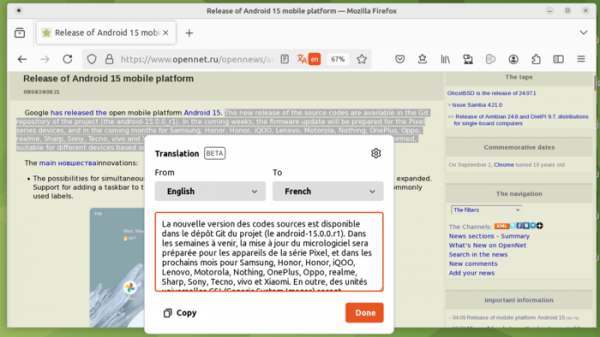
- The ability to perform machine translation of selected text fragments on a page after the entire page is translated is now available (i.e., translation can be applied to fragments from an already translated page). The page translation feature is activated via an indicator in the address bar, and fragment translation is accessed through the context menu displayed when right-clicking on the highlighted block. The built-in translation system in Firefox operates without relying on external cloud services, translating directly on the user's local system. This system is based on the open Bergamot engine, which serves as a wrapper for the Marian machine translation framework that utilizes recurrent neural networks (RNN) and transformer-based language models.

- The built-in machine translation engine now supports Latvian, Lithuanian, Catalan, Croatian, Czech, Danish, Indonesian, Romanian, Serbian, Slovak, and Vietnamese languages.
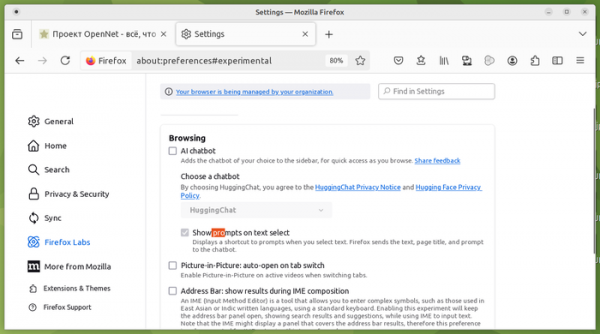
- A new section titled 'Firefox Labs' has been added to the configurator, offering experimental features for testing.

Currently, three experimental features are available:
- Automatic continuation of video playback in a floating window (picture-in-picture mode) when switching away from the tab displaying the video (if the user switches tabs while watching a video, the video will remain visible over the new tab thanks to the automatic activation of picture-in-picture mode). When returning to the original tab with the video, the picture-in-picture mode automatically deactivates.
- Display of recommendations and search results in the address bar while typing complex characters using the IME (Input Method Editor) interface.
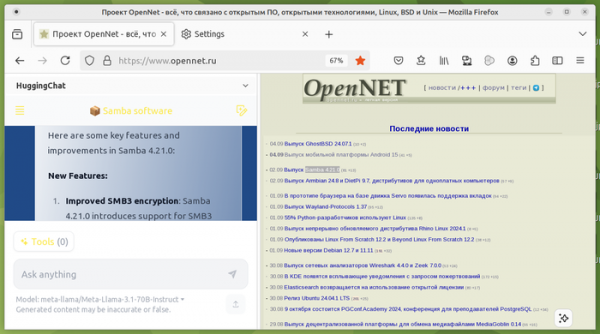
- An integrated chatbot using large language models for natural language interaction with users. Interaction with the bot is conducted in a sidebar. Users can choose from services like Anthropic Claude, ChatGPT, Google Gemini, HuggingChat, and Le Chat Mistral (only HuggingChat is operational on the Rostelecom network). Users can send text questions to the AI bot or submit excerpts of text highlighted on the viewed page. The context menu, displayed upon right-clicking the highlighted area, includes a section called 'Ask chatbot,' through which users can request a summary or clarification of the highlighted content.
- On the Linux platform, an animated effect is enabled by default when reaching the end of the scrollable area.
- The issue with displaying buttons for copying to and pasting from the clipboard in the context menu has been resolved.
- The desktop systems build includes the Web Codecs API, allowing manipulation of multimedia streams at a low level (for example, individual frames in videos) and providing access to built-in browser decoders and encoders for images, sound, and video. This API may be in demand in fields such as streaming, applying effects on the client side, audio and video transcoding, and developing audio and video editors.
- Support for cryptographic primitives Curve25519 (digital signatures Ed25519 and key agreement scheme X25519) has been added to the WebCrypto API implementation, which can be accessed via the SubtleCrypto interface (methods deriveKey(), deriveBits(), generateKey(), importKey(), and exportKey()).
- The HTML element has been updated with a 'name' attribute that allows for grouping elements without using JavaScript, ensuring that only one element is displayed at any given time while the others remain hidden (when a user opens a new section, the others automatically close).
- In the Android version, page loading is accelerated through the organization of parallel loading of related resources. A reliable password generation feature has been added for registration forms.
In addition to new features and bug fixes, Firefox 130 addresses 13 vulnerabilities. Seven vulnerabilities are marked as critical, five of which are due to memory handling issues such as buffer overflows and accessing freed memory areas. These issues could potentially allow for the execution of malicious code when specially crafted pages are opened. Two critical issues are caused by improper type handling (Type Confusion).
Additionally, there is the consideration of incorporating a new JPEG-XL image format decoder into the Firefox codebase, developed by Google employees in Rust. If the initiative is approved, the Rust implementation will replace the current C++ JPEG-XL decoder, which consists of over 100,000 lines of code. The proponent of the transition is Bobby Holley, the Chief Technology Officer at Mozilla, who served on the board of the Rust Foundation.
Source: opennet.ru
