

The release of the web browser Firefox 139 has taken place, and updates for the previous long-term support branches — 115.24.0 and 128.11.0 — have been formed. The Firefox 140 branch has entered the beta testing phase, with a release scheduled for June 24.
Key features in Firefox 139:
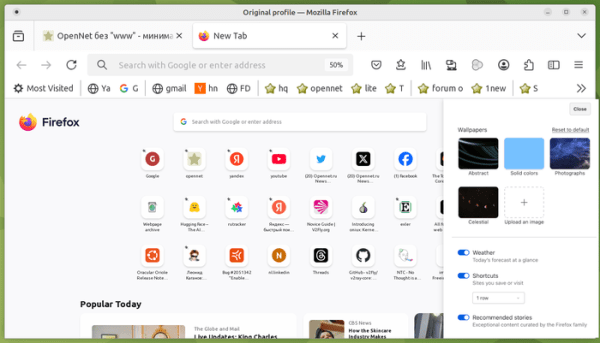
- Users can now assign a custom background image or choose a background color for the page shown when opening a new tab. This feature is not enabled by default for all users and will gradually be activated for a larger percentage of them. To force it on, users can use the 'Firefox Labs' settings section (about:settings#experimental). The new release also includes new standard background images and introduces a new wallpaper category called 'Celestial.'

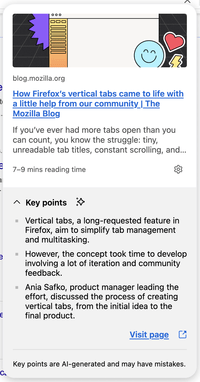
- An experimental feature has been added for link previews on pages — if you hold down Alt+Shift and hover over a link, a popup will appear providing information about the page the link points to. This includes the title, an image, and a brief content summary generated by a large language model (utilizing the built-in AI assistant running on the user's system). This feature can be enabled through the 'Firefox Labs' section (about:settings#experimental).

- The translation feature now works not only on web pages but also on internal pages of add-ons accessible via the URL 'moz-extension://'.
- Data loading performance has been significantly enhanced when using HTTP/3, particularly noticeable when resuming connections (QUIC 0-RTT) and over communication channels with high throughput and long latency.
- In line with Chrome's move to encrypt users' sensitive data on the Windows platform, support for direct migration of passwords and payment methods from Chrome has been discontinued. To transfer passwords from Chrome now, users must manually export passwords in CSV format and upload the resulting file to Firefox.
- On June 10, the Review Checker (Fakespot) service will cease operations, and on July 8, the Pocket service will do the same.
- The Temporal object is enabled by default, providing an alternative set of methods for working with dates and times. The new API allows for manipulation of dates with or without time zone consideration, converting time, formatting output, and performing arithmetic operations with time. Time can be specified in a time zone-independent representation (Temporal.PlainDate, Temporal.PlainTime, Temporal.PlainDateTime), tied to a time zone (Temporal.ZonedDateTime), and in epoch representation (Temporal.Instant — a number of nanoseconds since January 1, 1970).
- The ability to truncate timer precision for Workers has been added.
- Page search operations now cover the content of HTML blocks <details>. If the searched phrase is present in the block, it will automatically expand during the search.
- A new flag 'until-found' has been proposed for the 'hidden' attribute, which makes an element searchable on the page and scrollable via a text mask. For example, hidden text can be added to the page, which will be found during local search.
- The method window.getSelection().toString() ensures correct serialization of text selected in text fields.
- For WebAuthn, largeBlob and credProps extensions have been implemented for storing and retrieving additional data related to the user account.
- In the HTMLDialogElement API, the requestClose() method has been added, initiating the closing of a dialog based on the HTML element <dialog>. Unlike the Close() method, the new method allows for cancellation of the closing by adding a 'cancel' event handler.
- The behavior of the built-in editor for contenteditable and designMode is similar to Chrome in terms of handling whitespace before the block boundary and between visible content (Firefox no longer adds an element <br> after the whitespace before the block boundary).
- In the web developer tools, filter settings are now preserved in the network inspection panel between different sessions. In the JavaScript debugger, the format for the line where execution is paused has been improved, and the root directory is limited to the selection. are set up correctly..
- The Android platform version has implemented support for bookmark sorting, improved the download management interface, enhanced news feed capabilities, and begun implementing support for the JetPack Compose framework.
In addition to new features and bug fixes, Firefox 139 addresses 14 vulnerabilities. Eight of these vulnerabilities stem from memory handling issues, such as buffer overflows and accessing freed memory regions. These issues could potentially allow an attacker to execute code through specially crafted pages. One vulnerability (CVE-2025-5262) has been assigned a critical severity level. It is caused by a double-free error in the libvpx encoder code, which supports VP8 and VP9 formats, and can be exploited via WebRTC.
The beta version of Firefox 140 adds an 'Unload Tab' option to the context menu shown when right-clicking on a tab, allowing users to unload the tab from memory to reduce resource usage. In the vertical tab panel, the ability to resize the pinned tabs area has been implemented. Users can also add their own search engines (Settings > Search > Add).
Source: opennet.ru
