

The release of the GNU Octave 11.1.0 system for mathematical computations has taken place (the first release of the 11.x series; the 11.0 branch was used for development), providing an interpreted language largely compatible with Matlab. GNU Octave can be used for solving linear problems, nonlinear and differential equations, computations using complex numbers and matrices, data visualization, and conducting mathematical experiments. The code is written in C++ (Qt interface) and is distributed under the GPLv3 license.
Among the changes in the new release:
- A new command for searching has been added to the pkg package manager: 'pkg search foo bar baz'. The 'pkg install' command now automatically determines whether the provided argument is a local file, a URL, or a package name. Local caching of package metadata and verification of downloaded packages by SHA256 hash have been implemented.
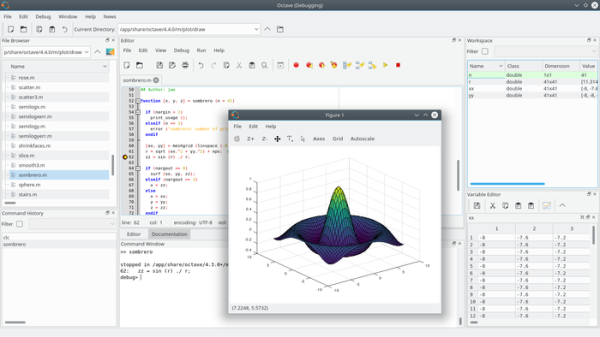
- The file browsing interface is divided into two tabs — one for navigating the file system contents and the other for viewing and managing all files opened in the editor.
- The file search dialog has been enhanced with a list of previously submitted search queries, and it is now possible to search for files using multiple patterns.
- The graphical interface now utilizes vector icons in SVG format, and the default command line interface for Octave is provided.
- Settings have been added to disable the splash screen and to use the current directory (where the editor is launched) as the default in the file opening dialog.
- PDF printing operations have been accelerated by 25%.
- Support for alpha blending has been improved in the visualization on systems with new versions of OpenGL.
- Support for objects defined by the 'classdef' keyword has been enhanced. When accessing object elements via the dot notation (object.element), properties with the specified name are checked first, and if the property is absent, method names are checked, which corresponds to MatLab behavior.
- The execution of array convolution operations has been significantly accelerated (from 10% to 150 times, depending on the size and shape) for cases where the number of columns exceeds the number of rows (vector arrays).
- The ability to perform broadcasting operations on arrays of different dimensions of special types of matrices, such as sparse, diagonal, and permutation matrices, has been added. Among other things, support for mixed operations between sparse and full matrices, as well as between diagonal matrices and standard vectors, has been implemented.
- Changes have been made to improve compatibility with Matlab. In the functions cumprod, cumsum, min, max, cummin, cummax, prod, sum, sumsq, bounds, center, meansq, range, statistics, and zscore, support for the parameters 'all', 'vecdim', and 'nanflag' has been added.
- The performance of the functions sum, cumsum, and sumsq has been increased by up to 6 times. The execution speed has been accelerated by up to 4.5 times, with memory consumption reduced by up to 3.5 times in the randi function.
- A mode of operation with increased computational precision has been implemented in the sum function. Computational accuracy has been enhanced in the norm and fzero functions.
- Support for input data types double and single has been added to the roots function and statistical functions.
- New functions have been added: _Exit, assert_equal, corrcov, dither, funm, mape, rms, rmse, trexc, xline, and yline.
Source: opennet.ru
