

The release of the Linux distribution Fedora 34 has been announced. Products for download include Fedora Workstation, Fedora Server, CoreOS, Fedora IoT Edition, as well as a set of 'spins' with live builds of desktop environments like KDE Plasma 5, Xfce, i3, MATE, Cinnamon, LXDE, and LXQt. Builds have been created for x86_64, Power64, ARM64 (AArch64) architectures and various devices with 32-bit ARM processors. The publication of Fedora Silverblue builds is delayed.
The most notable improvements in Fedora 34 are:
- All audio streams have been transitioned to multimedia server PipeWire, which is now used by default instead of PulseAudio and JACK. The use of PipeWire allows the standard desktop edition to provide professional-grade audio processing capabilities, eliminate fragmentation, and unify the audio infrastructure for different applications.
In previous releases, sound processing in Fedora Workstation utilized a background process called PulseAudio, and applications used a client library to interact with this process, mixing and managing audio streams. Professional audio processing was handled by the JACK audio server and its associated client library. To ensure compatibility, a PipeWire layer has been implemented instead of the libraries for PulseAudio and JACK, which allows existing PulseAudio and JACK clients, as well as applications distributed in Flatpak format, to function. For older clients using the low-level ALSA API, an ALSA plugin has been installed to route audio streams directly to PipeWire.
- KDE desktop builds by default have been switched to use Wayland. The X11-based session has been moved to an optional status. It is noted that the version of KDE Plasma 5.20 included in Fedora 34 is almost on par in functionality with operation over X11, including fixes for screencasting and middle mouse button pasting. For use with proprietary NVIDIA drivers, the kwin-wayland-nvidia package is employed. Compatibility with X11 applications is provided through the XWayland component.
- Improved support for Wayland. The ability to use the XWayland component has been added in systems with proprietary NVIDIA drivers. Support for headless mode has been implemented in Wayland-based environments, allowing desktop components to run on remote server systems with access organized via VNC or RDP.
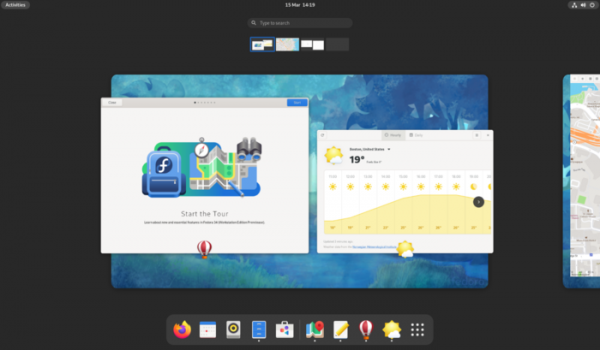
- The Fedora Workstation desktop has been updated to release GNOME 40 and the GTK 4 library. In GNOME 40, virtual desktops in the Activities Overview have been transitioned to a horizontal orientation and are displayed as a continuously scrollable chain from left to right. Each desktop shown in the overview clearly presents the open windows, with dynamic panning and scaling during user interaction. A seamless transition between the application list and virtual desktops has been ensured. The organization of work with multiple monitors has improved. The design of many applications has been modernized. GPU rendering for shaders has been enabled in GNOME Shell.

- All editions of Fedora have transitioned to using the systemd-oomd mechanism for early response to memory shortages in the system, replacing the previously used earlyoom process. Systemd-oomd is based on the kernel PSI (Pressure Stall Information) subsystem, which allows user-space analysis of waiting times for various resources (CPU, memory, input/output) to accurately assess the system's load and slowdown characteristics. PSI enables the detection of the onset of delays due to resource shortages and selectively terminates resource-intensive processes at a stage when the system is still not in critical condition and has not begun aggressively cutting the cache and swapping data to the swap space.
- In the Btrfs file system, which has been the default since the last release for Fedora desktop variants (Fedora Workstation, Fedora KDE, etc.), transparent data compression using the ZSTD algorithm is included. Compression is applied by default for new Fedora 34 installations. Users of existing systems can enable compression by adding the flag 'compress=zstd:1' to /etc/fstab and running 'sudo btrfs filesystem defrag -czstd -rv / /home/' to compress already existing data. The 'compsize' utility can be used to assess the effectiveness of compression. It is noted that storing data in a compressed format not only saves disk space but also increases the lifespan of SSD drives by reducing the amount of write operations, and improves the read and write speed of large, easily compressible files on slower drives.
- Among the official editions of the distribution, there is a variant with the i3 window manager, which offers a tiled window layout on the desktop.
- The creation of KDE desktop images for systems based on the AArch64 architecture has begun, in addition to builds with GNOME and Xfce desktops, as well as images for server systems.
- A new Comp Neuro Container image has been added, which includes a set of applications for modeling and simulation, useful for conducting research in the field of neurobiology.
- In the edition for the Internet of Things (Fedora IoT), which offers a minimal system environment that is updated atomically by replacing the entire system image, and where applications are isolated from the main system using containers (managed via podman), support for ARM platforms such as Pine64, RockPro64, and Jetson Xavier NX has been added, along with improved support for SoC i.MX8-based boards like 96boards Thor96 and Solid Run HummingBoard-M. Hardware watchdog mechanisms have been provided for automatic system recovery.
- The formation of separate packages with libraries used in Node.js projects has been discontinued. Instead, only basic packages with the interpreter, header files, primary libraries, binary modules, and essential tools for package management (NPM, yarn) will be provided for Node.js. It is now allowed to bundle all existing dependencies into a single package in applications using Node.js supplied in the Fedora repository, without splitting and extracting used libraries into separate packages. Bundling libraries will help eliminate clutter from minor packages, simplify package maintenance (previously, maintainers spent more time reviewing and testing hundreds of library packages than the main program package), remove infrastructure conflicts between libraries, and resolve issues with library version binding (maintainers will include verified and tested versions in the package).
- The FreeType font engine has been switched to use the HarfBuzz glyph shaping engine. Utilizing HarfBuzz in FreeType has improved hinting quality (the smoothing of glyph outlines during rasterization to enhance clarity on low-resolution screens) when displaying text in languages with complex text layout where glyphs can be formed from multiple characters. Specifically, the application of HarfBuzz resolves the issue of ligatures being ignored during hinting when there are no separate Unicode characters.
- The option to disable SELinux during operation has been removed — disabling through the settings in /etc/selinux/config (SELINUX=disabled) is no longer supported. After SELinux initialization, LSM handlers are now switched to read-only mode, which enhances protection against attacks aimed at disabling SELinux after exploiting vulnerabilities that allow modifications to kernel memory. To disable SELinux, you can reboot the system with the 'selinux=0' parameter in the kernel command line. The ability to switch between 'enforcing' and 'permissive' modes during boot has been retained.
- The DDX component Xwayland, which enables the launch of the X.Org Server for running X11 applications in Wayland-based environments, has been moved to a separate package built from a fresh codebase independent of stable releases. server X.Org.
- It is now ensured that all updated systemd services are restarted simultaneously after the transaction in the RPM package manager is completed. Previously, a service was restarted immediately after updating each overlapping package; now a queue is formed and services are restarted at the very end of the RPM session, after all packages and libraries have been updated.
- Images for ARMv7 (armhfp) architectures are now defaulted to using UEFI.
- The size of the swap device provided by the zRAM mechanism has been increased from a quarter to half of the physical memory size, and limited to a maximum of 8 GB. This change allows the Anaconda installer to successfully run on systems with limited RAM.
- The stable branch now delivers crate packages for the Rust language. These packages are prefixed with 'rust-'.
- To reduce the size of installation ISO images, a clean SquashFS is provided without the embedded EXT4 layer, which was used for historical reasons.
- Configuration files for the GRUB bootloader have been unified across all supported architectures, regardless of EFI support.
- To reduce disk space consumption, the firmware files used by the Linux kernel are compressed (since kernel 5.3, firmware loading from xz archives is supported). In unpacked form, all firmware takes about 900 MB, while compression has managed to reduce their size by half.
- The ntp package (a server for precise time synchronization) has been replaced with the ntpsec fork.
- The packages xemacs, xemacs-packages-base, xemacs-packages-extra, and neXtaw have been marked as deprecated, as their development has long ceased. The nscd package has also been deprecated — systemd-resolved is now used for host database caching, and sssd may be used for caching services with named.
- The delivery of X11 utility collections xorg-x11-* has been discontinued; each utility is now offered in a separate package.
- The use of the name master in git repositories for the project has been discontinued, as the term has recently been deemed politically incorrect. The default branch name in git repositories is now 'main', while repositories with packages, such as src.fedoraproject.org/rpms, use the branch 'rawhide'.
- Package versions updated, including: GCC 11, LLVM/Clang 12, Glibc 2.33, Binutils 2.35, Golang 1.16, Ruby 3.0, Ruby on Rails 6.1, BIND 9.16, MariaDB 10.5, PostgreSQL 13. LXQt 0.16.0 and Xfce 4.16 desktops updated.
- A new logo has been unveiled.


Simultaneously, for Fedora 34, the 'free' and 'nonfree' repositories of the RPM Fusion project are now operational, providing packages with additional multimedia applications (MPlayer, VLC, Xine), video/audio codecs, DVD support, proprietary AMD and NVIDIA drivers, gaming software, and emulators.
Source: opennet.ru
