

After three years of development, a stable version of the FreeDOS operating system 1.4 has been released, enhancing the free alternative to DOS with a set of GNU utilities. The FreeDOS code is distributed under the GPLv2 license. Builds are available for download on floppy disks, CDs, and USB Flash drives, ranging from 17 MB to 638 MB.
The FreeDOS project was founded in 1994 and can currently be applied in areas such as pre-installing a minimal environment on new computers, running old games, utilizing embedded technology (e.g., POS terminals), teaching students the basics of operating system construction, usage in emulators, and creating CDs/Flash drives for firmware installation and motherboard setup.
Key features of FreeDOS:
- Support for FAT32 and long file names.
- Ability to run network applications.
- Implementation of disk caching.
- Support for memory management systems HIMEM, EMM386, and UMBPCI. Memory manager JEMM386.
- Support for printing systems; drivers for CD-ROMs and mice.
- Support for ACPI, suspend modes, and operation in power-saving mode.
- Includes MPXPLAY media player with support for mp3, ogg, and wmv.
- XDMA and XDVD — UDMA drivers for hard drives and DVD drives.
- Mouse driver CUTEMOUSE.
- Utilities for working with archives 7Zip, INFO-ZIP zip, and unzip.
- Multi-window text editors EDIT and SETEDIT, as well as the file viewer PG.
- FreeCOM — command shell with support for file name auto-completion.
- Network support, web browsers Links and Dillo, BitTorrent client.
- Presence of the FDTUI (FreeDOS Text User Interface) shell, offering a user interface.
- Presence of a package manager.
- A set of ported programs from Linux (DJGPP).
- Set of high-performance network applications mtcp.
- Support for USB controllers and ability to work with USB Flash.
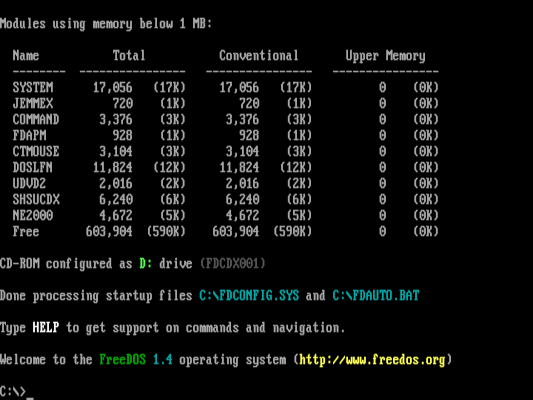
Among the changes in the new version:
- The FreeCOM command shell has improved compatibility with the classic command.com.
- The Xcopy and Move commands have revamped implementations for recursive copying and moving of directories and optimized stack usage.
- The partition management program Fdisk has resolved critical issues that could lead to data loss when working with certain partitions.
- The reliability of the mTCP suite of network applications has been enhanced.
- The program for displaying help manuals FDHelp has been completely rewritten.
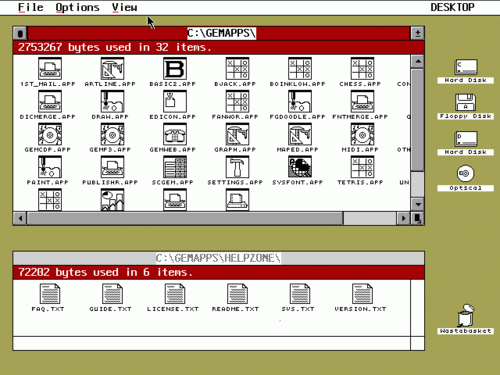
- Among graphical shells, only OpenGEM remains in the distribution, while the Seal and oZone shells have been excluded from delivery due to stability issues.

- The installer has been updated.
- Updated applications JEMM, 7Zip, FORMAT, FASM, MORE, and RUNTIME.
- The BMP2PNG utility has been replaced with the DOSVIEW image viewer, which supports conversion between various formats.
- A reorganization of the package distribution across installation media has been conducted. By eliminating duplicates, the size of the Live CD has been reduced from 400 MB to 301 MB, and the Bonus CD from 633 MB to 392 MB. The Live CD now includes standard DOS programs, user applications, archivers, drivers, games, network applications, and sound-related programs, while the Bonus CD contains development tools, editors, bootloaders, advanced utilities, and the OpenGEM graphical interface.
- Work is underway on a new FreeDOS kernel, but it is not yet ready for release, so the old kernel, the same as in FreeDOS 1.3, continues to be supplied with FreeDOS 1.4. For example, the new kernel can run Windows 3.1 in standard mode but is not yet suitable for running Windows for Workgroups in enhanced mode.
Source: opennet.ru
